by Alice Speri
The Intercept
How Ahed Tamimi Became the Symbol of Palestinian Resistance to Israeli Oppression
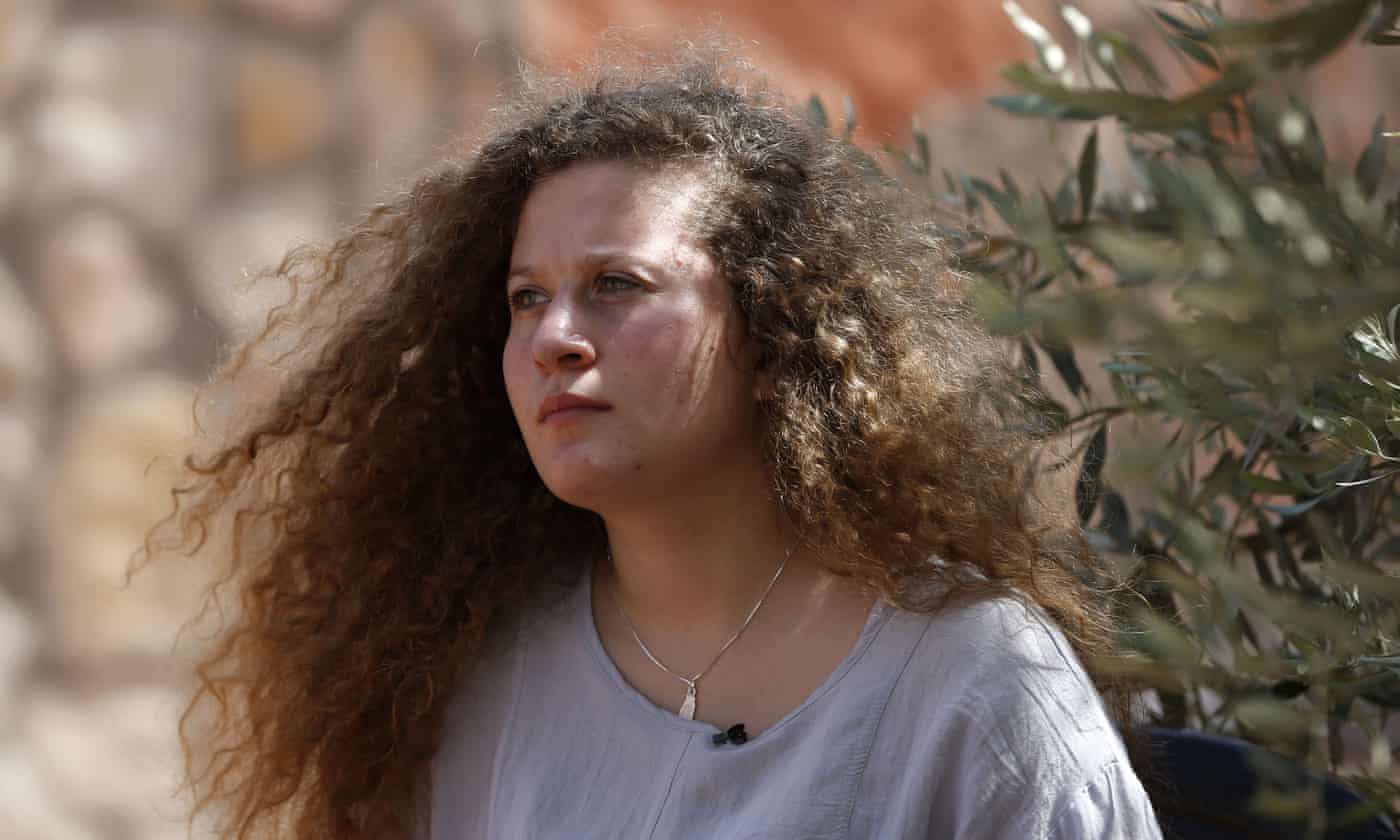
NABI SALEH, WEST BANK — As if anyone needed reminding, even on the day of her release from prison, Israeli authorities seemed to want to show Ahed Tamimi, her family, and her many supporters that they control Palestinian lives.
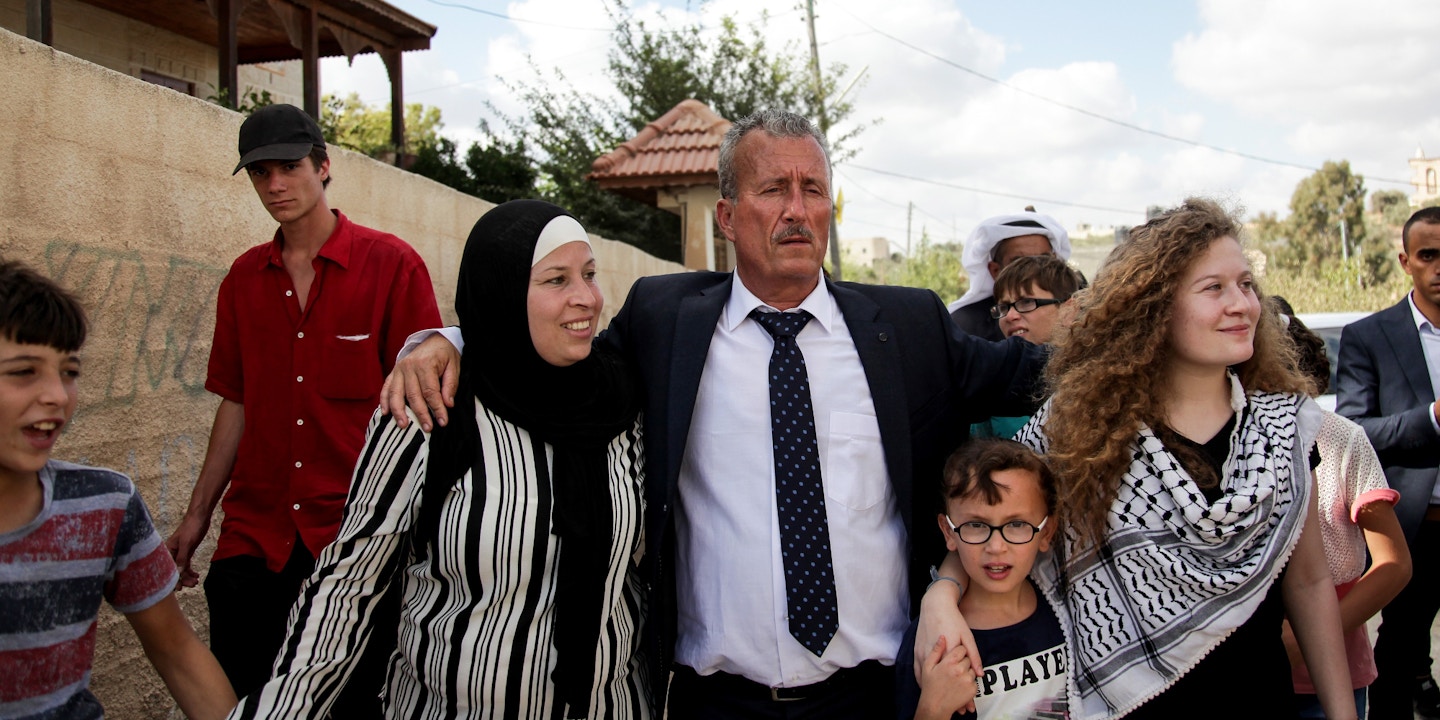
Ahed and her mother, Nariman, were supposed to be freed on Saturday after serving an eight-month sentence in an Israeli military prison, but because Saturday is not a work day in Israel, their release was postponed. On Sunday, their family was told that they would be freed at 7 a.m. at a military checkpoint in the northern West Bank, nearly an hour and a half drive from their village, Nabi Saleh. When relatives and friends arrived there, the military sent them, as well as dozens of members of the press, to a different checkpoint, nearly two hours in the opposite direction. When they reached there, Bassem Tamimi was told, again, that his daughter and wife would be released at the first checkpoint. As the convoy of cars turned around one more time, they received another call telling them to head back to the second checkpoint.
“They were playing cat and mouse; they were trying to break everyone,” Manal Tamimi, Ahed’s aunt, told The Intercept. “They don’t need to give any justification. They just do what they want.”
More...
Showing posts with label Ahed Tamimi. Show all posts
2018-07-31
Ahed Tamimi: 'I am a freedom fighter. I will not be the victim'
by Oliver Holmes and Sufian Taha
The Guardian
Day after her release, teenage Palestinian activist says she hopes to become lawyer and lead cases against Israel
The teenage Palestinian activist Ahed Tamimi has said she used her eight months in prison as an opportunity to study international law and hopes to one day lead cases against Israel in international courts.
“God willing, I will manage to study law,” the 17-year-old from Nabi Saleh in the occupied West Bank told the Guardian a day after her . “I will present the violations against the Palestinians in criminal courts. And to try Israel for it and to be a big lawyer, and to return rights to my country.”
Tamimi, who rose to global prominence as a child living under military occupation, said she and other Palestinians in her all-female prison unit would sit for hours and learn legal texts. “We managed to transform the jail into a school,” she said.
To an outcry from rights groups, the teenager was arrested in December after on camera outside her home. The soldiers had been deployed at one of Nabi Saleh’s weekly protests, where residents have thrown stones at troops who have responded with teargas, arrests and, at times, live ammunition.
She later accepted a deal in court to plead guilty to assault, incitement and two counts of obstructing soldiers.
“The experience of being arrested was really hard. As much as I try, I cannot describe it,” Ahed said. But she added: “This experience added value to my life, maybe it made me more mature. More conscious.”
Her trial was held behind closed doors. Concerns about her treatment in detention were raised after a video emerged in which a male Israeli interrogator threatened the then 16-year-old, commenting on her body and “eyes of an angel”.
Ahed said her treatment was not unusual. “It was not the first, and it was not a coincidence. This is their style of interrogating,” she said.
Her case has highlighted the arrest and detention of what local human rights groups say are more than 300 Palestinian minors.
Ahed said her experience in jail helped with her ambitions to become an international lawyer. “For example, I was under interrogation. There were violations against me. International law says that this should not happen to me,” she said, adding that in another life she would have trained to be a professional footballer.
Nabi Saleh is populated almost exclusively by members of her extended family and is a focus of the anti-occupation movement. Images or videos of Ahed throughout her childhood, often grappling with or staring down soldiers during village protests, have gone viral.
After gaining worldwide attention, the Tamimi family say their daughter has been offered scholarships to study at a university abroad but that she is still deciding.
The Palestinian government has launched , including for alleged war crimes and what it says is a system of governance that amounts to apartheid. Israel has vehemently denied the allegations.
Ahed’s family home is filled with activists and Palestinian officials, who sit drinking coffee in small paper cups on plastic stools outside. Within hours of her release, the teenager met the Palestinian president, Mahmoud Abbas. Two Italian artists were arrested for painting a mural of Ahed’s face of the Israel separation barriers that divides the Palestinian territories.
Her international recognition infuriated the Israeli government, Ahed said. “They are afraid of the truth. If they were not wrong, they would not be afraid of the truth. The truth scares them. And I managed to deliver this truth to the world. And of course, they’re afraid how far I reached. They always fear the truth, they are the occupier, and we are under occupation.”
Some in Israel believe the focus on and arrest of the teenager was a self-defeating move for the country, while others have praised the soldiers’ apparent restraint and have accuse Nabi Saleh residents of provocations.
Ahed has no regrets about the day she hit the solider, a man she believed had earlier that day shot her 15-year-old cousin in the head with a rubber bullet during a clash.
She was reunited with her cousin upon release and he was at her home on Monday, a large scar marking his face.
But fame has also taken a toll on a girl who was seen as a local hero before she was in secondary school. “I feel proud that became a symbol for the Palestinian cause in order to deliver the message of Palestinian to the whole world. Of course, it is a heavy burden on me. It’s true; it’s a big responsibility. But I am totally confident that I am for of it.”
For now, she hopes for a little rest and to decide her next steps, still enjoying the high of leaving prison. “At last, I saw the sky without a fence. I can walk on the street without handcuffs. I can see the stars, the moon. I haven’t seen them for a long time and now I am with my family.”
Yet her 22-year-old brother, Wa’ed Tamimi, is in prison awaiting a sentence for his involvement in confrontations with soldiers. And the conflict is never far away. An Israeli military outpost and settlement can be seen from the garden where she speaks.
“I’m not the victim of the occupation,” Ahed said. “The Jew or the settler child who carries a rifle at the age of 15, they are the victims of the occupation. For me, I am capable of distinguishing between right and wrong. But not him. His view is clouded. His heart is filled with hatred and scorn against the Palestinians. He is the victim, not me. I always say I am a freedom fighter. So I will not be the victim.”
The Guardian
Day after her release, teenage Palestinian activist says she hopes to become lawyer and lead cases against Israel
The teenage Palestinian activist Ahed Tamimi has said she used her eight months in prison as an opportunity to study international law and hopes to one day lead cases against Israel in international courts.“God willing, I will manage to study law,” the 17-year-old from Nabi Saleh in the occupied West Bank told the Guardian a day after her . “I will present the violations against the Palestinians in criminal courts. And to try Israel for it and to be a big lawyer, and to return rights to my country.”
Tamimi, who rose to global prominence as a child living under military occupation, said she and other Palestinians in her all-female prison unit would sit for hours and learn legal texts. “We managed to transform the jail into a school,” she said.
To an outcry from rights groups, the teenager was arrested in December after on camera outside her home. The soldiers had been deployed at one of Nabi Saleh’s weekly protests, where residents have thrown stones at troops who have responded with teargas, arrests and, at times, live ammunition.
She later accepted a deal in court to plead guilty to assault, incitement and two counts of obstructing soldiers.
“The experience of being arrested was really hard. As much as I try, I cannot describe it,” Ahed said. But she added: “This experience added value to my life, maybe it made me more mature. More conscious.”
Her trial was held behind closed doors. Concerns about her treatment in detention were raised after a video emerged in which a male Israeli interrogator threatened the then 16-year-old, commenting on her body and “eyes of an angel”.
Ahed said her treatment was not unusual. “It was not the first, and it was not a coincidence. This is their style of interrogating,” she said.
Her case has highlighted the arrest and detention of what local human rights groups say are more than 300 Palestinian minors.
Ahed said her experience in jail helped with her ambitions to become an international lawyer. “For example, I was under interrogation. There were violations against me. International law says that this should not happen to me,” she said, adding that in another life she would have trained to be a professional footballer.
Nabi Saleh is populated almost exclusively by members of her extended family and is a focus of the anti-occupation movement. Images or videos of Ahed throughout her childhood, often grappling with or staring down soldiers during village protests, have gone viral.
After gaining worldwide attention, the Tamimi family say their daughter has been offered scholarships to study at a university abroad but that she is still deciding.
The Palestinian government has launched , including for alleged war crimes and what it says is a system of governance that amounts to apartheid. Israel has vehemently denied the allegations.
Ahed’s family home is filled with activists and Palestinian officials, who sit drinking coffee in small paper cups on plastic stools outside. Within hours of her release, the teenager met the Palestinian president, Mahmoud Abbas. Two Italian artists were arrested for painting a mural of Ahed’s face of the Israel separation barriers that divides the Palestinian territories.
Her international recognition infuriated the Israeli government, Ahed said. “They are afraid of the truth. If they were not wrong, they would not be afraid of the truth. The truth scares them. And I managed to deliver this truth to the world. And of course, they’re afraid how far I reached. They always fear the truth, they are the occupier, and we are under occupation.”
Some in Israel believe the focus on and arrest of the teenager was a self-defeating move for the country, while others have praised the soldiers’ apparent restraint and have accuse Nabi Saleh residents of provocations.
Ahed has no regrets about the day she hit the solider, a man she believed had earlier that day shot her 15-year-old cousin in the head with a rubber bullet during a clash.
She was reunited with her cousin upon release and he was at her home on Monday, a large scar marking his face.
But fame has also taken a toll on a girl who was seen as a local hero before she was in secondary school. “I feel proud that became a symbol for the Palestinian cause in order to deliver the message of Palestinian to the whole world. Of course, it is a heavy burden on me. It’s true; it’s a big responsibility. But I am totally confident that I am for of it.”
For now, she hopes for a little rest and to decide her next steps, still enjoying the high of leaving prison. “At last, I saw the sky without a fence. I can walk on the street without handcuffs. I can see the stars, the moon. I haven’t seen them for a long time and now I am with my family.”
Yet her 22-year-old brother, Wa’ed Tamimi, is in prison awaiting a sentence for his involvement in confrontations with soldiers. And the conflict is never far away. An Israeli military outpost and settlement can be seen from the garden where she speaks.
“I’m not the victim of the occupation,” Ahed said. “The Jew or the settler child who carries a rifle at the age of 15, they are the victims of the occupation. For me, I am capable of distinguishing between right and wrong. But not him. His view is clouded. His heart is filled with hatred and scorn against the Palestinians. He is the victim, not me. I always say I am a freedom fighter. So I will not be the victim.”
2018-04-06
A Song is Born
by Uri Avnery
Gush Shalom
A FRIEND from overseas sent me the recording of a song. An Arab song, with a soft Arab melody, sung by an Arab girls' choir, accompanied by a flute.
It goes like this:
Ahed / You are the promise and the glory / Standing as high as an olive tree / From the cradle to the present / Your honor will not be violated / Palestine has been planted in us / As a dock for every ship / We are the land and you are the water /
You are covered with blond hair / You are as pure as Jerusalem / You taught our generation how the forgotten people should revolt / They thought the Palestinians are afraid of them because they are wearing armor and holding a weapon? / Palestine has been planted in us / As a dock for every ship / Our nation must be united and resist for the freedom of Palestine and the prisoners /
Your blue eyes are a lighthouse / For a country that has every religion / You united the people far away and close / You ignited the spark in all our hearts / Your head is raised up high encouraging us / You ignited the light in our darkness /
Despite the softness of your hands / Your hands have shaken the world / Your hands returned the slap to the occupier / And returned esteem to the nation / Palestine has been planted in us / As a dock for every ship / We are the land and you are the water.
IF I were an adherent of the occupation, this song would frighten me very much.
Because the force of songs is much stronger than the force of weapons. A gun wears out, but a song lasts forever.
In the early days of the Israeli army, there was a slogan hanging in our mess: "An army that is singing is an army of victory!"
The present Palestinian generation has decided to lower its head and wait until the storm has passed. The coming Palestinian generation may act in a completely different way.
On the eve of my 15th birthday, I joined an underground (or "terrorist") group that fought against the British colonial regime. Almost eighty years later I remember just about every song of that time, word for word. Songs like "We are unknown soldiers without uniforms…" and many more. Afterwards I wrote an anthem for my company.
I am not a poet. Far from it. But I have written some songs in my time, including "Samson's Foxes", an anthem for my commando unit in the Israeli army. So I know the force of a song. Especially a song about the heroism of a 16 year old girl.
THE MOMENT I saw the scene of Ahed al-Tamimi boxing the face of an Israeli army captain, I knew that something important had happened.
The British politician Lord Acton famously wrote: "Power tends to corrupt, and absolute power corrupts absolutely." I would add: "Occupying another people tends to make you stupid, and a long occupation makes you utterly stupid."
In my youth, when I was already a member of the anti-British underground, I was working in the office of a British lawyer, many of whose clients were officials of the British administration. I often asked myself: "How can it be that such intelligent people can behave so stupidly?” They were nice people, who treated even a lowly clerk like me politely. But they had no alternative: the occupation compels the occupier to behave stupidly.
It works like this: in order to uphold an occupation regime for any length of time, the occupier must believe in the superiority of his race and in the inferiority of his subjects, who are seen as primitive creatures. Otherwise, what gives him the right to subject another people? That is exactly what has happened to us now.
THE MOMENT I saw the face-boxing scene on TV, I knew that something momentous had happened. The Palestinian people now have a national heroine. The Palestinian youth now has a model to emulate.
The Israeli public has got used to the occupation. They believe that this is a normal situation, that the occupation can go on forever. But the occupation is not a natural situation, and some day it will come to an end.
Ten thousand British ruled hundreds of millions of Indians, until a skinny man called Gandhi went to produce salt on the seashore, contrary to the law. The Indian youth arose, and British rule fell away like a leaf from a tree in autumn.
The same stupidity took hold of all the occupation enforcers who dealt with Ahed al-Tamimi. Army officers. Prosecutors, military judges.
If we were wise occupiers ? an oxymoron ? we would have sent Ahed home long ago. Expelled her by force from the prison. But we are still keeping her locked up. Her and her mother.
True, some days ago the army realized its own stupidity. With the help of Ahed's devoted (Jewish) advocate, Gabi Lasky, a "compromise" was worked out. Several charges were dropped and Ahed was sentenced to "only" eight months in prison.
She will be released in three more months. But that is too late: the picture of Ahed is already engraved in the mind of every Palestinian boy or girl. Ahed, the girl covered with blond hair, her blue eyes shining like a lighthouse. Ahed the saint. Ahed the savior.
The Palestinian Jeanne d’Arc, the national symbol.
THE STORY of Ahed al-Tamimi happened in the West Bank. But it resounded in the Gaza Strip, too.
For most Israelis, the Gaza Strip is something else. It is not occupied territory. It does not concern us.
But the situation of the Gaza Strip is even worse than straight occupation. The strip is completely surrounded. North and east is Israel, west is the sea, where the Israeli navy shoots at everything except for fishing boats close to the shore. The south belongs to Egypt, which behaves even worse than the Israelis and in close cooperation with them.
The situation in the Gaza Strip is as close to hell as one can get. Food at subsistence level, electricity for two to four hours a day, the water is polluted. Work is extremely scarce. Only the most severely ill are let out.
Why? It has to do with the demon that plagues the Israeli government: the demographic devil.
In historical Palestine, the land between the Mediterranean and the Jordan river, there now live about 13 million people, roughly half Jewish and half Arab, with a slight edge in favor of the Arabs. Numbers are uncertain, but roughly there are 3 million Arabs in the West Bank, 2 million in the Gaza Strip and 1.5 million Arab citizens in Israel. The Arab birthrate is higher than the Jewish average.
These numbers disturb the sleep of many Israeli officials, especially politicians. They look for means to change the balance. They once had the illusion that if the situation in Gaza got unbearable, people from Gaza would emigrate. But it did not happen. Palestinians have become very tenacious.
Then a new fashion came up: just ignore the bastards. Just imagine that the Gaza Strip has sunk into the sea, as one Israeli politician once prayed. No Strip. Two million Palestinian less.
But the Strip is there. True, Gaza is ruled by the Islamic Hamas party, while the West Bank is ruled by Abu Mazen's PLO, and the enmity between the two is vicious. But that happened in almost all liberation movements in history. In our case, the underground split between the Haganah ("Defense"), which belonged to the official Zionist leadership, and the Irgun ("Organization", short for National Military Organization). Then the Irgun split, and the even more extreme LEHI ("Fighters for the Freedom of Israel", called the "Stern Gang" by the British) was born. They all hated each other.
But among the people, there is no difference at all. They are all Palestinians. Ahed is the heroine of all of them. Perhaps her model played a role in what happened last week.
For some time, the Gaza Strip was quiet. Some kind of modus vivendi had even come into being between the Hamas government and the Israeli one. The Israelis congratulated themselves on their cleverness. And then it happened.
Suddenly, as if from nowhere, the population of Gaza stood up. Hamas organized them to assemble on Friday near the border fence, unarmed. A prolonged campaign of passive resistance was to start.
When I was asked what would happen, I said that the Israeli army would shoot to kill. Simple: Israelis don't know how to deal with passive resistance. They shoot in order to turn it into violent resistance. With that they know how to deal. With more violence.
AND THAT is exactly what happened last Friday, the first day of the campaign: snipers were posted along the line, with orders to shoot the "ringleaders" ? anyone who stood out. 18 unarmed demonstrators were killed, almost a thousand were shot and wounded.
If anyone thought that the democratic world would stand up and condemn Israel, they were sadly wrong. Reactions were feeble, at most. What was revealed was the incredible hold the Israeli government and its Zionist organization has over the world’s political establishments and communication outlets. With few exceptions the atrocious news was not published at all, or as minor items.
But this cannot go on for long. The Gaza protests will continue, especially on Fridays (the Muslim holy day), until May 15, the Naqba ("Catastrophe") Day, which commemorates the mass flight / expulsion of half the Palestinian people from their homes. Palestinian flags will fill screens around the globe.
Ahed will still be in prison.
Gush Shalom
A FRIEND from overseas sent me the recording of a song. An Arab song, with a soft Arab melody, sung by an Arab girls' choir, accompanied by a flute.
It goes like this:
Ahed / You are the promise and the glory / Standing as high as an olive tree / From the cradle to the present / Your honor will not be violated / Palestine has been planted in us / As a dock for every ship / We are the land and you are the water /
You are covered with blond hair / You are as pure as Jerusalem / You taught our generation how the forgotten people should revolt / They thought the Palestinians are afraid of them because they are wearing armor and holding a weapon? / Palestine has been planted in us / As a dock for every ship / Our nation must be united and resist for the freedom of Palestine and the prisoners /
Your blue eyes are a lighthouse / For a country that has every religion / You united the people far away and close / You ignited the spark in all our hearts / Your head is raised up high encouraging us / You ignited the light in our darkness /
Despite the softness of your hands / Your hands have shaken the world / Your hands returned the slap to the occupier / And returned esteem to the nation / Palestine has been planted in us / As a dock for every ship / We are the land and you are the water.
IF I were an adherent of the occupation, this song would frighten me very much.
Because the force of songs is much stronger than the force of weapons. A gun wears out, but a song lasts forever.
In the early days of the Israeli army, there was a slogan hanging in our mess: "An army that is singing is an army of victory!"
The present Palestinian generation has decided to lower its head and wait until the storm has passed. The coming Palestinian generation may act in a completely different way.
On the eve of my 15th birthday, I joined an underground (or "terrorist") group that fought against the British colonial regime. Almost eighty years later I remember just about every song of that time, word for word. Songs like "We are unknown soldiers without uniforms…" and many more. Afterwards I wrote an anthem for my company.
I am not a poet. Far from it. But I have written some songs in my time, including "Samson's Foxes", an anthem for my commando unit in the Israeli army. So I know the force of a song. Especially a song about the heroism of a 16 year old girl.
THE MOMENT I saw the scene of Ahed al-Tamimi boxing the face of an Israeli army captain, I knew that something important had happened.
The British politician Lord Acton famously wrote: "Power tends to corrupt, and absolute power corrupts absolutely." I would add: "Occupying another people tends to make you stupid, and a long occupation makes you utterly stupid."
In my youth, when I was already a member of the anti-British underground, I was working in the office of a British lawyer, many of whose clients were officials of the British administration. I often asked myself: "How can it be that such intelligent people can behave so stupidly?” They were nice people, who treated even a lowly clerk like me politely. But they had no alternative: the occupation compels the occupier to behave stupidly.
It works like this: in order to uphold an occupation regime for any length of time, the occupier must believe in the superiority of his race and in the inferiority of his subjects, who are seen as primitive creatures. Otherwise, what gives him the right to subject another people? That is exactly what has happened to us now.
THE MOMENT I saw the face-boxing scene on TV, I knew that something momentous had happened. The Palestinian people now have a national heroine. The Palestinian youth now has a model to emulate.
The Israeli public has got used to the occupation. They believe that this is a normal situation, that the occupation can go on forever. But the occupation is not a natural situation, and some day it will come to an end.
Ten thousand British ruled hundreds of millions of Indians, until a skinny man called Gandhi went to produce salt on the seashore, contrary to the law. The Indian youth arose, and British rule fell away like a leaf from a tree in autumn.
The same stupidity took hold of all the occupation enforcers who dealt with Ahed al-Tamimi. Army officers. Prosecutors, military judges.
If we were wise occupiers ? an oxymoron ? we would have sent Ahed home long ago. Expelled her by force from the prison. But we are still keeping her locked up. Her and her mother.
True, some days ago the army realized its own stupidity. With the help of Ahed's devoted (Jewish) advocate, Gabi Lasky, a "compromise" was worked out. Several charges were dropped and Ahed was sentenced to "only" eight months in prison.
She will be released in three more months. But that is too late: the picture of Ahed is already engraved in the mind of every Palestinian boy or girl. Ahed, the girl covered with blond hair, her blue eyes shining like a lighthouse. Ahed the saint. Ahed the savior.
The Palestinian Jeanne d’Arc, the national symbol.
THE STORY of Ahed al-Tamimi happened in the West Bank. But it resounded in the Gaza Strip, too.
For most Israelis, the Gaza Strip is something else. It is not occupied territory. It does not concern us.
But the situation of the Gaza Strip is even worse than straight occupation. The strip is completely surrounded. North and east is Israel, west is the sea, where the Israeli navy shoots at everything except for fishing boats close to the shore. The south belongs to Egypt, which behaves even worse than the Israelis and in close cooperation with them.
The situation in the Gaza Strip is as close to hell as one can get. Food at subsistence level, electricity for two to four hours a day, the water is polluted. Work is extremely scarce. Only the most severely ill are let out.
Why? It has to do with the demon that plagues the Israeli government: the demographic devil.
In historical Palestine, the land between the Mediterranean and the Jordan river, there now live about 13 million people, roughly half Jewish and half Arab, with a slight edge in favor of the Arabs. Numbers are uncertain, but roughly there are 3 million Arabs in the West Bank, 2 million in the Gaza Strip and 1.5 million Arab citizens in Israel. The Arab birthrate is higher than the Jewish average.
These numbers disturb the sleep of many Israeli officials, especially politicians. They look for means to change the balance. They once had the illusion that if the situation in Gaza got unbearable, people from Gaza would emigrate. But it did not happen. Palestinians have become very tenacious.
Then a new fashion came up: just ignore the bastards. Just imagine that the Gaza Strip has sunk into the sea, as one Israeli politician once prayed. No Strip. Two million Palestinian less.
But the Strip is there. True, Gaza is ruled by the Islamic Hamas party, while the West Bank is ruled by Abu Mazen's PLO, and the enmity between the two is vicious. But that happened in almost all liberation movements in history. In our case, the underground split between the Haganah ("Defense"), which belonged to the official Zionist leadership, and the Irgun ("Organization", short for National Military Organization). Then the Irgun split, and the even more extreme LEHI ("Fighters for the Freedom of Israel", called the "Stern Gang" by the British) was born. They all hated each other.
But among the people, there is no difference at all. They are all Palestinians. Ahed is the heroine of all of them. Perhaps her model played a role in what happened last week.
For some time, the Gaza Strip was quiet. Some kind of modus vivendi had even come into being between the Hamas government and the Israeli one. The Israelis congratulated themselves on their cleverness. And then it happened.
Suddenly, as if from nowhere, the population of Gaza stood up. Hamas organized them to assemble on Friday near the border fence, unarmed. A prolonged campaign of passive resistance was to start.
When I was asked what would happen, I said that the Israeli army would shoot to kill. Simple: Israelis don't know how to deal with passive resistance. They shoot in order to turn it into violent resistance. With that they know how to deal. With more violence.
AND THAT is exactly what happened last Friday, the first day of the campaign: snipers were posted along the line, with orders to shoot the "ringleaders" ? anyone who stood out. 18 unarmed demonstrators were killed, almost a thousand were shot and wounded.
If anyone thought that the democratic world would stand up and condemn Israel, they were sadly wrong. Reactions were feeble, at most. What was revealed was the incredible hold the Israeli government and its Zionist organization has over the world’s political establishments and communication outlets. With few exceptions the atrocious news was not published at all, or as minor items.
But this cannot go on for long. The Gaza protests will continue, especially on Fridays (the Muslim holy day), until May 15, the Naqba ("Catastrophe") Day, which commemorates the mass flight / expulsion of half the Palestinian people from their homes. Palestinian flags will fill screens around the globe.
Ahed will still be in prison.
2018-03-23
Israel sentences Ahed Tamimi to eight months in prison
by Tamara Nassar
The Electronic Intifada
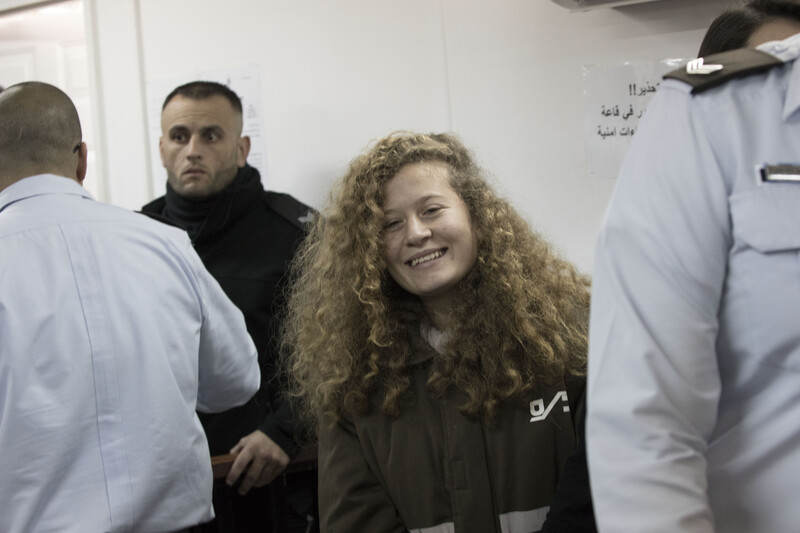
An Israeli military court has approved a plea deal which will see Palestinian teenager Ahed Tamimi serve an eight-month prison sentence on top of a fine of nearly $1,500.
Ahed, who turned 17 in January, was charged with assaulting soldiers and incitement after a video recorded by her mother Nariman circulated, showing Ahed and her cousin Nour slapping and shoving two heavily armed Israeli soldiers on 15 December.
Ahed was arrested in the middle of the night at her home in the occupied West Bank village of Nabi Saleh on 19 December.
Nour and Nariman were also detained by the army following the videotaped incident and have been sentenced to time served -- 16 days in prison -- and eight months in prison, respectively, after accepting plea deals.
MORE...
The Electronic Intifada
An Israeli military court has approved a plea deal which will see Palestinian teenager Ahed Tamimi serve an eight-month prison sentence on top of a fine of nearly $1,500.
Ahed, who turned 17 in January, was charged with assaulting soldiers and incitement after a video recorded by her mother Nariman circulated, showing Ahed and her cousin Nour slapping and shoving two heavily armed Israeli soldiers on 15 December.
Ahed was arrested in the middle of the night at her home in the occupied West Bank village of Nabi Saleh on 19 December.
Nour and Nariman were also detained by the army following the videotaped incident and have been sentenced to time served -- 16 days in prison -- and eight months in prison, respectively, after accepting plea deals.
MORE...
2018-02-14
Ahed Tamimi remains in Israeli prison as “trial” adjourned
by Ali Abunimah
Electronic Intifada
More than two dozen prominent US Black artists and public figures are speaking out in support of Ahed Tamimi, as the teenager’s trial began in an Israeli military court.
On Tuesday, Ahed was brought before the Ofer military court in the occupied West Bank.
Amid the presence of many journalists and diplomats, the military judge ordered the session to be held behind closed doors, claiming this was for Ahed’s own good.
MORE...
Electronic Intifada
More than two dozen prominent US Black artists and public figures are speaking out in support of Ahed Tamimi, as the teenager’s trial began in an Israeli military court.
On Tuesday, Ahed was brought before the Ofer military court in the occupied West Bank.
Amid the presence of many journalists and diplomats, the military judge ordered the session to be held behind closed doors, claiming this was for Ahed’s own good.
MORE...
2018-02-09
Empire Files: Abby Martin Meets Ahed Tamimi -- Message From A Freedom Fighter
Ahed Tamimi, Teen Palestinian Activist, Speaks on Life Under Occupation
2018-01-17
US media reverse Ahed Tamimi’s reality
by Michael F. Brown
Electronic Intifada
When 16-year-old Palestinian Ahed Tamimi stood up to Israeli occupation soldiers, she couldn’t have known just how much of her story mainstream US media would cut away and twist.
Salient facts, like how Ahed has spent her entire life under military occupation and Israel’s near-fatal violence against her cousin, were either ignored outright or downplayed. Others, such as the indisputable reality that Palestinian land is being stolen by Israel, were treated as if they were simply matters of opinion.
Some in the US press even presented Ahed as the aggressor, rather than the Israeli forces she challenged through mild physical contact.
Ahed’s use of slapping, kicking and angry rhetoric received more attention from David M. Halbfinger in The New York Times and especially from Dana Dovey in Newsweek than the much more harmful Israeli resort to violence, theft and seemingly permanent occupation.
The shocking photo of Muhammad Fadel Tamimi, Ahed’s 15-year-old cousin, and his misshapen head published in a 5 January Haaretz article by Gideon Levy and Alex Levac stands in stark contrast to the solitary sentence Halbfinger allotted Muhammad’s shooting in a 22 December article one week after the confrontation.
Halbfinger dispenses with Muhammad’s severe injury by stating in the 13th paragraph: “The latest incident, filmed in the family’s backyard, occurred within hours after a cousin of Ms. Tamimi’s was shot in the face with a rubber bullet, and it was streamed live on Facebook.”
MORE...
Electronic Intifada
When 16-year-old Palestinian Ahed Tamimi stood up to Israeli occupation soldiers, she couldn’t have known just how much of her story mainstream US media would cut away and twist.Salient facts, like how Ahed has spent her entire life under military occupation and Israel’s near-fatal violence against her cousin, were either ignored outright or downplayed. Others, such as the indisputable reality that Palestinian land is being stolen by Israel, were treated as if they were simply matters of opinion.
Some in the US press even presented Ahed as the aggressor, rather than the Israeli forces she challenged through mild physical contact.
Ahed’s use of slapping, kicking and angry rhetoric received more attention from David M. Halbfinger in The New York Times and especially from Dana Dovey in Newsweek than the much more harmful Israeli resort to violence, theft and seemingly permanent occupation.
The shocking photo of Muhammad Fadel Tamimi, Ahed’s 15-year-old cousin, and his misshapen head published in a 5 January Haaretz article by Gideon Levy and Alex Levac stands in stark contrast to the solitary sentence Halbfinger allotted Muhammad’s shooting in a 22 December article one week after the confrontation.
Halbfinger dispenses with Muhammad’s severe injury by stating in the 13th paragraph: “The latest incident, filmed in the family’s backyard, occurred within hours after a cousin of Ms. Tamimi’s was shot in the face with a rubber bullet, and it was streamed live on Facebook.”
MORE...
2018-01-10
My Daughter, These Are Tears of Struggle
Ahed Tamimi's father: I'm proud of my daughter. She is a freedom fighter who, in the coming years, will lead the resistance to Israeli rule
by Bassem Tamimi
Haaretz
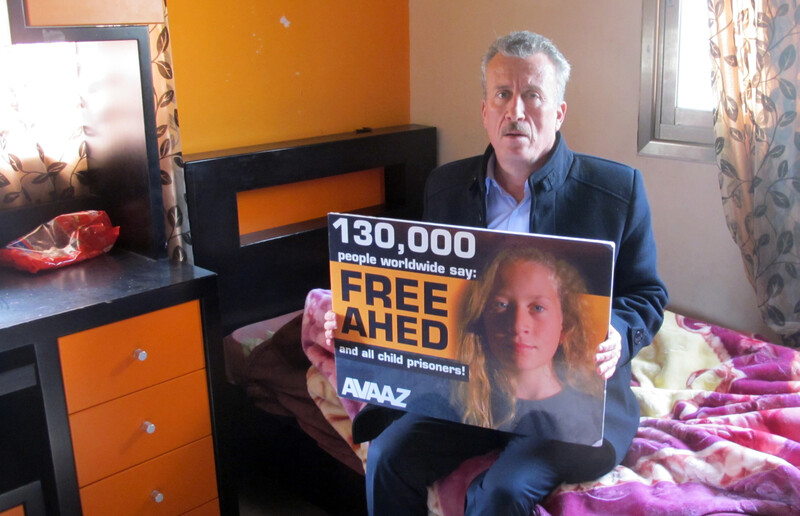
This night too, like all the nights since dozens of soldiers raided our home in the middle of the night, my wife Nariman, my 16-year-old daughter Ahed and Ahed’s cousin Nur will spend behind bars. Although it is Ahed’s first arrest, she is no stranger to your prisons. My daughter has spent her whole life under the heavy shadow of the Israeli prison — from my lengthy incarcerations throughout her childhood, to the repeated arrests of her mother, brother and friends, to the covert-overt threat implied by your soldiers’ ongoing presence in our lives. So her own arrest was just a matter of time. An inevitable tragedy waiting to happen.
Several months ago, on a trip to South Africa, we screened for an audience a video documenting the struggle of our village, Nabi Saleh, against Israel’s forced rule. When the lights came back on, Ahed stood up to thank the people for their support. When she noticed that some of the audience members had tears in their eyes, she said to them: “We may be victims of the Israeli regime, but we are just as proud of our choice to fight for our cause, despite the known cost. We knew where this path would lead us, but our identity, as a people and as individuals, is planted in the struggle, and draws its inspiration from there. Beyond the suffering and daily oppression of the prisoners, the wounded and the killed, we also know the tremendous power that comes from belonging to a resistance movement; the dedication, the love, the small sublime moments that come from the choice to shatter the invisible walls of passivity.
“I don’t want to be perceived as a victim, and I won’t give their actions the power to define who I am and what I’ll be. I choose to decide for myself how you will see me. We don’t want you to support us because of some photogenic tears, but because we chose the struggle and our struggle is just. This is the only way that we’ll be able to stop crying one day.”
More...
by Bassem Tamimi
Haaretz
This night too, like all the nights since dozens of soldiers raided our home in the middle of the night, my wife Nariman, my 16-year-old daughter Ahed and Ahed’s cousin Nur will spend behind bars. Although it is Ahed’s first arrest, she is no stranger to your prisons. My daughter has spent her whole life under the heavy shadow of the Israeli prison — from my lengthy incarcerations throughout her childhood, to the repeated arrests of her mother, brother and friends, to the covert-overt threat implied by your soldiers’ ongoing presence in our lives. So her own arrest was just a matter of time. An inevitable tragedy waiting to happen.
Several months ago, on a trip to South Africa, we screened for an audience a video documenting the struggle of our village, Nabi Saleh, against Israel’s forced rule. When the lights came back on, Ahed stood up to thank the people for their support. When she noticed that some of the audience members had tears in their eyes, she said to them: “We may be victims of the Israeli regime, but we are just as proud of our choice to fight for our cause, despite the known cost. We knew where this path would lead us, but our identity, as a people and as individuals, is planted in the struggle, and draws its inspiration from there. Beyond the suffering and daily oppression of the prisoners, the wounded and the killed, we also know the tremendous power that comes from belonging to a resistance movement; the dedication, the love, the small sublime moments that come from the choice to shatter the invisible walls of passivity.
“I don’t want to be perceived as a victim, and I won’t give their actions the power to define who I am and what I’ll be. I choose to decide for myself how you will see me. We don’t want you to support us because of some photogenic tears, but because we chose the struggle and our struggle is just. This is the only way that we’ll be able to stop crying one day.”
More...
And if Ahed Tamimi Were Your Daughter?
How is it that Israelis are totally indifferent to the plight of the blond girl behind bars who could easily be their child?
by Gideon Levy
Haaretz
For the past two weeks, she has burst into Israelis’ living rooms every few days through another perfunctory report on the extension of her arrest. Once again, we see the golden curls; once again, we see the Botticelli figure in the brown Shin Bet security service uniform and the handcuffs, looking more like a girl from Ramat Hasharon than a girl from Nabi Saleh.
Yet even Ahed Tamimi’s “non-Arab” appearance hasn’t managed to touch any hearts here. The wall of dehumanization and demonization that has been built through vile campaigns of incitement, propaganda and brain-washing against the Palestinians has trumped even the blonde from Nabi Saleh.
More...
by Gideon Levy
Haaretz
For the past two weeks, she has burst into Israelis’ living rooms every few days through another perfunctory report on the extension of her arrest. Once again, we see the golden curls; once again, we see the Botticelli figure in the brown Shin Bet security service uniform and the handcuffs, looking more like a girl from Ramat Hasharon than a girl from Nabi Saleh.
Yet even Ahed Tamimi’s “non-Arab” appearance hasn’t managed to touch any hearts here. The wall of dehumanization and demonization that has been built through vile campaigns of incitement, propaganda and brain-washing against the Palestinians has trumped even the blonde from Nabi Saleh.
More...
Subscribe to:
Posts (Atom)