by Gideon Levy
Haaretz
A young father of two is hospitalized with serious injuries after being shot by Israeli soldiers during a Gaza border rally. In 2014, the IDF destroyed his home, and he was left with nothing.
The full scale of the harrowing despair of the Gaza Strip is embodied in a haggard young man in the surgical ward on the third floor of Al-Ahli Hospital in Hebron. Two rounds fired by Israel Defense Forces snipers left him seriously wounded, internal organs blown apart, his right leg shattered. Only his mother is by his side in this narrow room, which is starkly empty apart from the old hospital bed he’s lying in, and a fake leather sofa that’s even older and more tattered. There’s no television set, no radio, no one comes to visit, there’s no place to move around, and he has no money to buy a cup of coffee in the cafeteria.
The patient is Ibrahim al-Masri, one of the hundreds who have suffered serious wounds in the Gaza demonstrations of the past month, and one of the very few who has been allowed to undergo medical treatment in the West Bank. Indeed, he is the only Gaza resident hospitalized in Hebron.
Alone, distraught, penniless, now also disabled -- Masri has no chance in life. The despair in Hebron isn’t any easier to bear, and he’s already waiting to return to Gaza, which is utterly indifferent to him. A visit to him is like a descent into hell.
Twenty-three years old, he’s married to Faiza and the father of a 3-year-old daughter, Lama, and a son of 9 months, Sami. A young couple plus two in the Gaza Strip 2018, without a home and without a job, now also with a disabled husband and father. Rehab, his mother, is the only person whom Israel allowed to leave the cage of Gaza with him; now the two are imprisoned in this cramped room, where no one comes to visit or offer support.
Masri says he hardly speaks with his children by phone: The little one is just a baby and he has nothing to say to the 3 year-old. “What will I tell her? That our life has been destroyed?” When she saw him in serious condition in the Indonesia Hospital in Sheikh Ziyad in Gaza, where he was taken originally, she was badly frightened, ran to her mother’s arms and cried until they left.
ion has improved, he says now. According to his doctors, he will be able to return to Gaza in another week or so. Where will he undergo rehabilitation? No one knows. Masri has also been told that it will take time before he can walk and get around, in general. He would like to return to Gaza for a few days, because he and his mother have run out of money and he has no change of clothing, and in Hebron everything is expensive. But it’s very unlikely that Israel will allow him to return to the West Bank again after his release.
They arrived here with 250 shekels ($70), which neighbors loaned them, and nothing remains. Masri is sorry now that he went to demonstrate. His mother says he did it in order to vent his anger. He corrects her: “What did it help? So many young people have become cripples, and no one cares.”
Showing posts with label Non-Violent Resistance. Show all posts
2018-05-12
2017-05-12
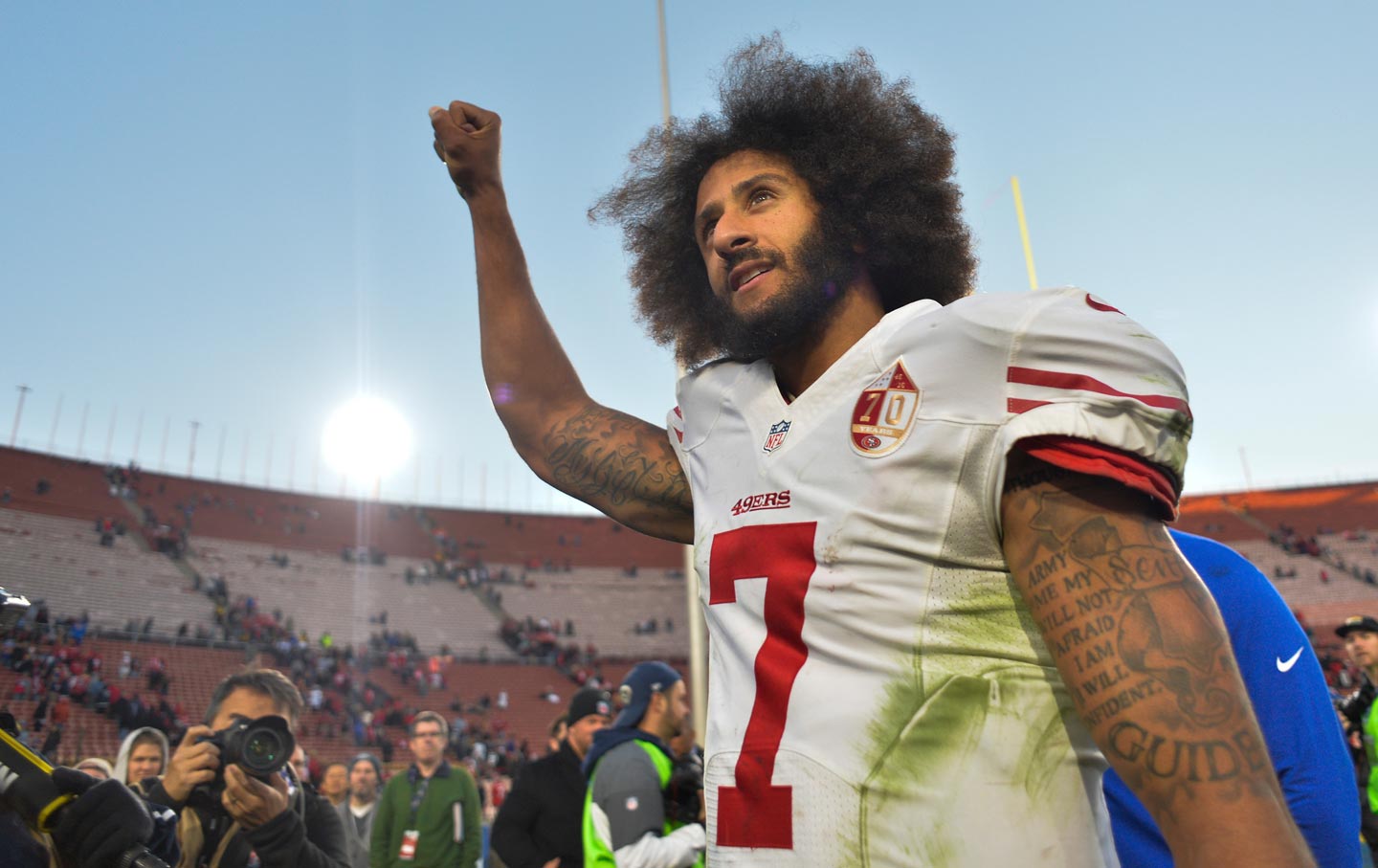
Colin Kaepernick’s Message to Chicago Youth: ‘Know Your Rights’
by Dave Zirin
The Nation
NFL quarterback took his Know Your Rights Camp to the South Side of Chicago. Here is an exclusive look inside.

It starts with Colin Kaepernick. The free-agent NFL quarterback came to the South Side of Chicago last Saturday to hold one of his Know Your Rights Camps: full-day youth seminars that Kaepernick organizes, funds, and emcees. Already staged in New York City and the Bay Area, with more cities to come, these are not open events for sports fans, the press, or random people. Their aim is to speak directly to black, brown, and economically disadvantaged youth, invited through local community organizations, about history, nutrition, legal rights, and financial literacy. As Kaepernick said to me, “Every city has grassroots resources. Our goal is to raise awareness about those resources and help young people access them to empower themselves and the people around them.”
It might start with Colin Kaepernick, but it doesn’t end with him. There is a young multiracial network of roughly 50 Know Your Rights volunteers. They have flown in from all over country to handle logistics at the event’s site, the DuSable Museum of African American History in Hyde Park. These are people like Kerem from Orange County who said, “This message is about equal rights. Often people in underserved communities don’t understand that they have these rights and they need to claim them…. Colin has sacrificed a lot to get to this point. It shows he is passionate about this and we all feed from that.”
Another volunteer, someone just hanging out in a Know Your Rights T-shirt, was Kaepernick’s San Francisco 49ers teammate Eric Reid. “I came here to support Colin,” he said to me. “I want to show these kids that there are people who want them to succeed despite how they may feel when they go to school. But I also came here to learn.”
Reid also spoke about the last season of anthem protests, where he kneeled alongside Kaepernick. He explained in a quiet but proud voice, “All we wanted to do was expand the discussion. People were being killed by police and we wanted that recognized and discussed. And I think we accomplished that.”
The day started with breakfast: eggs, yogurt, biscuits, and fruit for the 200 young people who were at the door by 9:00 am. A 12-year-old named Daymien gave up the opening game of his baseball season to attend. “I wanted to play today, but I think this is more important,” he said. “I wanted to come here for knowledge and learn my history.” In addition to the breakfasts and lunches provided, young people were given T-shirts that read “Know Your Rights” on the front. On the back, the shirts listed the following 10 points:
YOU HAVE THE RIGHT TO BE FREE.
YOU HAVE THE RIGHT TO BE HEALTHY.
YOU HAVE THE RIGHT TO BE BRILLIANT.
YOU HAVE THE RIGHT TO BE SAFE.
YOU HAVE THE RIGHT TO BE LOVED.
YOU HAVE THE RIGHT TO BE COURAGEOUS.
YOU HAVE THE RIGHT TO BE ALIVE.
YOU HAVE THE RIGHT TO BE TRUSTED.
YOU HAVE THE RIGHT TO BE EDUCATED.
YOU HAVE THE RIGHT TO KNOW YOUR RIGHTS.
The free breakfasts and the 10 points both derive, intentionally, from the political legacy of the Black Panthers. I spoke with Ameer Loggins, a young writer and PhD candidate at Cal-Berkeley who helped develop the Know Your Rights curriculum as well as the ten-point plan. “This is an extension of the Freedom Schools of the civil-rights movement, the Panther schools, and all non-institutional educational programs that go out into the communities. The only difference is that we are mobile and we are associated with Colin, and that puts it on a different kind of platform.” As this camp was in Chicago, the particulars of the city’s history and policing were central to the agenda.
After breakfast Kaepernick introduced the day, saying, “We are here to uplift each other. We also have great speakers and guests who are here for no other reason than that they love you and they want to support you.”
He then brought out “one of the great men of Chicago,” hip-hop icon Common, who flew in just for the camp and stayed the entire six-hour day. Common said, “I’m honored to be here. I’m here because last September I saw Colin Kaepernick standing up for us as a people. I thought, ‘Man that’s one of the most courageous acts I’ve seen by someone in the spotlight since Muhammad Ali.’ I’ve always said that Muhammad Ali was one of my heroes, so now I have to say that Colin Kaepernick is one of my heroes. But it’s not just Colin now. He has a team. We have a team: The Know Your Rights team speaking about how we can exist not only to fight but to elevate and reach our goals and dreams…to go out there and be the kings and queens we were created to be. I want each and every one of you to know that we care and I want you to listen, ask questions and take notes today, and as then go out onto our city and spread the message for people who aren’t here.”
The first speaker was the aforementioned Ameer Loggins, who gave a college-level seminar on Chicago history, segregation, and structural racism. Loggins said, “Chicago is the most segregated city in the United States and no one talks about the effects of that in 2017. We talk about Selma and Jim Crow and the harm of segregation in the past but not the present. It’s not just segregation of space. It’s a segregation of resources and economics, food access, and property ownership…. Even if you say, ‘We had a black mayor, and Barack lives in Chicago,’ it doesn’t trickle down. People say we made it, but if our community doesn’t collectively benefit with resources, what the hell did we make it for?”
After going through the effects of 21st-century segregation?how it puts a person in a penned-in environment where they can be policed, subjected to violence, and denied resources?he made the argument that “young people just like you” made the civil-rights movement by “contesting segregated space,” and said, “You have the same power. Turn your segregated space into contested space. Don’t just sit there and take it. You don’t need to break windows. Arm yourself with enough knowledge and you can whip ass with your brain.”
It was rousing and, by my informal polling, a highlight for the students in attendance. One young woman said to me, “I wish my social-studies teacher was here taking notes.”
After Loggins, Kaepernick returned to the stage to underline the message, saying, “We are trying to show you what you are dealing with so you can combat it.” Then he introduced the next speakers. “We are now bringing out the legal defense team so you can protect yourselves, protect your family, protect your communities.”
Out came Guillermo Gutierrez and Charles Jones from First Defense Legal Aid, with the message that “Chicago is the false-confession capital of world.” To drive the point home, these “street attorneys” educated the students about Jon Burge, the South Side police officer and now convicted felon who tortured confessions out of more than 200 suspects between 1972 and 1991.
They said that the future of some people in the room could depend on knowing their rights when approached by law enforcement, and hammered home what to say if stopped by police. “First and foremost, you always have the right to ask, ‘Am I free to go?’ That is your constitutional right. If they say ‘no,’ you have the right to say, ‘I do not consent to be searched.’ If you don’t say those words, they can and will search you.”
Then they stressed, “Always remain silent. Call us. Have an attorney present. That is your right.”
Gutierrez and Jones made the students repeat their hotline number?1 (800) Law-Rep4?as well as promise to distribute cards with the number to family and friends.
Students asked about retaliation from police if they invoked these rights, concerned that they would be pegged as uncooperative. The First Defense Legal Aid performed skits to show not only how to resist any police coercion but also how to articulate their rights to minimize conflict.
Kaepernick came out and reinforced the point, saying, “So if an officer stops you, what do you say?” The students all said as one, “Am I free to go?’”
Then Kaepernick became an organizer?or the world’s chillest public-school administrator?dividing the students into breakout sessions that would cover “holistic health” and “financial literacy,” directing them into what rooms to go to by colored wrist-bands they received upon registration. He also said, “Remember, we have snacks that you can grab between sessions. But please, no eating in the auditorium.”
Yareli Quintana, a food consultant and spirited speaker, then took the stage to speak about making intelligent eating choices and how to take “baby steps” for healthier living. She made the case that food is self-determination and to integrate fruits and vegetables into their diets to better develop their minds. She even did a PowerPoint presentation about how different foods affect the brain. Kaepernick came up afterward and said, “we will have a resource map for you so you can find community gardens that grow their own healthy foods.”
The emphasis on healthy choices was evident throughout the day. One of the more harrowing moments came when radio host Ebro Darden asked the students, “How many of you have eaten fast food three times this week?” Almost the entire room raised their hands. Then he asked, “How many of you have members of your family with cancer or diabetes?” Again, almost the entire room raised their hands.
The talk of community gardens and, in the financial-literacy section, the importance of dressing and speaking in a professional manner, also produced a robust debate about whether it was realistic for these students to even find healthy food, save money, or dress a certain way, and whether those kinds of personal choices could beat back oppression. It was the century-old debate about what is known as “respectability politics”?whether racism needs to be fought systemically or by changing individual habits. Different speakers articulated different sides of this, with the students chiming in as well.
The substance of this discussion was perhaps less important than the fact that the dialogue was open, intense, but also friendly: a display for the young people in the audience of what debate looks like and how adults can disagree without being disagreeable. The students shaped this debate by speaking about their own experiences, what was realistic for them and what was not.
Kaepernick ended the day by speaking to the students about his own journey. He talked about growing up as the adopted son in an all-white home. He said, “I love my family to death. They’re the most amazing people I know. But when I looked in the mirror, I knew I was different. Learning what it meant to be an African man in America, not a black man but an African man, was critical for me. Through this knowledge, I was able to identify myself and my community differently…
“I thought I was from Milwaukee. I thought my ancestry started at slavery and I was taught in school that we were all supposed to be grateful just because we aren’t slaves. But what I was able to do was trace my ancestry and DNA lineage back to Ghana, Nigeria, the Ivory Coast, and saw my existence was more than just being a slave. It was as an African man. We had our own civilizations, and I want you to know how high the ceiling is for our people. I want you to know that our existence now is not normal. It’s oppressive. For me, identifying with Africa gave me a higher sense of who I was, knowing that we have a proud history and are all in this together.”
Then he took a deep breath and said, “This was so important for me and I want to share it with you. So when you leave, you are all getting backpacks, and inside of them are Ancestry DNA kits so you can trace your ancestry and connect with your lost relatives who may have taken this test as well.”
The students exploded with joy upon hearing this. I was told there was a similar reaction in Oakland and New York.
Then he said, “I love you guys. I appreciate you. Build with each other. Because you will be this community moving forward.”
Afterwards, I spoke to Kaepernick at some length. He is training every day for the 2017 season and, optimistic that his hard work and stellar 2016 season will be rewarded, believes that he will find an NFL home. But we kept the conversation focused on the camp.
“I thought it was amazing,” he said. “Every time we do an event, leading up to it, I’m always a little bit nervous. ‘Do we have everything in line? Are the Ts crossed and the Is dotted?’ But once the program starts running, you see the kids having fun and and absorbing what we are saying. That’s the win for us…to see them get the tools to navigate an oppressive society.”
He compared the Know Your Rights team to a football squad: “It’s the same sense of camaraderie. Building toward a common goal. And in this space we are trying to help communities that are oppressed. That’s what we want. We want to show that we can build with each other and love each other because in oppressed communities no one is going to help them but themselves. It’s so exciting to see it come together.” He then smiled so wide and looked so relaxed, I thought he would float to the ceiling. “It’s a very liberating thing to feel. It’s hard to explain.”
One thing we did not talk about was whether he was being politically blackballed by the league for his political ideas and activism. There was no need. After spending the day with Colin Kaepernick, all I could think about was a quote from Bill Russell in 1967 when he was asked about how Muhammad Ali was coping with being stripped of the heavyweight title. Russell said, “I’m not worried about Muhammad Ali. I’m worried about the rest of us.”
I’m not worried about Colin Kaepernick. As for “the rest of us,” we’ve got work to do.
The Nation
NFL quarterback took his Know Your Rights Camp to the South Side of Chicago. Here is an exclusive look inside.

It starts with Colin Kaepernick. The free-agent NFL quarterback came to the South Side of Chicago last Saturday to hold one of his Know Your Rights Camps: full-day youth seminars that Kaepernick organizes, funds, and emcees. Already staged in New York City and the Bay Area, with more cities to come, these are not open events for sports fans, the press, or random people. Their aim is to speak directly to black, brown, and economically disadvantaged youth, invited through local community organizations, about history, nutrition, legal rights, and financial literacy. As Kaepernick said to me, “Every city has grassroots resources. Our goal is to raise awareness about those resources and help young people access them to empower themselves and the people around them.”
It might start with Colin Kaepernick, but it doesn’t end with him. There is a young multiracial network of roughly 50 Know Your Rights volunteers. They have flown in from all over country to handle logistics at the event’s site, the DuSable Museum of African American History in Hyde Park. These are people like Kerem from Orange County who said, “This message is about equal rights. Often people in underserved communities don’t understand that they have these rights and they need to claim them…. Colin has sacrificed a lot to get to this point. It shows he is passionate about this and we all feed from that.”
Another volunteer, someone just hanging out in a Know Your Rights T-shirt, was Kaepernick’s San Francisco 49ers teammate Eric Reid. “I came here to support Colin,” he said to me. “I want to show these kids that there are people who want them to succeed despite how they may feel when they go to school. But I also came here to learn.”
Reid also spoke about the last season of anthem protests, where he kneeled alongside Kaepernick. He explained in a quiet but proud voice, “All we wanted to do was expand the discussion. People were being killed by police and we wanted that recognized and discussed. And I think we accomplished that.”
The day started with breakfast: eggs, yogurt, biscuits, and fruit for the 200 young people who were at the door by 9:00 am. A 12-year-old named Daymien gave up the opening game of his baseball season to attend. “I wanted to play today, but I think this is more important,” he said. “I wanted to come here for knowledge and learn my history.” In addition to the breakfasts and lunches provided, young people were given T-shirts that read “Know Your Rights” on the front. On the back, the shirts listed the following 10 points:
YOU HAVE THE RIGHT TO BE FREE.
YOU HAVE THE RIGHT TO BE HEALTHY.
YOU HAVE THE RIGHT TO BE BRILLIANT.
YOU HAVE THE RIGHT TO BE SAFE.
YOU HAVE THE RIGHT TO BE LOVED.
YOU HAVE THE RIGHT TO BE COURAGEOUS.
YOU HAVE THE RIGHT TO BE ALIVE.
YOU HAVE THE RIGHT TO BE TRUSTED.
YOU HAVE THE RIGHT TO BE EDUCATED.
YOU HAVE THE RIGHT TO KNOW YOUR RIGHTS.
The free breakfasts and the 10 points both derive, intentionally, from the political legacy of the Black Panthers. I spoke with Ameer Loggins, a young writer and PhD candidate at Cal-Berkeley who helped develop the Know Your Rights curriculum as well as the ten-point plan. “This is an extension of the Freedom Schools of the civil-rights movement, the Panther schools, and all non-institutional educational programs that go out into the communities. The only difference is that we are mobile and we are associated with Colin, and that puts it on a different kind of platform.” As this camp was in Chicago, the particulars of the city’s history and policing were central to the agenda.
After breakfast Kaepernick introduced the day, saying, “We are here to uplift each other. We also have great speakers and guests who are here for no other reason than that they love you and they want to support you.”
He then brought out “one of the great men of Chicago,” hip-hop icon Common, who flew in just for the camp and stayed the entire six-hour day. Common said, “I’m honored to be here. I’m here because last September I saw Colin Kaepernick standing up for us as a people. I thought, ‘Man that’s one of the most courageous acts I’ve seen by someone in the spotlight since Muhammad Ali.’ I’ve always said that Muhammad Ali was one of my heroes, so now I have to say that Colin Kaepernick is one of my heroes. But it’s not just Colin now. He has a team. We have a team: The Know Your Rights team speaking about how we can exist not only to fight but to elevate and reach our goals and dreams…to go out there and be the kings and queens we were created to be. I want each and every one of you to know that we care and I want you to listen, ask questions and take notes today, and as then go out onto our city and spread the message for people who aren’t here.”
The first speaker was the aforementioned Ameer Loggins, who gave a college-level seminar on Chicago history, segregation, and structural racism. Loggins said, “Chicago is the most segregated city in the United States and no one talks about the effects of that in 2017. We talk about Selma and Jim Crow and the harm of segregation in the past but not the present. It’s not just segregation of space. It’s a segregation of resources and economics, food access, and property ownership…. Even if you say, ‘We had a black mayor, and Barack lives in Chicago,’ it doesn’t trickle down. People say we made it, but if our community doesn’t collectively benefit with resources, what the hell did we make it for?”
After going through the effects of 21st-century segregation?how it puts a person in a penned-in environment where they can be policed, subjected to violence, and denied resources?he made the argument that “young people just like you” made the civil-rights movement by “contesting segregated space,” and said, “You have the same power. Turn your segregated space into contested space. Don’t just sit there and take it. You don’t need to break windows. Arm yourself with enough knowledge and you can whip ass with your brain.”
It was rousing and, by my informal polling, a highlight for the students in attendance. One young woman said to me, “I wish my social-studies teacher was here taking notes.”
After Loggins, Kaepernick returned to the stage to underline the message, saying, “We are trying to show you what you are dealing with so you can combat it.” Then he introduced the next speakers. “We are now bringing out the legal defense team so you can protect yourselves, protect your family, protect your communities.”
Out came Guillermo Gutierrez and Charles Jones from First Defense Legal Aid, with the message that “Chicago is the false-confession capital of world.” To drive the point home, these “street attorneys” educated the students about Jon Burge, the South Side police officer and now convicted felon who tortured confessions out of more than 200 suspects between 1972 and 1991.
They said that the future of some people in the room could depend on knowing their rights when approached by law enforcement, and hammered home what to say if stopped by police. “First and foremost, you always have the right to ask, ‘Am I free to go?’ That is your constitutional right. If they say ‘no,’ you have the right to say, ‘I do not consent to be searched.’ If you don’t say those words, they can and will search you.”
Then they stressed, “Always remain silent. Call us. Have an attorney present. That is your right.”
Gutierrez and Jones made the students repeat their hotline number?1 (800) Law-Rep4?as well as promise to distribute cards with the number to family and friends.
Students asked about retaliation from police if they invoked these rights, concerned that they would be pegged as uncooperative. The First Defense Legal Aid performed skits to show not only how to resist any police coercion but also how to articulate their rights to minimize conflict.
Kaepernick came out and reinforced the point, saying, “So if an officer stops you, what do you say?” The students all said as one, “Am I free to go?’”
Then Kaepernick became an organizer?or the world’s chillest public-school administrator?dividing the students into breakout sessions that would cover “holistic health” and “financial literacy,” directing them into what rooms to go to by colored wrist-bands they received upon registration. He also said, “Remember, we have snacks that you can grab between sessions. But please, no eating in the auditorium.”
Yareli Quintana, a food consultant and spirited speaker, then took the stage to speak about making intelligent eating choices and how to take “baby steps” for healthier living. She made the case that food is self-determination and to integrate fruits and vegetables into their diets to better develop their minds. She even did a PowerPoint presentation about how different foods affect the brain. Kaepernick came up afterward and said, “we will have a resource map for you so you can find community gardens that grow their own healthy foods.”
The emphasis on healthy choices was evident throughout the day. One of the more harrowing moments came when radio host Ebro Darden asked the students, “How many of you have eaten fast food three times this week?” Almost the entire room raised their hands. Then he asked, “How many of you have members of your family with cancer or diabetes?” Again, almost the entire room raised their hands.
The talk of community gardens and, in the financial-literacy section, the importance of dressing and speaking in a professional manner, also produced a robust debate about whether it was realistic for these students to even find healthy food, save money, or dress a certain way, and whether those kinds of personal choices could beat back oppression. It was the century-old debate about what is known as “respectability politics”?whether racism needs to be fought systemically or by changing individual habits. Different speakers articulated different sides of this, with the students chiming in as well.
The substance of this discussion was perhaps less important than the fact that the dialogue was open, intense, but also friendly: a display for the young people in the audience of what debate looks like and how adults can disagree without being disagreeable. The students shaped this debate by speaking about their own experiences, what was realistic for them and what was not.
Kaepernick ended the day by speaking to the students about his own journey. He talked about growing up as the adopted son in an all-white home. He said, “I love my family to death. They’re the most amazing people I know. But when I looked in the mirror, I knew I was different. Learning what it meant to be an African man in America, not a black man but an African man, was critical for me. Through this knowledge, I was able to identify myself and my community differently…
“I thought I was from Milwaukee. I thought my ancestry started at slavery and I was taught in school that we were all supposed to be grateful just because we aren’t slaves. But what I was able to do was trace my ancestry and DNA lineage back to Ghana, Nigeria, the Ivory Coast, and saw my existence was more than just being a slave. It was as an African man. We had our own civilizations, and I want you to know how high the ceiling is for our people. I want you to know that our existence now is not normal. It’s oppressive. For me, identifying with Africa gave me a higher sense of who I was, knowing that we have a proud history and are all in this together.”
Then he took a deep breath and said, “This was so important for me and I want to share it with you. So when you leave, you are all getting backpacks, and inside of them are Ancestry DNA kits so you can trace your ancestry and connect with your lost relatives who may have taken this test as well.”
The students exploded with joy upon hearing this. I was told there was a similar reaction in Oakland and New York.
Then he said, “I love you guys. I appreciate you. Build with each other. Because you will be this community moving forward.”
Afterwards, I spoke to Kaepernick at some length. He is training every day for the 2017 season and, optimistic that his hard work and stellar 2016 season will be rewarded, believes that he will find an NFL home. But we kept the conversation focused on the camp.
“I thought it was amazing,” he said. “Every time we do an event, leading up to it, I’m always a little bit nervous. ‘Do we have everything in line? Are the Ts crossed and the Is dotted?’ But once the program starts running, you see the kids having fun and and absorbing what we are saying. That’s the win for us…to see them get the tools to navigate an oppressive society.”
He compared the Know Your Rights team to a football squad: “It’s the same sense of camaraderie. Building toward a common goal. And in this space we are trying to help communities that are oppressed. That’s what we want. We want to show that we can build with each other and love each other because in oppressed communities no one is going to help them but themselves. It’s so exciting to see it come together.” He then smiled so wide and looked so relaxed, I thought he would float to the ceiling. “It’s a very liberating thing to feel. It’s hard to explain.”
One thing we did not talk about was whether he was being politically blackballed by the league for his political ideas and activism. There was no need. After spending the day with Colin Kaepernick, all I could think about was a quote from Bill Russell in 1967 when he was asked about how Muhammad Ali was coping with being stripped of the heavyweight title. Russell said, “I’m not worried about Muhammad Ali. I’m worried about the rest of us.”
I’m not worried about Colin Kaepernick. As for “the rest of us,” we’ve got work to do.
2016-11-25
Still Not Thanking Native Americans
Returned to its historical roots, Thanksgiving would be a day to express thanks to Native Americans whose generosity saved the Pilgrims, but that never seems to be a lesson learned, as Dennis J Bernstein reports on the Dakota pipeline standoff.
By Dennis J Bernstein
ConsortiumNews.com
Late Sunday night -- at the start of Thanksgiving week -- Native American protesters were attacked by law enforcement agents near the site of the Dakota Access pipeline, a project that Native Americans and environmentalists have been trying to block.
Police and other security forces deployed tear gas, rubber bullets, percussion grenades and water hoses to stop about 400 protesters from crossing the Blackwater Bridge on state Highway 1806, about a mile from an uncompleted section under Lake Oahe, a Missouri River reservoir, where work has been on hold by order of federal agencies.
“As medical professionals, we are concerned for the real risk of loss of life due to severe hypothermia under these conditions,” the Standing Rock Medic & Healer Council said in a statement posted on Facebook. One hundred sixty-seven people were injured and seven were taken to the hospital, according to Jade Begay, a spokeswoman for the Indigenous Environmental Network.
Sunday’s standoff began around 6 p.m. local time, when a group of about 100 “water protectors” attempted to clear burned out trucks that were blocking the bridge, which is on the most direct route from the Standing Rock Sioux Reservation to Bismarck, North Dakota. The trucks have been in place for several weeks, and law enforcement has constructed a barricade behind them, forcing all traffic to take an approximately 20-mile detour.
“The purpose of this action was to do something to remove that barricade because it’s dangerous,” said Begay, a member of the Tesuque Pueblo and Dine, who has been at the Standing Rock encampments since September. “That barricade poses a danger not just to everyone at the camp, but also to Cannon Ball and other communities that are south.”
“They’re using that barricade as an excuse for us not to be able to lawfully protest,” said Frank Archambault, a member of the Standing Rock Sioux Tribe from Little Eagle, South Dakota. “We got word that the drill is now on the pad so tensions are high right now.”
The 1,200-mile, four-state pipeline is intended to carry oil from western North Dakota to a shipping point in Illinois. But construction of the $3.8 billion pipeline has been protested for months by the Standing Rock Sioux, whose reservation lies near the pipeline route and there are fears a leak could contaminate the drinking water. They also worry that construction could threaten sacred sites.
Cheryl Angel, an Elder member of the Rosebud Nation, was an eyewitness to what happened Sunday night [Nov. 20] in sub-freezing weather with water hoses.
Cheryl Angel: I’m a member of the Rosebud Sioux Tribe. I am Sasusaku, Lakota. I currently live at Cannonball, to support Standing Rock, in their efforts to save the water that millions of Americans [depend upon]. [On the evening of November 20th], after a day of prayer and ceremony at all three camps, our security attempted to open the bridge by removing the burnt out trucks that the North Dakota authorities had put there themselves, and had started on fire themselves and left on the bridge.
So our security forces tried to remove them from the bridge and the North Dakota authorities then decided to escalate their presence by calling in a militarized vehicle, and I’m going to say … maybe 100 more law enforcement vehicles. There were so many you couldn’t even count them. You need to understand that … what separates the tribe from the pipeline area that’s being excavated is the Cannonball River. At some points it’s about 40 feet wide, at other points it’s only 20 feet wide. But there is a bridge that connects between those two lands, those two boundaries. And that’s where the armored vehicles were parked that were already burnt out.
Dennis Bernstein: And, in terms of what happened… we understand that a number of people were wounded with these tear gas canisters. We understand that they were using water hoses in, I guess, 20 - 25 degree [Fahrenheit] weather. Tell us more about that kind of violence. So people can really, you know, get a human face on what’s going on there.
CA: I felt like I was in a war zone. I had … been called to a meeting so I was heading for the meeting. I could hear young warriors running through the camps, saying “Everybody to the north bridge.” So everybody answered the call. They got in their vehicles and they drove to the north bridge. So both sides of the road had cars facing north. People were walking on the sides of the road.
I had taken a back path that the deer, the wildlife, use and I entered from between two hills on a deer path. And I walked through the trees up along the fence and then from that point on … there was flood lights, there was at least 40 floodlights on the north side of the river, about a quarter mile apart, along the entire path of that pipeline. So it’s like moonlight… it’s like daylight on the north side of the river. On the south side, not so much. And people had gathered there, they had… they were singing at the front line. They were playing music at the front line. They were chanting “Water is life.”
By the time I had gotten there, people were coming back, soaked in water, and it was really cold out, and the wind had picked up. And truckloads of people with assistance had brought blankets and jackets, and water, and goggles and face masks. So when you entered the bridge you could look to your right and pick up a blanket, and pick up a goggle, and pick up a face mask, and you could walk further to where the encounter was taking place.
So, I kept to the right of the bridge, and I went down to where the razor wire is, because it’s like a war zone there. I’m not kidding. They have floodlights, they have the tank right centered on the bridge, and there was no instructions. They … had a water cannon there. I heard throughout the night that they had used seven fire engine trucks. They emptied seven of them. It was unbelievable. I didn’t think that they would continue to water cannon people. And I asked them… I went to the front lines and said “Stop this… please go home. We’re here praying for you. We’ll find you new jobs. Pray with us, stand with us. We’re protecting the water for millions.”
And they didn’t listen, they stood behind the barbed wire and they continued … they would lift their rifles and they would pick out, literally pick out, individuals in the crowd and they would shoot them. And so water protectors had plastic container tops, and they were using those as shields. And they were protecting people whenever they could. I was on the front line. I was very, very lucky, because I didn’t get shot. I got maced, I got peppered sprayed, I got water cannoned.
The force of a water cannon if you haven’t had one… it knocks you off your feet. And we had built fires to warm up the people who were soaking wet, in the frigid weather, people are shaking, they were drenched in water and tear gas.
Our medics were out there in full force, doing what was necessary to keep people breathing. People were sharing their inhalers. Those who couldn’t breathe… it was unbelievable. I didn’t think that things would come to this end. But unless Obama stands up, unless people start calling their senators, our lives are in danger, not only the water, but our lives, are physically in danger. So, it hurts me to talk like this.But a call needs to be made. Hundreds of calls need to be made.
Our water needs to be protected. We need support up here. We need wool blankets. We need wool clothes. We need to replenish our first aid kits. We need more thermal blankets. We need batteries. We need jerky. We need those snack bars that you eat, when you’re not able to eat a hot meal. Thermoses. We need… I think we need hundreds of thermoses, because we can’t even carry hot water with us anywhere we go. It was just unbelievable. It was… between being shot with water and then dodging bullets, I’m trying to deliver a peaceful message, and saying prayer. It was hard.
I mean, I slid down the hill, I was knocked off the hill by a water cannon, people picked me up. There was a man standing right next to … a military vehicle, without any face protection, without any blanket and he was singing. And he kept singing, and they just kept spraying him over and over. I picked up an army blanket, I covered him up with it. I stood beside him. We sang together, we prayed together. And they still shot at us, they still maced us, and they still used the water cannon on whoever they wanted to… on everybody that was within their reach, everybody.
And the fires that were started to protect everybody, to warm people up… those fires that were set to warm people up because there was no warming station at that site, were targeted by the police… were targeted by the water cannons. […] The fires that were keeping us warm, they intended on [extinguishing the fires that were there for warmth] and that was there intent.
We didn’t start the fires, only the warming stations. The fires that were started randomly out in the field those were by the tear gas canisters that they were shooting off there. They were shooting canisters at us, into the crowd, everybody at one point thought they were trapped on the bridge because lights were coming over from the south of us. And those turned out to be our own warriors, our own water protectors, our own horse riders to support us. They stood up on the hill, on both sides of the bridge, on the south end, and we were down at the bottom on the bridge, up against the razor wire. I asked them to stop, repeatedly, repeatedly. They wouldn’t stop. They just kept going.
But the thing that really hurt me the most, is when they were trying to put out the fires that were literally saving peoples’ lives. I had got knocked down and was totally drenched in water, I walked over to the fire to warm up and I was only there long enough to empty the water out of my shoes and then they started targeting the fires. So the protectors put up a shield. And for thirty seconds they stood there with a continuous blast of water, and they were totally drenched. And then they all split. First the water hit the fire and there was so much steam and smoke that came out of there. We were blinded.
But there were two of us and we grabbed one of those Teflon, Mylar body armors, and we stretched it between us, and we knelt down on it, and held it between us, we crouched together, we covered one end of the fire. And we just sat there and we prayed. And they kept putting the water over us, until we were completely drenched, again, over and over.
And I could hear a young girl, when the smoke cleared, she was saying “grab the logs, grab the logs” and so people ran over, they grabbed the logs out of the fire and they ran a few yards south, put them together and started another fire, so people could warm up before they were taken to the medic tents. Because there were hundreds of people soaking wet. They weren’t dressed in wool.
When I make a call out for clothing it’s not for any cotton, it’s not for polyester, it’s for waterproof jackets and there’s hardly any waterproof tents at all, snow pants, snow bibs, anything that’s waterproof, and wool. We need wool sweaters, wool socks, wool gloves, wool jackets. Those are the things that we need right now.
I wish the Red Cross would show up. I really do wish that whoever has power to send the Red Cross over there [would]. We could do that because we are in a state of emergency. That’s how it was on the front line.
DB: It’s really important … you sort of hit this really hard but just to underline it… because places like NPR and the local police are saying that they had the water there because you all were starting fires, and that you were throwing Molotov cocktails. That was the story that was coming out of the police, and the local press. You want to talk a little bit more about that?
CA: I’m not afraid to call a liar to their face. If they’re going to post things like that they should be standing on the front lines, getting eyewitness testimony, instead of just passing on the lies [that] the sheriff, … and the governor of North Dakota, and the DAPL are putting out. Because they are taking their own words and using them against the people, to not know the truth. And that should be a crime. It should be.
If I was lying to get people to hurt other people, would I be called a good person? Would I be fit to wear a uniform? Would I be fit to lead a state? I don’t think so. Not according to the values that America claims that it follows. And so, NPR, get on the front line, take your own video, because you weren’t there. So I would like all these major media outlets to quit reprinting lies that are undocumented, undocumented statements from the police.
All that happened is our security wanted to open that road, because it is a public road. And that’s what they said to us when we had our vehicles parked on it. On October 24th they said “go on” they said “we need to open the road. It’s a public road. Move your cars.” So why can’t we move those 3 trucks off the bridge? It’s a public road. That’s how it all started.
DB: But those are two burnt trucks?
CA: That the military forces had placed there themselves. The North Dakota officials put those there and they started them on fire. And before they left they said, “Please stay away from the vehicles. They have propane inside of them, they’re explosive devices.” Which, of course, made everybody to move back from the bridge. And they left them there. And then they put razor wire, which is also unconstitutional. You cannot use that type of razor wire. I mean you only see those in war zones. You don’t see them in the United States. But I’m starting to feel we’re in a war zone. So it’s a battle, people. We need bodies, up front.
We need the world to know that water is a precious commodity and it is sacred to natives. When you understand its relationship to life you will understand the sacredness of it. And we need your support. We need this economy to stop being the oil and gas industries, it’s not good for our country. We need to divest from fossil fuels, and start being a leader in the world by adopting a green policy and getting new jobs for these people who are in the oil industry. Thank you for listening to me. My flight is about to leave. And I’m leaving for ceremony. I’ll be in ceremony for four days. And I’ll be available after four days. And things will probably change by then too.
By Dennis J Bernstein
ConsortiumNews.com
Late Sunday night -- at the start of Thanksgiving week -- Native American protesters were attacked by law enforcement agents near the site of the Dakota Access pipeline, a project that Native Americans and environmentalists have been trying to block.
Police and other security forces deployed tear gas, rubber bullets, percussion grenades and water hoses to stop about 400 protesters from crossing the Blackwater Bridge on state Highway 1806, about a mile from an uncompleted section under Lake Oahe, a Missouri River reservoir, where work has been on hold by order of federal agencies.
“As medical professionals, we are concerned for the real risk of loss of life due to severe hypothermia under these conditions,” the Standing Rock Medic & Healer Council said in a statement posted on Facebook. One hundred sixty-seven people were injured and seven were taken to the hospital, according to Jade Begay, a spokeswoman for the Indigenous Environmental Network.
Sunday’s standoff began around 6 p.m. local time, when a group of about 100 “water protectors” attempted to clear burned out trucks that were blocking the bridge, which is on the most direct route from the Standing Rock Sioux Reservation to Bismarck, North Dakota. The trucks have been in place for several weeks, and law enforcement has constructed a barricade behind them, forcing all traffic to take an approximately 20-mile detour.
“The purpose of this action was to do something to remove that barricade because it’s dangerous,” said Begay, a member of the Tesuque Pueblo and Dine, who has been at the Standing Rock encampments since September. “That barricade poses a danger not just to everyone at the camp, but also to Cannon Ball and other communities that are south.”
“They’re using that barricade as an excuse for us not to be able to lawfully protest,” said Frank Archambault, a member of the Standing Rock Sioux Tribe from Little Eagle, South Dakota. “We got word that the drill is now on the pad so tensions are high right now.”
The 1,200-mile, four-state pipeline is intended to carry oil from western North Dakota to a shipping point in Illinois. But construction of the $3.8 billion pipeline has been protested for months by the Standing Rock Sioux, whose reservation lies near the pipeline route and there are fears a leak could contaminate the drinking water. They also worry that construction could threaten sacred sites.
Cheryl Angel, an Elder member of the Rosebud Nation, was an eyewitness to what happened Sunday night [Nov. 20] in sub-freezing weather with water hoses.
Cheryl Angel: I’m a member of the Rosebud Sioux Tribe. I am Sasusaku, Lakota. I currently live at Cannonball, to support Standing Rock, in their efforts to save the water that millions of Americans [depend upon]. [On the evening of November 20th], after a day of prayer and ceremony at all three camps, our security attempted to open the bridge by removing the burnt out trucks that the North Dakota authorities had put there themselves, and had started on fire themselves and left on the bridge.
So our security forces tried to remove them from the bridge and the North Dakota authorities then decided to escalate their presence by calling in a militarized vehicle, and I’m going to say … maybe 100 more law enforcement vehicles. There were so many you couldn’t even count them. You need to understand that … what separates the tribe from the pipeline area that’s being excavated is the Cannonball River. At some points it’s about 40 feet wide, at other points it’s only 20 feet wide. But there is a bridge that connects between those two lands, those two boundaries. And that’s where the armored vehicles were parked that were already burnt out.
Dennis Bernstein: And, in terms of what happened… we understand that a number of people were wounded with these tear gas canisters. We understand that they were using water hoses in, I guess, 20 - 25 degree [Fahrenheit] weather. Tell us more about that kind of violence. So people can really, you know, get a human face on what’s going on there.
CA: I felt like I was in a war zone. I had … been called to a meeting so I was heading for the meeting. I could hear young warriors running through the camps, saying “Everybody to the north bridge.” So everybody answered the call. They got in their vehicles and they drove to the north bridge. So both sides of the road had cars facing north. People were walking on the sides of the road.
I had taken a back path that the deer, the wildlife, use and I entered from between two hills on a deer path. And I walked through the trees up along the fence and then from that point on … there was flood lights, there was at least 40 floodlights on the north side of the river, about a quarter mile apart, along the entire path of that pipeline. So it’s like moonlight… it’s like daylight on the north side of the river. On the south side, not so much. And people had gathered there, they had… they were singing at the front line. They were playing music at the front line. They were chanting “Water is life.”
By the time I had gotten there, people were coming back, soaked in water, and it was really cold out, and the wind had picked up. And truckloads of people with assistance had brought blankets and jackets, and water, and goggles and face masks. So when you entered the bridge you could look to your right and pick up a blanket, and pick up a goggle, and pick up a face mask, and you could walk further to where the encounter was taking place.
So, I kept to the right of the bridge, and I went down to where the razor wire is, because it’s like a war zone there. I’m not kidding. They have floodlights, they have the tank right centered on the bridge, and there was no instructions. They … had a water cannon there. I heard throughout the night that they had used seven fire engine trucks. They emptied seven of them. It was unbelievable. I didn’t think that they would continue to water cannon people. And I asked them… I went to the front lines and said “Stop this… please go home. We’re here praying for you. We’ll find you new jobs. Pray with us, stand with us. We’re protecting the water for millions.”
And they didn’t listen, they stood behind the barbed wire and they continued … they would lift their rifles and they would pick out, literally pick out, individuals in the crowd and they would shoot them. And so water protectors had plastic container tops, and they were using those as shields. And they were protecting people whenever they could. I was on the front line. I was very, very lucky, because I didn’t get shot. I got maced, I got peppered sprayed, I got water cannoned.
The force of a water cannon if you haven’t had one… it knocks you off your feet. And we had built fires to warm up the people who were soaking wet, in the frigid weather, people are shaking, they were drenched in water and tear gas.
Our medics were out there in full force, doing what was necessary to keep people breathing. People were sharing their inhalers. Those who couldn’t breathe… it was unbelievable. I didn’t think that things would come to this end. But unless Obama stands up, unless people start calling their senators, our lives are in danger, not only the water, but our lives, are physically in danger. So, it hurts me to talk like this.But a call needs to be made. Hundreds of calls need to be made.
Our water needs to be protected. We need support up here. We need wool blankets. We need wool clothes. We need to replenish our first aid kits. We need more thermal blankets. We need batteries. We need jerky. We need those snack bars that you eat, when you’re not able to eat a hot meal. Thermoses. We need… I think we need hundreds of thermoses, because we can’t even carry hot water with us anywhere we go. It was just unbelievable. It was… between being shot with water and then dodging bullets, I’m trying to deliver a peaceful message, and saying prayer. It was hard.
I mean, I slid down the hill, I was knocked off the hill by a water cannon, people picked me up. There was a man standing right next to … a military vehicle, without any face protection, without any blanket and he was singing. And he kept singing, and they just kept spraying him over and over. I picked up an army blanket, I covered him up with it. I stood beside him. We sang together, we prayed together. And they still shot at us, they still maced us, and they still used the water cannon on whoever they wanted to… on everybody that was within their reach, everybody.
And the fires that were started to protect everybody, to warm people up… those fires that were set to warm people up because there was no warming station at that site, were targeted by the police… were targeted by the water cannons. […] The fires that were keeping us warm, they intended on [extinguishing the fires that were there for warmth] and that was there intent.
We didn’t start the fires, only the warming stations. The fires that were started randomly out in the field those were by the tear gas canisters that they were shooting off there. They were shooting canisters at us, into the crowd, everybody at one point thought they were trapped on the bridge because lights were coming over from the south of us. And those turned out to be our own warriors, our own water protectors, our own horse riders to support us. They stood up on the hill, on both sides of the bridge, on the south end, and we were down at the bottom on the bridge, up against the razor wire. I asked them to stop, repeatedly, repeatedly. They wouldn’t stop. They just kept going.
But the thing that really hurt me the most, is when they were trying to put out the fires that were literally saving peoples’ lives. I had got knocked down and was totally drenched in water, I walked over to the fire to warm up and I was only there long enough to empty the water out of my shoes and then they started targeting the fires. So the protectors put up a shield. And for thirty seconds they stood there with a continuous blast of water, and they were totally drenched. And then they all split. First the water hit the fire and there was so much steam and smoke that came out of there. We were blinded.
But there were two of us and we grabbed one of those Teflon, Mylar body armors, and we stretched it between us, and we knelt down on it, and held it between us, we crouched together, we covered one end of the fire. And we just sat there and we prayed. And they kept putting the water over us, until we were completely drenched, again, over and over.
And I could hear a young girl, when the smoke cleared, she was saying “grab the logs, grab the logs” and so people ran over, they grabbed the logs out of the fire and they ran a few yards south, put them together and started another fire, so people could warm up before they were taken to the medic tents. Because there were hundreds of people soaking wet. They weren’t dressed in wool.
When I make a call out for clothing it’s not for any cotton, it’s not for polyester, it’s for waterproof jackets and there’s hardly any waterproof tents at all, snow pants, snow bibs, anything that’s waterproof, and wool. We need wool sweaters, wool socks, wool gloves, wool jackets. Those are the things that we need right now.
I wish the Red Cross would show up. I really do wish that whoever has power to send the Red Cross over there [would]. We could do that because we are in a state of emergency. That’s how it was on the front line.
DB: It’s really important … you sort of hit this really hard but just to underline it… because places like NPR and the local police are saying that they had the water there because you all were starting fires, and that you were throwing Molotov cocktails. That was the story that was coming out of the police, and the local press. You want to talk a little bit more about that?
CA: I’m not afraid to call a liar to their face. If they’re going to post things like that they should be standing on the front lines, getting eyewitness testimony, instead of just passing on the lies [that] the sheriff, … and the governor of North Dakota, and the DAPL are putting out. Because they are taking their own words and using them against the people, to not know the truth. And that should be a crime. It should be.
If I was lying to get people to hurt other people, would I be called a good person? Would I be fit to wear a uniform? Would I be fit to lead a state? I don’t think so. Not according to the values that America claims that it follows. And so, NPR, get on the front line, take your own video, because you weren’t there. So I would like all these major media outlets to quit reprinting lies that are undocumented, undocumented statements from the police.
All that happened is our security wanted to open that road, because it is a public road. And that’s what they said to us when we had our vehicles parked on it. On October 24th they said “go on” they said “we need to open the road. It’s a public road. Move your cars.” So why can’t we move those 3 trucks off the bridge? It’s a public road. That’s how it all started.
DB: But those are two burnt trucks?
CA: That the military forces had placed there themselves. The North Dakota officials put those there and they started them on fire. And before they left they said, “Please stay away from the vehicles. They have propane inside of them, they’re explosive devices.” Which, of course, made everybody to move back from the bridge. And they left them there. And then they put razor wire, which is also unconstitutional. You cannot use that type of razor wire. I mean you only see those in war zones. You don’t see them in the United States. But I’m starting to feel we’re in a war zone. So it’s a battle, people. We need bodies, up front.
We need the world to know that water is a precious commodity and it is sacred to natives. When you understand its relationship to life you will understand the sacredness of it. And we need your support. We need this economy to stop being the oil and gas industries, it’s not good for our country. We need to divest from fossil fuels, and start being a leader in the world by adopting a green policy and getting new jobs for these people who are in the oil industry. Thank you for listening to me. My flight is about to leave. And I’m leaving for ceremony. I’ll be in ceremony for four days. And I’ll be available after four days. And things will probably change by then too.
2016-11-23
A Tradition of Forgetting Indian Rights
Ironically, as Americans commemorate how Native Americans helped save the Pilgrims in 1621, Indian-rights activists are under attack today in defense of land that a 1868 treaty guaranteed as theirs, observes Nat Parry.
By Nat Parry
Consortiumnews.com
Making official a quintessential American tradition dating back to the 1621 feast between the Pilgrims and the Wampanoag tribe, President Abraham Lincoln in 1863 declared the last Thursday of November to be the national day of Thanksgiving ? a vain attempt to unite the North and South at the height of the Civil War.
Five years later, continuing a closely paralleled American tradition, the U.S. government signed the Fort Laramie Treaty of 1868, which established the Great Sioux Reservation west of the Missouri River and promised no more white settlement in a huge, 18-million acre swath of land.
Over the next two decades, as Civil War Reconstruction was completed and a nationwide Thanksgiving date was finally agreed upon by Northern and Southern states, the U.S. continuously reneged on the Fort Laramie Treaty, eventually breaking the Great Sioux Reservation up into five smaller reservations: Cheyenne River Reservation, Lower Brule Indian Reservation, Rosebud Indian Reservation, Pine Ridge Reservation, and Standing Rock Reservation.
More than a century later, in 1980, the U.S. Supreme Court ruled that the government had illegally taken this land, and awarded $120.5 million to the Sioux Nation, based on the market value of the land in 1877, plus interest. For nearly four decades, however, the Lakota Sioux have refused to accept payment and instead continued to demand that the United States return the territory.
Today, the Sioux people are continuing to take a stand on these principles ? the flashpoint now being the Dakota Access Pipeline, which, upon its completion is expected to transport some 470,000 barrels of crude oil a day across several states. Sioux tribe members and their allies have protested this pipeline for months, raising concerns about the threat it poses to their water supply, the effects that the fracked oil will have on the climate, and the process by which the project was approved, saying that it failed to take into account Native rights.
“We live with so many broken promises, there’s no reason for it,” said Dave Archambault II, chairman of the Standing Rock Sioux tribe. “We understand what lands we own, and what lands were illegally taken from us.”
The government, of course, is responding the way it always has to Native American resistance ? through brute force. Over the past few months, police and private security forces have viciously suppressed the water protectors, siccing dogs on them and arresting them for “trespassing.” The repression, which a group of United Nations experts called “excessive” and “increasingly militarized,” culminated Sunday night in some of worst violence against Native people seen since the 1973 siege of nearby Pine Ridge Reservation in South Dakota.
Police fired tear gas, rubber bullets, pepper spray and water at hundreds of protesters in the subfreezing North Dakota weather late Sunday night and early Monday morning, following an attempt by protesters to remove burned vehicles blocking Backwater Bridge in order to enable emergency vehicles and local traffic to move freely.
The police assault led to several reported cases of life-threatening hypothermia. “It is below freezing right now and the Morton County Sheriff’s Department is using a water cannon on our people ? that is an excessive and potentially deadly use of force,” said activist Dallas Goldtooth.
Every aspect of this appears to violate the letter and spirit of the 1868 Laramie Treaty, in which the federal government not only promised to respect Sioux land rights, but also to come to the aid of Native people if they are wronged by outside forces.
“If bad men among the whites, or among other people subject to the authority of the United States, shall commit any wrong upon the person or property of the Indians, the United States will … proceed at once to cause the offender to be arrested and punished according to the laws of the United States, and also re-imburse the injured person for the loss sustained,” the treaty reads.
At this time of Thanksgiving, it would only be appropriate for President Barack Obama to insist that the “bad men” who are committing wrongs “upon the person or property of the Indians” stand down immediately, as well as to halt the construction of the Dakota Access Pipeline and reimburse the Sioux for losses already sustained.
Then, perhaps, the shameful tradition of breaking treaties while giving thanks might itself be broken, and Americans might be able to enjoy their turkey dinners and family reunions without a cloud of hypocrisy hanging over their heads.
By Nat Parry
Consortiumnews.com
Making official a quintessential American tradition dating back to the 1621 feast between the Pilgrims and the Wampanoag tribe, President Abraham Lincoln in 1863 declared the last Thursday of November to be the national day of Thanksgiving ? a vain attempt to unite the North and South at the height of the Civil War.
Five years later, continuing a closely paralleled American tradition, the U.S. government signed the Fort Laramie Treaty of 1868, which established the Great Sioux Reservation west of the Missouri River and promised no more white settlement in a huge, 18-million acre swath of land.
Over the next two decades, as Civil War Reconstruction was completed and a nationwide Thanksgiving date was finally agreed upon by Northern and Southern states, the U.S. continuously reneged on the Fort Laramie Treaty, eventually breaking the Great Sioux Reservation up into five smaller reservations: Cheyenne River Reservation, Lower Brule Indian Reservation, Rosebud Indian Reservation, Pine Ridge Reservation, and Standing Rock Reservation.
More than a century later, in 1980, the U.S. Supreme Court ruled that the government had illegally taken this land, and awarded $120.5 million to the Sioux Nation, based on the market value of the land in 1877, plus interest. For nearly four decades, however, the Lakota Sioux have refused to accept payment and instead continued to demand that the United States return the territory.
Today, the Sioux people are continuing to take a stand on these principles ? the flashpoint now being the Dakota Access Pipeline, which, upon its completion is expected to transport some 470,000 barrels of crude oil a day across several states. Sioux tribe members and their allies have protested this pipeline for months, raising concerns about the threat it poses to their water supply, the effects that the fracked oil will have on the climate, and the process by which the project was approved, saying that it failed to take into account Native rights.
“We live with so many broken promises, there’s no reason for it,” said Dave Archambault II, chairman of the Standing Rock Sioux tribe. “We understand what lands we own, and what lands were illegally taken from us.”
The government, of course, is responding the way it always has to Native American resistance ? through brute force. Over the past few months, police and private security forces have viciously suppressed the water protectors, siccing dogs on them and arresting them for “trespassing.” The repression, which a group of United Nations experts called “excessive” and “increasingly militarized,” culminated Sunday night in some of worst violence against Native people seen since the 1973 siege of nearby Pine Ridge Reservation in South Dakota.
Police fired tear gas, rubber bullets, pepper spray and water at hundreds of protesters in the subfreezing North Dakota weather late Sunday night and early Monday morning, following an attempt by protesters to remove burned vehicles blocking Backwater Bridge in order to enable emergency vehicles and local traffic to move freely.
The police assault led to several reported cases of life-threatening hypothermia. “It is below freezing right now and the Morton County Sheriff’s Department is using a water cannon on our people ? that is an excessive and potentially deadly use of force,” said activist Dallas Goldtooth.
Every aspect of this appears to violate the letter and spirit of the 1868 Laramie Treaty, in which the federal government not only promised to respect Sioux land rights, but also to come to the aid of Native people if they are wronged by outside forces.
“If bad men among the whites, or among other people subject to the authority of the United States, shall commit any wrong upon the person or property of the Indians, the United States will … proceed at once to cause the offender to be arrested and punished according to the laws of the United States, and also re-imburse the injured person for the loss sustained,” the treaty reads.
At this time of Thanksgiving, it would only be appropriate for President Barack Obama to insist that the “bad men” who are committing wrongs “upon the person or property of the Indians” stand down immediately, as well as to halt the construction of the Dakota Access Pipeline and reimburse the Sioux for losses already sustained.
Then, perhaps, the shameful tradition of breaking treaties while giving thanks might itself be broken, and Americans might be able to enjoy their turkey dinners and family reunions without a cloud of hypocrisy hanging over their heads.
Subscribe to:
Posts (Atom)