Showing posts with label Crimes Against Humanity. Show all posts

2023-04-13

Madness Abounds: Ukraine, Taiwan & Hiroo Onoda

 by EJ Hibbing

I got to thinking about Hiroo Onoda today. Onoda is not someone very well known these days and the fact that I think about him from time to time probably makes me somewhat unusual.


Onoda was a Japanese soldier who fought in the Pacific War. Along with three other members of his unit, he remained in the jungles of Lubang Island in the Philippines refusing to believe the war had ended even after Japan had surrendered. When the four stragglers discovered leaflets left for them explaining that the war was over and they should turn themselves in, they concluded that it was a trick and they continued to hold out.

In 1949, one of the four left the group and eventually surrendered. In 1952, when letters from home and family photos were dropped to them, the three holdouts still would not believe the war was over and Japan had surrendered. After one of the remaining three was shot and killed in 1954, Onoda and the other soldier, Kinshichi Kozuka, remained in that Lubang jungle for two more decades.

Kozuka was killed in 1972 and after his wartime commanding officer came to the Philippines to order him to surrender, Onoda finally gave up his sword and his rifle and returned to Japan.

Many people, particularly in Japan, seem to be impressed by Onoda’s loyalty to his commanding officer, to his country and to his cause, whatever that may have been in his mind. I am less impressed. I think his behavior was ridiculous. I think the man was a fool.

How was it possible that Onoda and the others did not know the war had ended? Even isolated in the jungle as they were, surely they must have known it was over. Reading about their suspicions of the leaflets they found or how they did not even trust the letters from their families, it his hard not to think they were crazy.

But I do not think they were crazy. Delusional, perhaps, and certainly in severe denial, but not crazy. Onoda appears to have been stable and sane as he lived out the rest of his fairly normal life in Japan and Brazil. He remained a nationalist and he gave money to Yasukuni Shrine, which might have demonstrated poor judgement but not mental illness.

How can a sane man spend twenty-nine years holding out in a jungle in the Philippines refusing to believe the war that was obviously over had ended and being unwilling to surrender and go home? I wish I had an answer to that question. If I did, my thoughts probably would not keep returning to the story of Hiroo Onoda.

While I feel confident saying Onoda was not crazy, following news about America’s foreign adventures leave me less sure about the sanity of members of the government and the mainstream media. Things that years of even months or weeks ago would have been considered mad are suddenly said regularly as if they are totally reasonable.

In Ukraine, we are told we must support the Kiev regime even though they are a corrupt government put in power by a US-sponsored coup, infested with Stepan Bandera worshipping neo-nazis that have been oppressing and even murdering ethnic Russians since 2014. Recently, laws have been passed banning the Russian language and the Russian Orthodox Church. Even praying in Russian has been proscribed.

We are also told that fearing the very real possibility that US provocation and escalation in Ukraine may lead to nuclear Armageddon is a sign of weakness. We are left with no recourse but to hope Russian president Vladimir Putin has the good sense and restraint not to retaliate with nuclear weapons even if America pushes his country to the brink.

Along with the Ukraine madness, we are being told that war with China is going to be necessary very soon. Australia, the Philippines and Japan are being prepared to fight. We can see the maps that show US military bases surrounding China. We can see America poking and prodding China every day. Yet, we are told we must be prepared to defend ourselves against “Chinese aggression” and people seem to believe this.

America’s determination to go to war with China by provoking a conflict over Taiwan has become something of an accepted fact among mainstream news sources and certainly by most American politicians. Having failed economically, war is the only way American can compete with China.

We are left with no recourse but to hope Chinese president Xi Jinping has the good sense and restraint not to retaliate with nuclear weapons even if America pushes his country to the brink.

How did this switch get turned on? How did people go from believing nuclear war is the most frightening and awful thing imaginable (and it is!) and must be avoided at all costs (it must!) to seeing it now as all but inevitable? Can this switch be turned off?

Americans may not be crazy, but like Hiroo Onoda in the jungles of Lubang Island they are in the grip of some overpowering propaganda and stifling groupthink that seem to be leading them toward a very, very ugly end. My greatest hope is that they do not take the rest of us down with them.

2022-08-10

Killing Children in ‘Self Defense’

by Craig Murray

Consortiumnews.com

Nobody can tell you how many children have been killed by drone strikes or “targeted” missiles and bombings in Afghanistan, Pakistan, Syria, Iraq, Lebanon, Somalia, Yemen or Libya, writes Craig Murray.

The lives of the latest 15 Palestinian children to be murdered by Israel in Gaza, lives ripped from their small, terrified bodies with devastating violence, do not seem of much concern to the powerful in the West, or indeed anywhere. 

The BBC repeated without question Israel’s claim that its latest launch of high explosive at the Gaza concentration camp was to prevent a terrorist attack on Israeli civilians ? of which prospective attack no evidence has been produced. No Western media has asked for any. Nor has it been explained why the attack would be stopped by Israel obliterating the alleged leader in Gaza of Islamic Jihad and many innocents who chanced to be in his vicinity. 

The scenarios in which the assassination of a leader prevent an attack which is in train are Hollywood. 

The brave Daniel Hale sits in solitary confinement (euphemistically called a “Communications Management Unit) for blowing the whistle on the U.S. drone assassination programme in Afghanistan.

Hale, a drone operative, revealed that 90 percent of people killed by the drone assassination programme in Afghanistan were not the designated target, but that by default everybody killed by a drone strike was labeled an enemy combatant unless positive proof to the contrary were provided (which of course no effort was made to collect).

The extra-judicial execution of “bad guys” with no legal process is not only carried out by Israel. The U.S. and U.K. do it all the time, across the conflicts created by their own neo-imperial adventures and lust for hydrocarbons. 

Nobody can tell you how many children have been killed by drone strikes or “targeted” missiles and bombings in Afghanistan, Pakistan, Syria, Iraq, Lebanon, Somalia, Yemen or Libya. 

The total across those countries is undoubtedly tens of thousands of dead children. We, however, are apparently the good guys. All those children have been killed in our “self-defence,” just as Israel killed those children in Gaza. I do hope that helps you sleep more soundly.

Craig Murray is an author, broadcaster and human rights activist. He was British ambassador to Uzbekistan from August 2002 to October 2004 and rector of the University of Dundee from 2007 to 2010. His coverage is entirely dependent on reader support. Subscriptions to keep this blog going are gratefully received.

This article is from CraigMurray.org.uk.

2021-09-29

The Names You’ll Never Know

A civilian deaths memorial could zig zag across the U.S., suggests Nick Turse. It could keep extending westwards, in a way that would spur Americans’ interest in their nation’s history and conflicts abroad.

By Nick Turse
Consortium News

As a parting shot, on its way out of Afghanistan, the United States military launched a drone attack that the Pentagon called a “righteous strike.” The final missile fired during 20 years of occupation, that Aug. 29 airstrike averted an Islamic State car-bomb attack on the last American troops at Kabul’s airport. At least, that’s what the Pentagon told the world.

Within two weeks, a New York Times investigation would dismantle that official narrative. Seven days later, even the Pentagon admitted it. Instead of killing an ISIS suicide bomber, the United States had slaughtered 10 civilians: Zemari Ahmadi, a longtime worker for a U.S. aid group; three of his children, Zamir, 20, Faisal, 16, and Farzad, 10; Ahmadi’s cousin Naser, 30; three children of Ahmadi’s brother Romal, Arwin, 7, Benyamin, 6, and Hayat, 2; and two 3-year-old girls, Malika and Somaya.

The names of the dead from the Kabul strike are as important as they are rare. So many civilians have been obliterated, incinerated, or — as in the Aug. 29 attack — “shredded” in America’s forever wars.

Who in the United States remembers them? Who here ever knew of them in the first place? Twenty years after 9/11, with the Afghan War declared over, combat in Iraq set to conclude, and President Joe Biden announcing the end of “an era of major military operations to remake other countries,” who will give their deaths another thought?

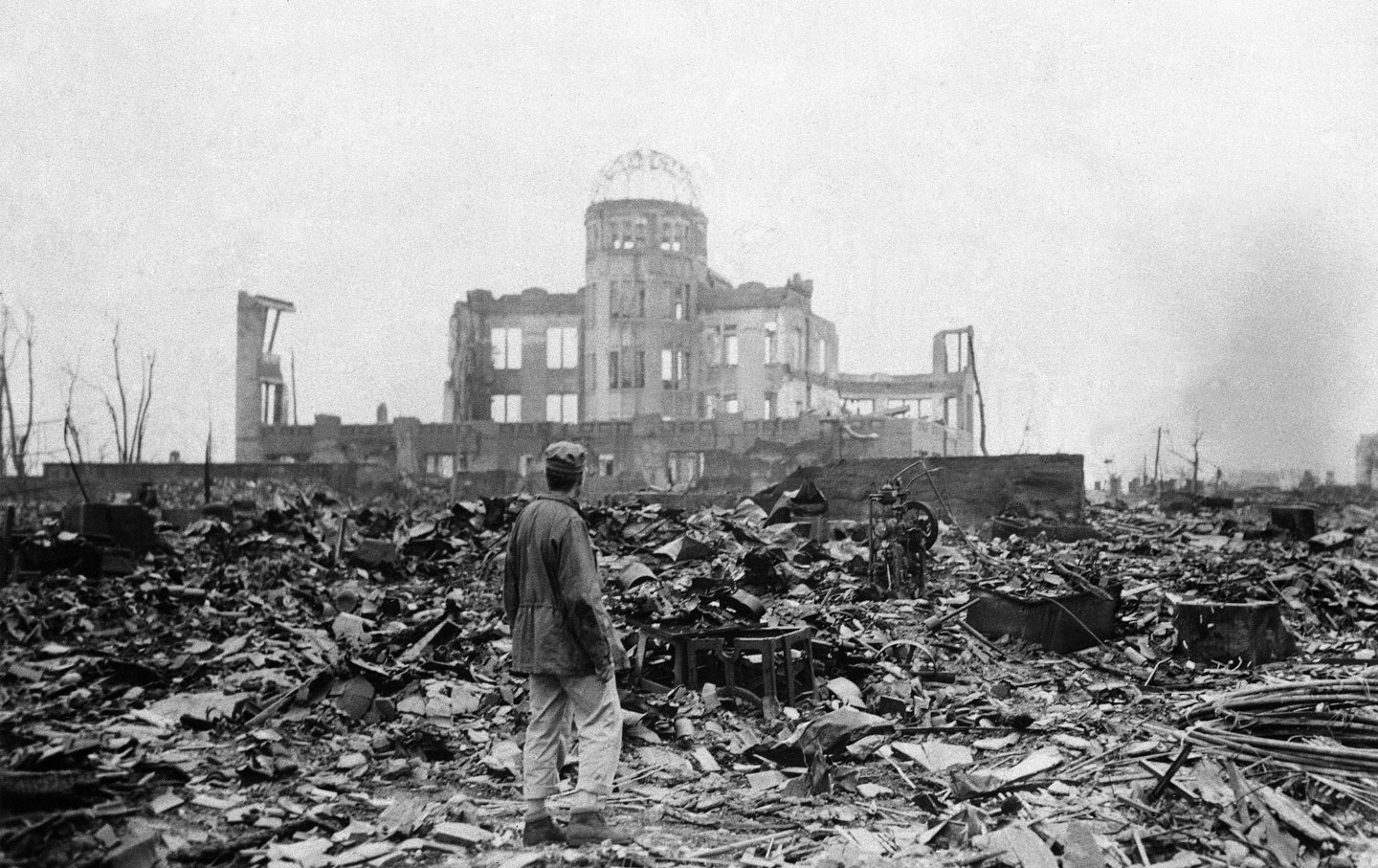
Americans have been killing civilians since before there was a United States. At home and abroad, civilians — Pequots, African Americans, Cheyenne and Arapaho, Filipinos, Haitians, Japanese, Germans, Koreans, Vietnamese, Cambodians, Laotians, Afghans, Iraqis, Syrians, Yemenis, and Somalis, among others — have been shot, burned, and bombed to death. The slaughter at Sand Creek, the Bud Dajo massacre, the firebombing of Dresden, the atomic bombing of Hiroshima, the My Lai massacre — the United States has done what it can to sweep it all under the rug through denial, cover-ups, and the most effective means of all: forgetting.

There’s little hope of Americans ever truly coming to terms with the Pequot or Haitian or Vietnamese blood on their hands. But before the forever wars slip from the news and the dead slide into the memory hole that holds several centuries worth of corpses, it’s worth spending a few minutes thinking about Zemari Ahmadi, Benyamin, Hayat, Malika, Somaya, and all the civilians who were going about their lives until the U.S. military ended them.

Names Remembered and Names Forgotten

Over the last 20 years, the United States has conducted more than 93,300 air strikes — in Afghanistan, Iraq, Libya, Pakistan, Somalia, Syria and Yemen — that killed between 22,679 and 48,308 civilians, according to figures recently released by Airwars, a U.K.-based airstrike monitoring group. The total number of civilians who have died from direct violence in America’s wars since 9/11 tops out at 364,000 to 387,000, according to Brown University’s Costs of War Project.

Who were those nearly 400,000 people?

There’s Malana. In 2019, at age 25, she had just given birth to a son, when her health began to deteriorate. Her relatives were driving her to a clinic in Afghanistan’s Khost Province when their vehicle was attacked by a U.S. drone, killing Malana and four others.

And Gul Mudin. He was wounded by a grenade and shot with a rifle, one of at least three civilians murdered by a U.S. Army “kill team” in Kandahar Province in 2010.

Then there was Gulalai, one of seven people, including three women — two of them pregnant — who were shot and killed in a Feb. 12, 2010, raid by Special Operations forces in Afghanistan’s Paktia Province.

And the four members of the Razzo family — Mayada, Tuqa, Mohannad, and Najib — killed in a Sept. 20, 2015, airstrike in Mosul, Iraq.

And there were the eight men, three women, and four children — Abdul Rashid as well as Abdul Rahman, Asadullah, Hayatullah, Mohamadullah, Osman, Tahira, Nadia, Khatima, Jundullah, Soheil, Amir, and two men, ages 25 and 36 respectively, named Abdul Waheed — who were killed in a Sept. 7, 2013, drone strike on Rashid’s red Toyota pickup in Afghanistan.

Then there were 22-year-old Lul Dahir Mohamed and her 4-year-old daughter, Mariam Shilo Muse, who were killed in an April 1, 2018, airstrike in Somalia.

And between 2013 and 2020, in seven separate U.S. attacks in Yemen — six drone strikes and one raid — 36 members of the al Ameri and al Taisy families were slaughtered.

Those names we know. Or knew, if only barely and fleetingly. Then there are the countless anonymous victims like the three civilians in a blue Kia van killed by Marines in Iraq in 2003. “Two bodies were slumped over in the front seats; they were men in street clothes and had no weapons that I could see. In the back seat, a woman in a black chador had fallen to the floor; she was dead, too,” wrote Peter Maass in The New York Times Magazine in 2003. Years later, at The Intercept, he painted an even more vivid picture of the “blue van, with its tires shot out and its windows shattered by bullets, its interior stained with blood and smelling of death, with flies feasting on already-rotting flesh.”

Those three civilians in Iraq were all too typical of the many anonymous dead of this country’s forever wars — the man shot for carrying a flashlight in an “offensive” manner; the children killed by an “errant” rocket; the man slain by “warning shots”; the three women and one man “machine-gunned” to death; and the men, women and children reduced to “charred meat” in an American bombing.

Who were the 11 Afghans — four of them children — who died in a 2004 helicopter attack, or the “dozen or more” civilians killed in 2010 during a nighttime raid by U.S. troops in that same country? And what about those 30 pine-nut farm workers slaughtered a year later by a drone strike there? And what were the names of Mohanned Tadfi’s mother, brother, sister-in-law, and seven nieces and nephews killed in the U.S. bombing that flattened the city of Raqqa, Syria, in 2017?

Often, the U.S. military had no idea whom they were killing. It frequently carried out “signature strikes” that executed unknown people due to suspicious behavior. So often, Americans killed such individuals for little or no reason — like holding a weapon in places where, as in this country, firearms were ubiquitous — and then counted them as enemy dead.

An investigation by Connecting Vets found that during a 2019 air campaign in Afghanistan’s Helmand province, for example, the threshold for an attack “could be met by as little as a person using or even touching a radio” or if an Afghan carrying “commercially bought two-way radios stepped into a home, the entire building would sometimes be leveled by a drone strike.”

Targeted assassinations were equally imprecise. Secret documents obtained by The Intercept revealed that, during a five-month stretch of Operation Haymaker — a drone campaign in 2011 and 2013 aimed at al-Qaeda and Taliban leaders along the Afghan-Pakistan border — 200 people were killed in airstrikes conducted to assassinate 35 high-value targets. In other words, nearly nine out of 10 people slain in those “targeted” killings were not the intended targets. So, who were they?

Even if targeting was ordinarily more accurate than during Operation Haymaker, U.S. policy has consistently adhered to the dictum that “military-age males” killed in airstrikes should automatically be classified as combatants unless proven innocent. In addition to killing people for spurious reasons, the U.S. also opted for allies who would prove at least as bad as, if not worse than, those they were fighting. For two decades, such American-taxpayer-funded warlords and militiamen murdered, raped, or shook-down the very people the U.S. government was supposedly protecting. And, of course, no one knows the names of all those killed by such allies who were being advised, trained, armed and funded by the United States.

Who, for instance, were the two men tied to the rear fender of a Toyota pickup truck in southeastern Afghanistan in 2012 by members of an Afghan militia backed by U.S. Special Operations forces? They were, wrote reporter Anand Gopal, dragged “along six miles of rock-studded road” until they were dead. Then their “bodies were left decomposing for days, a warning to anyone who thought of disobeying Azizullah,” the U.S.-allied local commander.

Or what about the 12 boys gunned down by CIA-backed militiamen at a madrassa in the Afghan village of Omar Khail? Or the six boys similarly slain at a school in nearby Dadow Khail? Or any of the dead from 10 raids in 2018 and 2019 by that same militia, which summarily executed at least 51 civilians, including boys as young as eight years old, few of whom, wrote reporter Andrew Quilty, appeared “to have had any formal relationship with the Taliban”?

How many reporters’ notebooks are filled with the unpublished names of just such victims? Or counts of those killed? Or the stories of their deaths? And how many of those who were murdered never received even a mention in an article anywhere?

Last year, I wrote 4,500 words for The New York Times Magazine about the deteriorating situation in Burkina Faso. As I noted then, that nation was one of the largest recipients of American security aid in West Africa, even though the State Department admitted that U.S.-backed forces were implicated in a litany of human-rights abuses, including extrajudicial killings.

What never made it into the piece was any mention of three men who were executed in two separate attacks. On May 22, 2019, uniformed Burkinabe troops arrived in the village of Konga and took two brothers, aged 38 and 25, away in the middle of the night. The next day, a relative found them on the side of the road, bound and executed. Most of the family fled the area. “The Army came back a week later,” a relative told me. “My uncle was the only one in our family who stayed. He was shot in broad daylight.” Such deaths are ubiquitous but aren’t even factored into the 360,000-plus civilian deaths counted by the Costs of War project, which offers no estimate for those killed in America’s “smaller war zones.”

Build the Wall!

We live in a world filled with monuments celebrating lives and deaths, trailblazers and memorable events, heroes and villains. They run the gamut from civil rights leader Martin Luther King, Jr., and women’s rights pioneers to the chieftains of the American Confederacy and Belgium’s King Leopold.

In the United States, there’s no shortage of memorials and monuments commemorating America’s wars and fallen soldiers. One of the most poignant lists the names of the American military dead of the Vietnam War. Initially derided by hawkish veterans and conservatives as a “black gash of shame” and a “nihilistic slab,” it’s now one of the most celebrated monuments in Washington, D.C. More than 58,000 men and women are represented on the visually arresting black granite walls of the Vietnam Veterans Memorial.

Vietnam itself has no shortage of monuments of its own. Many are Soviet-style memorials to those who died defeating the United States and reuniting their country. Others are seldom-seen, tiny memorials to massacres perpetrated by the Americans and their allies. No one knows how many similar cenotaphs exist in Iraq, Syria, Yemen, and other forever-war countries, but in 2017, journalist Emran Feroz found just such a memorial in Afghanistan’s Wardak Province — a remembrance of five civilians slain in drone strikes during 2013 and 2014.

There have been other attempts to memorialize the civilian dead of the forever wars from art installations to innovative visual protests to virtual commemorations.

In 2018, after then-President Trump signed a bill approving the construction of a Global War on Terrorism Memorial, Peter Maass proposed, even if only half-seriously, that the bullet-riddled blue Kia van he saw in Iraq should be placed on a pedestal on the National Mall. “If we start building monuments that focus our attention on the pitiless killing of civilians in our wars,” he wrote, “maybe we would have fewer wars to fight and less reason to build these monuments.”

A blue Kia on the National Mall would be a good starting point. But if we’re ever to grasp the meaning of the post-9/11 wars and all the conflicts that set the stage for them, however, we may need a wall as well — one that starts at the Kia and heads west. It would, of course, be immense. The Vietnam Veterans Memorial spans a total of 400 feet. The celebrated Vietnam War photographer Philip Jones Griffiths observed that a wall for the Vietnamese dead, counting combatants, of the American War would be nine miles long.

The Vietnam Veterans Memorial is arrayed in a unique chronological format, but the Civilian Deaths Memorial could begin with anyone. The last civilians killed by the United States as part of its 2001 to 2021 Afghan War – Zemari Ahmadi, Zamir, Faisal, Farzad, Naser, Arwin, Benyamin, Hayat, Malika, and Somaya – could lead it off. Then maybe Abdul Rashid and the 14 passengers from his red pick-up truck. Then Malana, Gul Mudin, Gul Rahim, Gulalai, Mayada, Tuqa, Mohannad, Najib, Lul Dahir Mohamed, and Mariam Shilo Muse. Then maybe Ngo Thi Sau, Cao Muoi, Cao Thi Thong, Tran Cong Chau Em, Nguyen Thi Nhi, Cao Thi Tu, Le Thi Chuyen, Dang Thi Doi, Ngo Thi Chiec, Tran Thi Song, Nguyen Thi Mot, Nguyen Thi Hai, Nguyen Thi Ba, Nguyen Thi Bon, Ho Thi Tho, Vo Thi Hoan, Pham Thi Sau, Dinh Van Xuan, Dinh Van Ba, Tran Cong Viet, Nguyen Thi Nham, Ngo Quang Duong, Duong Thi Hien, Pham Thi Kha, Huynh Van Binh, Huynh Thi Bay, Huynh Thi Ty, Le Van Van, Le Thi Trinh, Le Thi Duong, and Le Vo Danh and her unborn child, all slaughtered in the tiny South Vietnamese village of Phi Phu by U.S. troops (without any of the attention accorded to the My Lai massacre). They could be followed by the names of, or placeholders for, the remaining 2 million Vietnamese civilian dead and by countless Cambodians, Laotians, Afghans, Iraqis, Somalis and Yemenis.

The Civilian Wall could be built in a zig-zag fashion across the U.S. with the land in its way — homes and businesses, parks and roadways — seized by eminent domain, making Americans care about civilian deaths in ways that news articles never could.

When you lose your home to a slab of granite that reads “Pequot adult, Pequot adult, Pequot child…” 500 times, you may actually take notice. When you hear about renewed attacks in Iraq or drone strikes in Somalia or a Navy SEAL raid gone awry in Yemen and worry that the path of the wall might soon turn toward your town, you’re likely to pay far more attention to America’s conflicts abroad.

Obviously, a westward-traveling wall memorializing civilian carnage is a non-starter in this country, but the next time you hear some fleeting murmur about a family wiped out by a drone strike or read a passing news story about killings by a U.S.-backed militia, think about that imaginary wall and how, in a just world, it might be headed in your direction. In the meantime, perhaps the best we can hope for is Maass’s proposal for that blue Kia on the Mall. Perhaps it could be accompanied by the inscription found on a granite slab at the Heidefriedhof, a cemetery in Dresden, Germany, the site of a mass grave for civilians killed in a 1945 U.S. and British fire-bombing. It begins: “How many died? Who knows the number?”

Nick Turse is the managing editor of TomDispatch and a fellow at the Type Media Center. He is the author most recently of Next Time They’ll Come to Count the Dead: War and Survival in South Sudan and of the bestselling Kill Anything That Moves.

2018-05-14

Killing Gaza

by Chris Hedges
Truthdig

WASHINGTON, D.C.--Israel’s blockade of Gaza--where trapped Palestinians for the past seven weeks have held nonviolent protests along the border fence with Israel, resulting in more than 50 killed and 700 wounded by Israeli troops--is one of the world’s worst humanitarian disasters. Yet the horror that is Gaza, where 2 million people live under an Israeli siege without adequate food, housing, work, water and electricity, where the Israeli military routinely uses indiscriminate and disproportionate violence to wound and murder, and where almost no one can escape, is rarely documented. Max Blumenthal and Dan Cohen’s powerful new film, “Killing Gaza,” offers an unflinching and moving portrait of a people largely abandoned by the outside world, struggling to endure.

“Killing Gaza” will be released Tuesday, to coincide with what Palestinians call Nakba Day--“nakba” means catastrophe in Arabic--commemorating the 70th anniversary of the forced removal of some 750,000 Palestinians in 1948 by the Haganah, Jewish paramilitary forces, from their homes in modern-day Israel. The release of the documentary also coincides with the Trump administration’s opening of the new U.S. Embassy in Jerusalem.

● Starting Tuesday, May 15, “Killing Gaza” can be seen at Vimeo On Demand.
Because of Nakba Day and the anger over the transfer of the embassy to Jerusalem, this week is expected to be one of the bloodiest of the seven-week-long protest that Palestinians call the “Great Return March.” “Killing Gaza” illustrates why Palestinians, with little left to lose, are rising up by the thousands and risking their lives to return to their ancestral homes--70 percent of those in Gaza are refugees or the descendants of refugees--and be treated like human beings.


Cohen and Blumenthal, who is the author of the book “Goliath: Life and Loathing in Greater Israel,” one of the best accounts of modern Israel, began filming the documentary Aug. 15, 2014. Palestinian militias, armed with little more than light weapons, had just faced Israeli tanks, artillery, fighter jets, infantry units and missiles in a 51-day Israeli assault that left 2,314 Palestinians dead and 17,125 injured. Some 500,000 Palestinians were displaced and about 100,000 homes were destroyed. The 2014 assault, perhaps better described as a massacre, was one of eight massacres that Israel has carried out since 2004 against the 2 million Palestinians in Gaza, over half of whom are children. Israel, which refers to these periodic military assaults as “mowing the lawn,” seeks to make existence in Gaza so difficult that mere survival consumes most of the average Palestinian’s time, resources and energy.

The film begins in the Shuja’iyya neighborhood, reduced to mounds of rubble by the Israelis. The wanton destruction of whole neighborhoods was, as documented by the film, accompanied by the shooting of unarmed civilians by Israeli snipers and other soldiers of that nation.

“Much of the destruction took place in the course of a few hours on July 23,” Blumenthal, who narrates the film, says as destroyed buildings appear on the screen, block after block. “The invading Israeli forces found themselves under ferocious fire from local resistance forces, enduring unexpectedly high casualties. As the Israeli infantry fled in full retreat, they called in an artillery and air assault, killing at least 120 Palestinian civilians and obliterated thousands of homes.”

The film includes a brief clip of young Israelis in Tel Aviv celebrating the assault on Gaza, a reminder that toxic racism and militarism infect Israeli society.

“Die! Die! Bye!” laughing teenage girls shout at the celebration in Tel Aviv. “Bye, Palestine!”

“Fucking Arabs! Fuck Muhammad!” a young man yells.

“Gaza is a graveyard! Gaza is a graveyard! Ole, ole, ole, ole,” the crowd in Tel Aviv sings as it dances in jubilation. “There is no school tomorrow! There are no children left in Gaza!”

Terrified Palestinian families huddled inside their homes during the relentless shelling. Those who tried to escape in the face of the advancing Israelis often were gunned down with their hands in the air, and the bodies were left to rot in the scorching heat for days.

“I was inside when they started bulldozing my house,” Nasser Shamaly, a Shuja’iyya resident, says in the film. “They took down the wall and started shooting into the house. So I put my hands on my head and surrendered myself to the officer. This wasn’t just any soldier. He was the officer of the group! He didn’t say a word. He just shot me. I fell down and started crawling to get away from them.”

Shamaly, who hid wounded in his house for four days, was fortunate. His 23-year-old cousin, Salem Shamaly, who led a group of volunteers from the International Solidarity Movement to dig bodies out of the ruins in Shuja’iyya, was not.

“On the offensive’s 14th day, July 20th, 2014, four other activists and I went to the Shuja’iyya neighborhood, which Israel had bombed for days, to accompany rescue teams in the rubble during the two-hour cease-fire,” Joe Catron, one of the members of the International Solidarity Movement rescue team, says in the film. “A young Palestinian, whose name we later learned was Salem Shamaly, asked us to go with him to his house, where he hoped to find his family. It sounds ridiculous now, but at the time we thought the cease-fire would make it safe.”

“As we crossed an alley with a clear line of sight to Israeli positions by the separation barrier, a gunshot from their direction struck the ground between us. We scattered into two groups, sheltered behind buildings on either side. After a pause, Salem stepped into the alley, hoping to lead his group to our side, but was struck by another bullet. He fell to the ground.”

The film shows Shamaly wounded on the ground, barely able to move and crying out in pain.

“As he lay on his back, two more rounds hit him,” Catron continued. “He stopped moving. The gunfire kept us from reaching him. The Israeli artillery began flying overhead and striking the buildings behind us. We were forced to retreat, leaving him. We only learned his name two days later, when his mother, father, sister and cousin recognized him in a video I had tweeted.”

“We couldn’t retrieve his body for seven days,” Um Salem, the mother, says in the film. “His body was in the sun for seven days.”

Waseem Shamaly, Salem’s brother, who appears to be about 8 years old, is shown with his eyes swollen from crying. “He would take care of us, like our father,” the boy says. “Even at night, he would get us whatever we wanted. He used to buy us everything. Whatever we wished for, he would buy it. There was nothing he wouldn’t buy for us. He used to take us to hang out. He’d take us out with him just to kill our boredom a little.”

Waseem wipes his eyes.

“Now he is gone,” he continues weakly. “There is nobody to take us out and buy us treats.”

“This boy hasn’t been able to handle losing his brother,” says the father, Khalil Shamaly. “He couldn’t handle the news, seeing the way his brother died. He is in shock. It gets to the point where he goes lifeless. He collapses. When I pick him up he tells me his dying wishes. His dying wishes! As if he is leaving us. He is so young. But he gives us his dying wishes. If it weren’t for God’s mercy, I would have lost him too.”

“Destroyed cities and shattered homes can be rebuilt if the resources are there,” Blumenthal says. “But what about the survivors? How can they heal the scars imposed on their psyches? The youth of Gaza has grown up through three wars, each more devastating than the last. At least 90 percent of adolescents in Gaza suffer from post-traumatic stress disorder. With mental health services pushed to the brink, these unseen scars may never heal.”

The film turns to the town of Khuza’a, a farming community with 20,000 people, which was systematically blown up by Israel after three Israeli soldiers were killed in fighting with the al-Qassam Brigades, the armed wing of the ruling Hamas government in Gaza. The film shows a video from inside an Israeli tank as soldiers wait for explosives to bring down buildings in the town, including the mosque. When the explosions occur, the Israeli soldiers cheer and shout, “Long live the state of Israel!”

“We were shocked to see so many bodies in the streets,” Ahmed Awwad, a volunteer with the Palestinian Red Crescent, says in the film about Khuza’a. “Many were decomposing. We wanted to deal with it, but we didn’t know how. Once, when the Israelis let us in with our ambulance, we found about 10 corpses from different areas, scattered. As you approached a body, of course there is the odor, and there are worms. Hold it like this, and flesh comes off. Lift an arm and it pulls right off. We didn’t know what to do. There was nothing we could do. We had to stop. It would have been easier just to bury them. But we figured families would want the bodies. Bulldozers eventually loaded the bodies in trucks. We couldn’t pick up these bodies on our own. Most were executions, like an old lady at her front door. There was a young man, another man, and a little kid. The scenes, to be honest, were very ugly.”

The Rjeila family, including 16-year-old Ghadeer, who was physically disabled, attempts to escape the shelling. As a brother frantically pushes Ghadeer in her wheelchair (the scene, like several others in the film, is reconstructed through animation), the Israelis open fire. The brother is wounded. Ghadeer is killed.

The camera pans slowly through demolished houses containing blackened human remains. Walls and floors are smeared with blood.

Ahmed Awwad, a Palestinian Red Crescent volunteer, describes what happened after he and other volunteers finally receive permission from Israeli forces to retrieve bodies from Khuza’a. They find a man tied to a tree and shot in both legs. One of the volunteers, Mohammed al-Abadla, gets out of a vehicle and approaches the tree. When he switches on his flashlight, which the Israelis had instructed him to do, he is shot in heart and killed.

“For 51 days, Israel bombarded Gaza with the full might of its artillery,” Blumenthal says. “According to the Israeli military’s estimates, 23,410 artillery shells and 2.9 million bullets were fired into Gaza during the war.”

That’s one and a half bullets for every man, woman and child in the Gaza Strip.

There is footage of Israeli soldiers in an artillery unit writing messages, including “Happy Birthday to Me,” on shells being lobbed into Gaza. The soldiers laugh and eat sushi as they pound Palestinian neighborhoods with explosives.

Rafah is a city in Gaza on the border of Egypt. The film makes it clear that Egypt, through its sealing of Gaza’s southern border, is complicit in the blockade. Rafah was one of the first cities targeted by the Israelis. When Israeli troops took over buildings, they also kidnapped Palestinians and used them as human shields there and elsewhere, forcing them to stand at windows as the soldiers fired from behind.

“They blindfolded and handcuffed me and took me inside,” Mahmoud Abu Said says in the film. “They told me to come with them and put a M16 to my back. There were maybe six of them. They dropped their equipment and began searching. They started hitting me against the wall. And then sicced their dogs on me while I was handcuffed.”

“They put me here,” he says, standing in front of a window, “and stood behind me. Israeli soldiers placed me here while they stood behind me shooting. They took me to that window and that window too. Then they hit me against the wall and pushed me down. They put a mattress here,” he says, showing holes punched through the wall at floor level, “and sat down to shoot through these holes.”

“You see that car?” asks Suleiman Zghreibv, referring to a hunk of twisted metal that lies next to the ruins of his house. “He drove it,” he says of his 22-year-old son, who was executed by the Israelis. “This is the car we used to make our living. It wasn’t for personal use. It was a taxi. I can’t describe the suffering. What can I say? Words can’t express the pain. We have suffered and resisted for so long. We’ve been suffering our whole lives. We’ve suffered for the past 60 years because of Israel. War after war after war. Bombing after bombing after bombing. You build a house. They destroy it. You raise a child. They kill him. Whatever they do--the United States, Israel, the whole world, we’ll keep resisting until the last one of us dies.”

Israel intentionally targeted power plants, schools, medical clinics, apartment complexes, whole villages. Robert Piper, the United Nations Coordinator for Humanitarian Aid and Development Activities, said in 2017 that Gaza had “a long time ago” passed the “unlivability threshold.” Youth unemployment is at 60 percent. Suicide is epidemic. Traditional social structures and mores are fracturing, with divorce rising from 2 percent to 40 percent and girls and women increasingly being prostituted, something once seen only rarely in Gaza. Seventy percent of the 2 million Gazans survive on humanitarian aid packages of sugar, rice, milk and cooking oil. The U.N. estimates that 97 percent of Gaza’s water is contaminated. Israel’s destruction of Gaza’s sewage treatment plant means raw sewage is pumped into the sea, contaminating the beach, one of the very few respites for a trapped population. The Israelis did not even spare Gaza’s little zoo, slaughtering some 45 animals in the 2014 assault.

“I liked the monkeys best,” says a forlorn Ali Qasem, who worked at the zoo. “We laughed with them the most. We would laugh and play with them. They would take food right from your hand. They’d respond the most. There is a heavy feeling of sorrow. I used to spend 18 hours a day here. I was here all the time. I’d go home for five or six hours, then come back. I worked here as a volunteer. A few volunteers built this place little by little. We were excited to finish and invite visitors for free. To me, it was like humans were killed. It’s not OK because they were animals. It’s as if they were human beings, people we know. We used to bring them food from our homes.”

The film shows Palestinians, who have received little reconstruction aid despite pledges by international donors, camping out amid the ruins of homes, gathered around small fires for heat and light. Moeen Abu Kheysi, 54, gives a tour of the smashed house he had spent his life constructing for his family. He stops when he comes upon his 3-month-old grandson, Wadie. His face lights up in delight.

“Months passed and the cold rains of winter gave way to baking heat of spring,” Blumenthal says. “In Shuja’iyya, the Abu Kheysi family was still living in remnants of their home, but without their newest member. Born during the war, little Wadie did not make it through the harsh winter.”

“He was born during the war and he died during the war, well after the war,” a female member of the family explains. “He lived in a room without a wall. We covered the wall with tin sheets. We moved, but then we got kicked out. We couldn’t make rent. [We] had to come back, cover the wall and live here. Then the baby froze to death. It was very cold.”

“One day it suddenly became very cold,” Wadie’s mother says. “Wadie woke up at 9 in the morning. I started playing with him, gave him a bottle. Suddenly, he was shivering from the cold. I tried to warm him up but it wasn’t working.”

She begins to weep.

“There wasn’t even time to get to the hospital,” she says. “He stopped breathing before they left the house. His heart stopped beating instantly. His father started running in the street with him. He fainted when they yelled, “The baby is dead!” The baby’s uncle took over and carried him. He looked everywhere for a taxi but couldn’t find one. We couldn’t give him first aid ourselves. They finally found a car. They did all they could at the hospital, but he never woke up. He was dead. What can I say? We remember him all the time. I can’t get him off my mind. It’s as if I lost a piece of my heart. His sisters want to sleep in his cradle and wear his clothes. This one always asks to wear her brother’s clothes. We can’t forget him.”

“Grandpa!” Wadie’s small sister cries out. “Mama is crying again.”

2018-05-12

The Heartbreaking Reason This Palestinian Joined the Gaza Border Protests

by Gideon Levy
Haaretz

A young father of two is hospitalized with serious injuries after being shot by Israeli soldiers during a Gaza border rally. In 2014, the IDF destroyed his home, and he was left with nothing.

The full scale of the harrowing despair of the Gaza Strip is embodied in a haggard young man in the surgical ward on the third floor of Al-Ahli Hospital in Hebron. Two rounds fired by Israel Defense Forces snipers left him seriously wounded, internal organs blown apart, his right leg shattered. Only his mother is by his side in this narrow room, which is starkly empty apart from the old hospital bed he’s lying in, and a fake leather sofa that’s even older and more tattered. There’s no television set, no radio, no one comes to visit, there’s no place to move around, and he has no money to buy a cup of coffee in the cafeteria.

The patient is Ibrahim al-Masri, one of the hundreds who have suffered serious wounds in the Gaza demonstrations of the past month, and one of the very few who has been allowed to undergo medical treatment in the West Bank. Indeed, he is the only Gaza resident hospitalized in Hebron.

Alone, distraught, penniless, now also disabled -- Masri has no chance in life. The despair in Hebron isn’t any easier to bear, and he’s already waiting to return to Gaza, which is utterly indifferent to him. A visit to him is like a descent into hell.

Twenty-three years old, he’s married to Faiza and the father of a 3-year-old daughter, Lama, and a son of 9 months, Sami. A young couple plus two in the Gaza Strip 2018, without a home and without a job, now also with a disabled husband and father. Rehab, his mother, is the only person whom Israel allowed to leave the cage of Gaza with him; now the two are imprisoned in this cramped room, where no one comes to visit or offer support.

Masri says he hardly speaks with his children by phone: The little one is just a baby and he has nothing to say to the 3 year-old. “What will I tell her? That our life has been destroyed?” When she saw him in serious condition in the Indonesia Hospital in Sheikh Ziyad in Gaza, where he was taken originally, she was badly frightened, ran to her mother’s arms and cried until they left.

ion has improved, he says now. According to his doctors, he will be able to return to Gaza in another week or so. Where will he undergo rehabilitation? No one knows. Masri has also been told that it will take time before he can walk and get around, in general. He would like to return to Gaza for a few days, because he and his mother have run out of money and he has no change of clothing, and in Hebron everything is expensive. But it’s very unlikely that Israel will allow him to return to the West Bank again after his release.

They arrived here with 250 shekels ($70), which neighbors loaned them, and nothing remains. Masri is sorry now that he went to demonstrate. His mother says he did it in order to vent his anger. He corrects her: “What did it help? So many young people have become cripples, and no one cares.”

2018-02-09

Like a Safari: Israeli Troops in Jeeps Hunt a Palestinian Teen and Shoot Him in the Head

by Gideon Levy
Haaretz

The killing field of young Laith Abu Naim is an empty lot in the remote village of Al-Mughayyir, north of Ramallah. Someone once planned to build a house here, but got no further than iron rods and a retaining wall. The boy ran for his life between the rods, pursued by two armored Israel Defense Forces jeeps. The chase ended when the door of one of the vehicles opened and a soldier aimed his rifle straight at Laith’s forehead from a range of 20 meters. He fired one bullet, killing the teen ? the same way an animal is hunted down and bagged on a safari.

A 16-year-old boy who dreamed of becoming a soccer goalie threw stones at a jeep and suffered the punishment of execution at the hands of a soldier, perhaps to teach him a lesson, perhaps as revenge. The rubber-coated steel bullet struck the exact spot it was aimed at ? the boy’s forehead, above his left eye ? and had the anticipated result: Laith fell to the ground and died shortly afterward. The outstanding IDF sniper could have aimed at his legs, used tear gas, or tried to stop him in other ways. But he chose, in what seems to be an almost standard pattern in recent weeks in this area, to fire a round directly at the head.

That’s how soldiers shot two young men named Mohammed Tamimi, one from Nabi Saleh, the other from Aboud, wounding both youngsters seriously. The latter is still hospitalized in grave condition in a Ramallah hospital; the former, part of his skull missing, is recovering at home.

Laith Abu Naim now lies in the ground in his village’s cemetery.

MORE...

2018-01-21

The Firebombing of Tokyo

by Rory Fanning
Jacobin
Originally published 2015.3.9

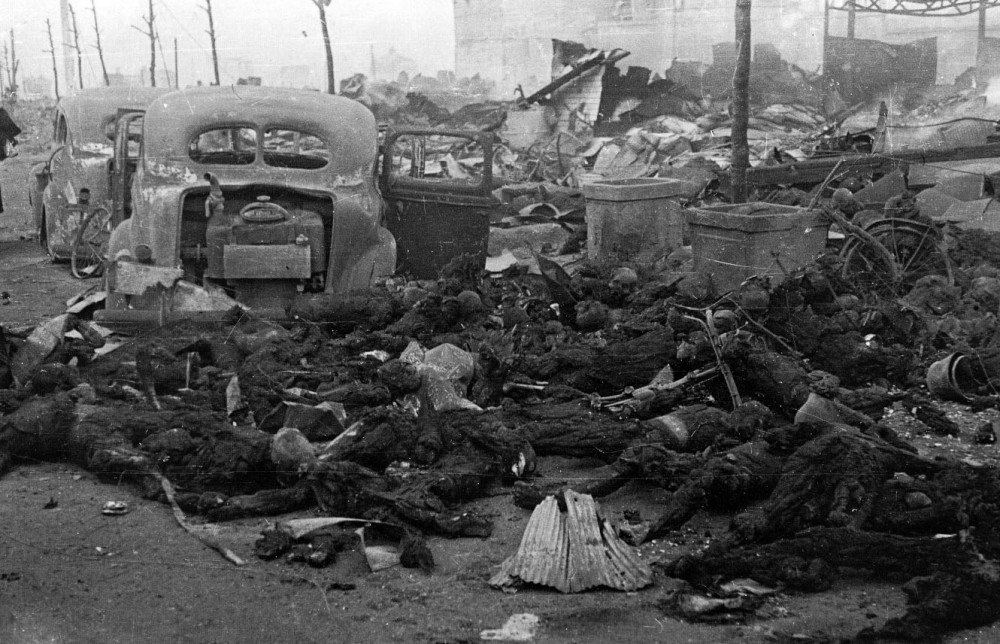
Today marks the seventieth anniversary of the American firebombing of Tokyo, World War II’s deadliest day. More people died that night from napalm bombs than in the atomic strikes on Hiroshima and Nagasaki. But few in the United States are aware that the attack even took place.

The lack of ceremonies or official state apologies for the firebombing is unsurprising considering that many Americans see World War II as the “just war” fought by the “greatest generation.” These labels leave the war and the atrocities Americans committed during it largely untouched by critique.

The little that is available to study on the firebombing, at least here in the US, is told from the perspective of American crewmen and brass, through usually biased American military historians. Those seeking better understanding of the March 9 tragedy must wade through reams of history primarily devoted to strategy; the heroics of American soldiers; the awesome power behind the bombs unleashed that day; and a cult-like devotion to the B-29 Superfortress, the plane that dropped the napalm over Tokyo and the atomic bombs, and was the inspiration for George Lucas’s Millennium Falcon.

The overriding narrative surrounding the events of March 9, 1945 is that the American pilots and military strategists such as Gen. Curtis LeMay, the architect of the firebombing, had no other option but to carry out the mission. The Americans had “no choice” but to burn to death nearly one hundred thousand Japanese civilians.

MORE...

2017-03-06

Noam Chomsky, from an interview at the University of Arizona on February 2, 2017.

from Information Clearing House

INTERVIEWER: "Let us turn to the role of the media in reporting alleged Russian interference in the US electoral process. Mainstream journalists have called Trump a puppet of Russia, a modern version of the Manchurian Candidate. Others have criticized the media for accepting unsubstantiated claims about Russian influence, and reporting such claims as facts. Normon Soloman and Serge Halimi, for example, stated that press reporting on this issue amounts to a mass hysteria reminiscent of the McCarthy era, while Seymour Hersh called the media reporting on Russia “outrageous.”3 What is your view of this situation? "

CHOMSKY: "My guess is that most of the world is just collapsing in laughter. Suppose all the charges are true, I mean every single one, it is so amateurish by US standards that you can hardly even laugh. What the US does is the kind of thing I described in Italy in 1948. Case after case like that, not hacking or spreading rumors in the media; but saying look, we’re going to starve you to death or kill you or destroy you unless you vote the way we want. I mean that’s what we do.

"Take the famous 9/11, let’s think about it for a minute. It was a pretty awful terrorist act. It could have been a lot worse. Now let’s suppose that instead of the plane being downed in Pennsylvania by passengers, suppose it had hit its target, which was probably the White House. Now suppose it had killed the president. Suppose that plans had been set for a military coup to take over the government. And right away, immediately 50,000 people were killed, 700,000 tortured. A bunch of economists were brought in from Afghanistan, let’s call them the “Kandahar Boys,” who very quickly destroyed the economy, and established a dictatorship which devastated the country. That would have been a lot worse than 9/11. It happened: the first 9/11, it happened on September 11, 1973, in Chile. We did it. Was that interfering or hacking a party? This record is all over the world, constantly overthrowing governments, invading, forcing people to follow what we call democracy, as in the cases I mentioned. As I say, if every charge is accurate, it’s a joke, and I’m sure half the world is collapsing in laughter about this, because people outside the United States know it. You don’t have to tell people in Chile about the first 9/11."

2016-09-29

Shimon Peres was no peacemaker. I’ll never forget the sight of pouring blood and burning bodies at Qana

by Robert Fisk
The Independent

Peres said the massacre came as a ‘bitter surprise’. It was a lie: the UN had repeatedly told Israel the camp was packed with refugees

When the world heard that Shimon Peres had died, it shouted “Peacemaker!” But when I heard that Peres was dead, I thought of blood and fire and slaughter.

I saw the results: babies torn apart, shrieking refugees, smouldering bodies. It was a place called Qana and most of the 106 bodies ? half of them children ? now lie beneath the UN camp where they were torn to pieces by Israeli shells in 1996. I had been on a UN aid convoy just outside the south Lebanese village. Those shells swished right over our heads and into the refugees packed below us. It lasted for 17 minutes.

Shimon Peres, standing for election as Israel’s prime minister ? a post he inherited when his predecessor Yitzhak Rabin was assassinated ? decided to increase his military credentials before polling day by assaulting Lebanon. The joint Nobel Peace Prize holder used as an excuse the firing of Katyusha rockets over the Lebanese border by the Hezbollah. In fact, their rockets were retaliation for the killing of a small Lebanese boy by a booby-trap bomb they suspected had been left by an Israeli patrol. It mattered not.

A few days later, Israeli troops inside Lebanon came under attack close to Qana and retaliated by opening fire into the village. Their first shells hit a cemetery used by Hezbollah; the rest flew directly into the UN Fijian army camp where hundreds of civilians were sheltering. Peres announced that “we did not know that several hundred people were concentrated in that camp. It came to us as a bitter surprise.”

It was a lie. The Israelis had occupied Qana for years after their 1982 invasion, they had video film of the camp, they were even flying a drone over the camp during the 1996 massacre ? a fact they denied until a UN soldier gave me his video of the drone, frames from which we published in The Independent. The UN had repeatedly told Israel that the camp was packed with refugees.

This was Peres’s contribution to Lebanese peace. He lost the election and probably never thought much more about Qana. But I never forgot it.

When I reached the UN gates, blood was pouring through them in torrents. I could smell it. It washed over our shoes and stuck to them like glue. There were legs and arms, babies without heads, old men’s heads without bodies. A man’s body was hanging in two pieces in a burning tree. What was left of him was on fire.

On the steps of the barracks, a girl sat holding a man with grey hair, her arm round his shoulder, rocking the corpse back and forth in her arms. His eyes were staring at her. She was keening and weeping and crying, over and over: “My father, my father.” If she is still alive ? and there was to be another Qana massacre in the years to come, this time from the Israeli air force ? I doubt if the word “peacemaker” will be crossing her lips.

There was a UN enquiry which stated in its bland way that it did not believe the slaughter was an accident. The UN report was accused of being anti-Semitic. Much later, a brave Israeli magazine published an interview with the artillery soldiers who fired at Qana. An officer had referred to the villagers as “just a bunch of Arabs” (‘arabushim’ in Hebrew). “A few Arabushim die, there is no harm in that,” he was quoted as saying. Peres’s chief of staff was almost equally carefree: “I don’t know any other rules of the game, either for the [Israeli] army or for civilians…”

Peres called his Lebanese invasion “Operation Grapes of Wrath”, which ? if it wasn’t inspired by John Steinbeck ? must have come from the Book of Deuteronomy. “The sword without and terror within,” it says in Chapter 32, “shall destroy both the young man and the virgin, the suckling also with the man of grey hairs.” Could there be a better description of those 17 minutes at Qana?

Yes, of course, Peres changed in later years. They claimed that Ariel Sharon ? whose soldiers watched the massacre at Sabra and Chatila camps in 1982 by their Lebanese Christian allies ? was also a “peacemaker” when he died. At least he didn’t receive the Nobel Prize.

Peres later became an advocate of a “two state solution”, even as the Jewish colonies on Palestinian land ? which he once so fervently supported ? continued to grow.

Now we must call him a “peacemaker”. And count, if you can, how often the word “peace” is used in the Peres obituaries over the next few days. Then count how many times the word Qana appears.

2016-09-08

America's Murderous Legacy in Laos

The Real News Network

As Barack Obama becomes the first sitting U.S. president to visit Laos, The Real News brings you an interview with Fred Branfman, the man who first exposed America's secret bombing campaign there.


JAISAL NOOR, TRNN: As Barack Obama, the first sitting U.S. president to visit Laos, we replay a report that looks at the legacy of the US bombing in Laos. We bring you an interview with the man that exposed the massive secret US bombing of Laos.

FRED BRANFMAN: From the Deputy Chief of Mission to Laos testifying to the U.S. Senate Foreign Relations Committee--this is an exact quote--when he was asked why they quadrupled the bombing of northern Laos, he said, quote, Well, we had all those planes sitting around and couldn't just let them sit there with nothing to do. unquote.

BARACK OBAMA: For the people of Laos, obviously this war was no secret. Over the course of roughly a decade the United States dropped more bombs on Laos than Germany and Japan during World War II
 
NOOR: President Obama visited the Cope Center that works with victims of explosives left from the Vietnam War era, providing them with prosthetic limbs and takes part in unexploded ordnance clearing efforts.

OBAMA: 270 million cluster bomblets were dropped on this country. For the people of Laos, the war did not end when the bombs stopped falling. 80 million cluster munitions did not explode.

NOOR: Despite Obama's visit the United States remains one of the handful of countries that continue to manufacture and sell cluster bombs, to its allies such as Saudi Arabia which is currently using them in Yemen.

This report is from 2008.

PETER HERBY: A cluster munition is a canister which is fired from an aircraft or an artillery position which contains many small sub munitions, the small munitions, which then explode. And some of these canisters can contain as many as 650 of these small sub munitions.

REKHA VISWANATHAN: Seventy-eight million unexploded cluster bombs are scattered across Laos to this day, active reminders of the Vietnam War. From 1964 to 1973, the US illegally bombed the country as part of a secret war to disrupt Vietcong supply routes into Vietnam.

HERBY: In Laos, they have been everywhere at the time of the war, in the 1960s and '70s, in villages. And the place was basically uninhabitable because of the degree of weapons contamination and, mainly, cluster munition contamination.

VISWANATHAN: The Laos National Unexploded Ordinance Program, or UXO, says Laos has the distinction of being per capita the most heavily bombed nation in the world.

MENG JUNLAMANEE: I went to the paddy field to work. I started ploughing the field, not knowing there was a bomb there. I ploughed the soil, hit the bomb and it exploded. I didn't know there was a bomb underneath.

JA-LOR: I was pulling the weeds in the paddy field. The hoe hit the bomb, and it exploded.

EDWIN FAIGMANE: People know about the dangers about this UXO, about these cluster munitions on the ground. But it's either they leave it on the ground and they will not be able to farm, or they take the risk just to be able to do some farming and plant rice.

HERBY: Our belief is it will be necessary and it's possible to prohibit perhaps more than 95 percent of existing cluster munitions, which means billions of sub munitions that are sitting in stocks around the world.

NOOR: We also interviewed the man that brought the US bombing of Laos to world attention in 1969, Fred Branfman. He passed away in 2014. This is part of our 2013 interview with Fred.

BRANFMAN: When I interviewed over 1,000 refugees from northern Laos who had had their homes and villages destroyed, tens of thousands of people murdered by U.S. bombing, the one thing I couldn't figure out was why the bombing had so increased after November 1968, when the U.S. had halted bombing over North Vietnam. All the peasants were telling me that the bombing had suddenly become four or five times greater. And I knew there was no military reason for it. It was only a few months later that I read--and this is a very important quote from the Deputy Chief of Mission to Laos testifying to the U.S. Senate Foreign Relations Committee--this is an exact quote--when he was asked why they quadrupled the bombing of northern Laos, he said, quote, Well, we had all those planes sitting around and couldn't just let them sit there with nothing to do. unquote.

Now the situation we have today is very similar. The Bush and Obama administrations have created the first US force of American assassins in our history. They've also created automated machines of war called drones. They have to come up with new missions. For example, President Obama stated as recently as last month that the drone strikes are only aimed at people whose names we know who are plotting to kill us back in America and who we can't get any other way.

This is an absolutely falsehood. The evidence is overwhelming that most of the drone strikes in Pakistan, in Yemen, in Somalia, are what they call signature strikes. These are strikes against people whose names they don't know. They have no idea what their names are. They're drone striking them on the basis of there's a crowd of people who they decide might be hiding a militant.

Now you might ask yourself why did they go from striking named people to striking unnamed people. Why did they go? They've only been able to name 77 senior Al-Qaeda leaders and Taliban leaders by name and they've killed 3-5,000 other people. Well the reason is obvious. They're all these drones sitting around out there. They don't know the names of that many Senior Al-Qaeda leaders. They ran out of targets so they then decided to start killing nameless people that both General McChrystal and the former Director of National Intelligence now tell us is infuriating the Muslim world.

NOOR: From Baltimore, this is Jaisal Noor.

2016-08-14

Just Five of the Worst Atrocities Carried Out by the British Empire

The Independent

A new YouGov poll has found the British public are generally proud of the British Empire and its colonial past.

YouGov found 44 per cent were proud of Britain's history of colonialism, with 21 per cent regretting it happened and 23 per cent holding neither view.

The same poll also found 43 per cent believed the British Empire was a good thing, 19 per cent said it was bad and 25 per cent said it was "neither".

At its height in 1922, the British empire governed a fifth of the world's population and a quarter of the world's total land area.

Although the proponents of Empire say it brought various economic developments to parts of the world it controlled, critics point to massacres, famines and the use of concentration camps by the British Empire.

1. Boer concentration camps

Boer-war.jpg
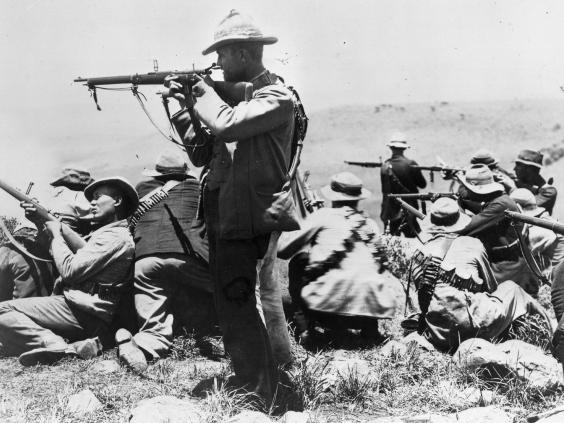
Armed Afrikaners on the veldt near Ladysmith during the second Boer War, circa 1900
During the Second Boer War (1899-1902), the British rounded up around a sixth of the Boer population - mainly women and children - and detained them in camps, which were overcrowded and prone to outbreaks of disease, with scant food rations.
Of the 107,000 people interned in the camps, 27,927 Boers died, along with an unknown number of black Africans.

2. Amritsar massacre

Amritsar-Massacre.jpg
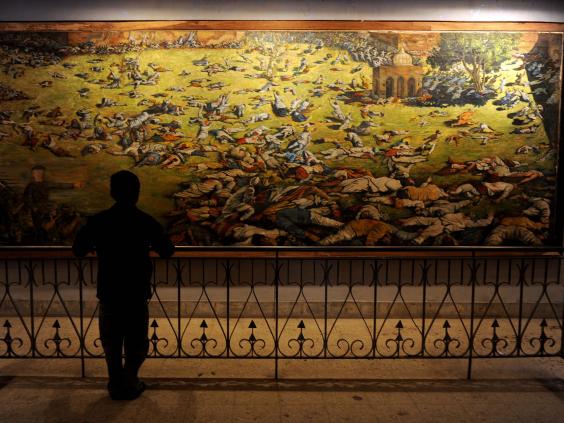
A young visitor looks at a painting depicting the Amritsar Massare at Jallianwala Bagh in Amritsar

When peaceful protesters defied a government order and demonstrated against British colonial rule in Amritsar, India, on 13 April 1919, they were blocked inside the walled Jallianwala Gardens and fired upon by Gurkha soldiers.

The soldiers, under the orders of Brigadier Reginald Dyer, kept firing until they ran out of ammunition, killing between 379 and 1,000 protesters and injuring another 1,100 within 10 minutes.

Brigadier Dyer was later lauded a hero by the British public, who raised £26,000 for him as a thank you.

3. Partitioning of India

Cyril-Radcliffe.jpg
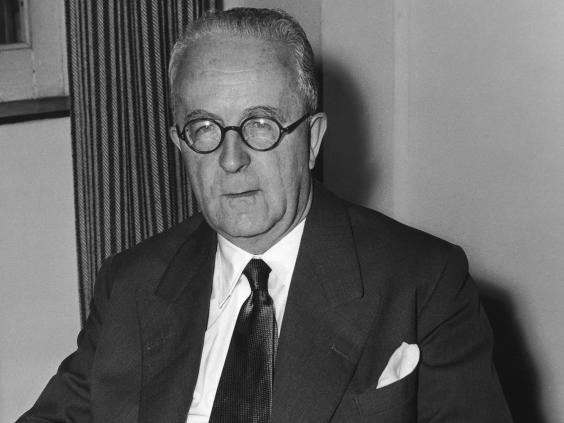
British lawyer and law lord Cyril Radcliffe, 1st Viscount Radcliffe (1899 - 1977) at the Colonial Office, London, July 1956
In 1947, Cyril Radcliffe was tasked with drawing the border between India and the newly created state of Pakistan over the course of a single lunch.

After Cyril Radcliffe split the subcontinent along religious lines, uprooting over 10 million people, Hindus in Pakistan and Muslims in India were forced to escape their homes as the situation quickly descended into violence.

Some estimates suggest up to one million people lost their lives in sectarian killings.

4. Mau Mau Uprising

mau-gt.jpg
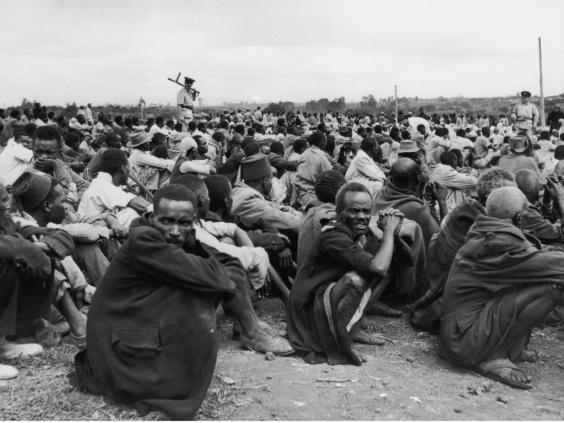
Mau Mau suspects at one of the prison camps in 1953
Thousands of elderly Kenyans, who claim British colonial forces mistreated, raped and tortured them during the Mau Mau Uprising (1951-1960), have launched a £200m damages claim against the UK Government.

Members of the Kikuyu tribe were detained in camps, since described as "Britain's gulags" or concentration camps, where they allege they were systematically tortured and suffered serious sexual assault.

Estimates of the deaths vary widely: historian David Anderson estimates there were 20,000, whereas Caroline Elkins believes up to 100,000 could have died.

5. Famines in India

India-famine2.jpg
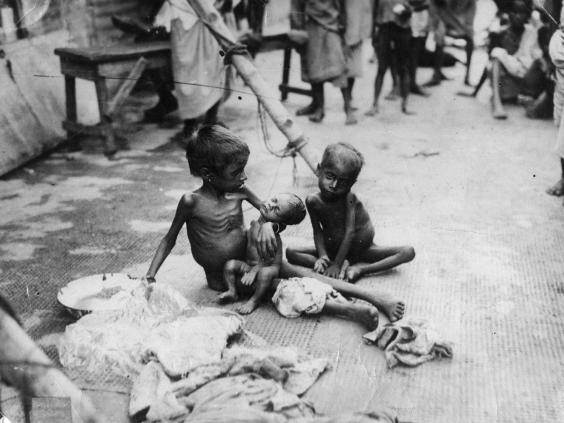
Starving children in India, 1945

Between 12 and 29 million Indians died of starvation while it was under the control of the British Empire, as millions of tons of wheat were exported to Britain as famine raged in India.

In 1943, up to four million Bengalis starved to death when Winston Churchill diverted food to British soldiers and countries such as Greece while a deadly famine swept through Bengal.


Talking about the Bengal famine in 1943, Churchill said: “I hate Indians. They are a beastly people with a beastly religion. The famine was their own fault for breeding like rabbits.”


2016-03-01

The Rape of East Timor: "Sounds Like Fun"

by John Pilger

Secret documents found in the Australian National Archives provide a glimpse of how one of the greatest crimes of the 20th century was executed and covered up. They also help us understand how and for whom the world is run.

The documents refer to East Timor, now known as Timor-Leste, and were written by diplomats in the Australian embassy in Jakarta. The date was November 1976, less than a year after the Indonesian dictator General Suharto seized the then Portuguese colony on the island of Timor.

The terror that followed has few parallels; not even Pol Pot succeeded in killing, proportionally, as many Cambodians as Suharto and his fellow generals killed in East Timor. Out of a population of almost a million, up to a third were extinguished.

This was the second holocaust for which Suharto was responsible. A decade earlier, in 1965, Suharto wrested power in Indonesia in a bloodbath that took more than a million lives. The CIA reported: "In terms of numbers killed, the massacres rank as one of the worst mass murders of the 20th century."

This was greeted in the Western press as "a gleam of light in Asia" (Time). The BBC's correspondent in South East Asia, Roland Challis, later described the cover-up of the massacres as a triumph of media complicity and silence; the "official line" was that Suharto had "saved" Indonesia from a communist takeover.

"Of course my British sources knew what the American plan was," he told me. "There were bodies being washed up on the lawns of the British consulate in Surabaya, and British warships escorted a ship full of Indonesian troops, so that they could take part in this terrible holocaust. It was only much later that we learned that the American embassy was supplying [Suharto with] names and ticking them off as they were killed. There was a deal, you see. In establishing the Suharto regime, the involvement of the [US-dominated] International Monetary Fund and the World Bank were part of it. That was the deal."

I have interviewed many of the survivors of 1965, including the acclaimed Indonesian novelist Pramoedya Ananta Toer, who bore witness to an epic of suffering "forgotten" in the West because Suharto was "our man". A second holocaust in resource-rich East Timor, an undefended colony, was almost inevitable.

In 1994, I filmed clandestinely in occupied East Timor; I found a land of crosses and unforgettable grief. In my film, Death of a Nation, there is a sequence shot on board an Australian aircraft flying over the Timor Sea. A party is in progress. Two men in suits are toasting each other in champagne. "This is a uniquely historical moment," babbles one of them, "that is truly, uniquely historical."

This is Australia's foreign minister, Gareth Evans. The other man is Ali Alatas, the principal mouthpiece of Suharto. It is 1989 and they are making a symbolic flight to celebrate a piratical deal they called a "treaty". This allowed Australia, the Suharto dictatorship and the international oil companies to divide the spoils of East Timor's oil and gas resources.

Thanks to Evans, Australia's then prime minister, Paul Keating -- who regarded Suharto as a father figure -- and a gang that ran Australia's foreign policy establishment, Australia distinguished itself as the only western country formally to recognise Suharto's genocidal conquest. The prize, said Evans, was "zillions" of dollars.

Members of this gang reappeared the other day in documents found in the National Archives by two researchers from Monash University in Melbourne, Sara Niner and Kim McGrath. In their own handwriting, senior officials of the Department of Foreign Affairs mock reports of the rape, torture and execution of East Timorese by Indonesian troops. In scribbled annotations on a memorandum that refers to atrocities in a concentration camp, one diplomat wrote: "sounds like fun". Another wrote: "sounds like the population are in raptures."

Referring to a report by the Indonesian resistance, Fretilin, that describes Indonesia as an "impotent" invader, another diplomat sneered: "If 'the enemy was impotent', as stated, how come they are daily raping the captured population? Or is the former a result of the latter?"

The documents, says Sarah Niner, are "vivid evidence of the lack of empathy and concern for human rights abuses in East Timor" in the Department of Foreign Affairs. "The archives reveal that this culture of cover-up is closely tied to the DFA's need to recognise Indonesian sovereignty over East Timor so as to commence negotiations over the petroleum in the East Timor Sea."

This was a conspiracy to steal East Timor's oil and gas. In leaked diplomatic cables in August 1975, the Australian Ambassador to Jakarta, Richard Woolcott, wrote to Canberra: "It would seem to me that the Department [of Minerals and Energy] might well have an interest in closing the present gap in the agreed sea border and this could be much more readily negotiated with Indonesia ... than with Portugal or independent Portuguese Timor." Woolcott revealed that he had been briefed on Indonesia's secret plans for an invasion. He cabled Canberra that the government should "assist public understanding in Australia" to counter "criticism of Indonesia".

In 1993, I interviewed C. Philip Liechty, a former senior CIA operations officer in the Jakarta embassy during the invasion of East Timor. He told me: "Suharto was given the green light [by the US] to do what he did. We supplied them with everything they needed [from] M16 rifles [to] US military logistical support ... maybe 200,000 people, almost all of them non-combatants died. When the atrocities began to appear in the CIA reporting, the way they dealt with these was to cover them up as long as possible; and when they couldn't be covered up any longer, they were reported in a watered-down, very generalised way, so that even our own sourcing was sabotaged."

I asked Liechty what would have happened had someone spoken out. "Your career would end," he replied. He said his interview with me was one way of making amends for "how badly I feel".

The gang in the Australian embassy in Jakarta appear to suffer no such anguish. One of the scribblers on the documents, Cavan Hogue, told the Sydney Morning Herald: "It does look like my handwriting. If I made a comment like that, being the cynical bugger that I am, it would certainly have been in the spirit of irony and sarcasm. It's about the [Fretilin] press release, not the Timorese." Hogue said there were "atrocities on all sides".

As one who reported and filmed the evidence of genocide, I find this last remark especially profane. The Fretilin "propaganda" he derides was accurate. The subsequent report of the United Nations on East Timor describes thousands of cases of summary execution and violence against women by Suharto's Kopassus special forces, many of whom were trained in Australia. "Rape, sexual slavery and sexual violence were tools used as part of the campaign designed to inflict a deep experience of terror, powerlessness and hopelessness upon pro-independence supporters," says the UN.

Cavan Hogue, the joker and "cynical bugger", was promoted to senior ambassador and eventually retired on a generous pension. Richard Woolcott was made head of the Department of Foreign Affairs in Canberra and, in retirement, has lectured widely as a "respected diplomatic intellectual".

Journalists watered at the Australian embassy in Jakarta, notably those employed by Rupert Murdoch, who controls almost 70 per cent of Australia's capital city press. Murdoch's correspondent in Indonesia was Patrick Walters, who reported that Jakarta's "economic achievements" in East Timor were "impressive", as was Jakarta's "generous" development of the blood-soaked territory. As for the East Timorese resistance, it was "leaderless" and beaten. In any case, "no one was now arrested without proper legal procedures".

In December 1993, one of Murdoch's veteran retainers, Paul Kelly, then editor-in-chief of The Australian, was appointed by Foreign Minister Evans to the Australia-Indonesia Institute, a body funded by the Australian government to promote the "common interests" of Canberra and the Suharto dictatorship. Kelly led a group of Australian newspaper editors to Jakarta for an audience with the mass murderer. There is a photograph of one of them bowing.

East Timor won its independence in 1999 with the blood and courage of its ordinary people. The tiny, fragile democracy was immediately subjected to a relentless campaign of bullying by the Australian government which sought to manoeuvre it out of its legal ownership of the sea bed's oil and gas revenue. To get its way, Australia refused to recognise the jurisdiction of the International Court of Justice and the Law of the Sea and unilaterally changed the maritime boundary in its own favour.

In 2006, a deal was finally signed, Mafia-style, largely on Australia's terms. Soon afterwards, Prime Minister Mari Alkitiri, a nationalist who had stood up to Canberra, was effectively deposed in what he called an "attempted coup" by "outsiders". The Australian military, which had "peace-keeping" troops in East Timor, had trained his opponents.

In the 17 years since East Timor won its independence, the Australian government has taken nearly $5 billion in oil and gas revenue - money that belongs to its impoverished neighbour.

Australia has been called America's "deputy sheriff" in the South Pacific. One man with the badge is Gareth Evans, the foreign minister filmed lifting his champagne glass to toast the theft of East Timor's natural resources. Today, Evans is a lectern-trotting zealot promoting a brand of war-mongering known as "RTP", or "Responsibility to Protect". As co-chair of a New York-based "Global Centre", he runs a US-backed lobby group that urges the "international community" to attack countries where "the Security Council rejects a proposal or fails to deal with it in a reasonable time". The man for the job, as the East Timorese might say.

2015-08-08

America's Greatest War Crimes (from Among So, So Many): Hiroshima and Nagasaki

"[The U.S.] never would have dropped the bomb if the Japanese had had white skin. It was a monstrous, racist act." - Lawrence Ferlinghetti

2015-08-06

70 Years Later, America Still Hasn’t Apologized for Murdering Hundreds of Thousands of Innocent Japanese Citizens in an Instant

by Christian Appy
TomDispatch.com

“Never, never waste a minute on regret. It’s a waste of time.”

- President Harry Truman


Here we are, 70 years after the nuclear obliteration of Hiroshima and Nagasaki, and I’m wondering if we’ve come even one step closer to a moral reckoning with our status as the world’s only country to use atomic weapons to slaughter human beings. Will an American president ever offer a formal apology? Will our country ever regret the dropping of “Little Boy” and “Fat Man,” those two bombs that burned hotter than the sun? Will it absorb the way they instantly vaporized thousands of victims, incinerated tens of thousands more, and created unimaginably powerful shockwaves and firestorms that ravaged everything for miles beyond ground zero? Will it finally come to grips with the “black rain” that spread radiation and killed even more people - slowly and painfully - leading in the end to a death toll for the two cities conservatively estimated at more than 250,000?

Given the last seven decades of perpetual militarization and nuclear “modernization” in this country, the answer may seem like an obvious no. Still, as a historian, I’ve been trying to dig a little deeper into our lack of national contrition. As I have, an odd fragment of Americana kept coming to mind, a line from the popular 1970 tearjerker Love Story: “Love,” says the female lead when her boyfriend begins to apologize, “means never having to say you’re sorry.” It has to be one of the dumbest definitions ever to lodge in American memory, since real love often requires the strength to apologize and make amends.

It does, however, apply remarkably well to the way many Americans think about that broader form of love we call patriotism. With rare exceptions, like the 1988 congressional act that apologized to and compensated the Japanese-American victims of World War II internment, when it comes to the brute exercise of power, true patriotism has above all meant never having to say you’re sorry. The very politicians who criticize other countries for not owning up to their wrong-doing regularly insist that we should never apologize for anything. In 1988, for example, after the US Navy shot down an Iranian civilian airliner over the Persian Gulf killing all 290 passengers (including 66 children), Vice President George H.W. Bush, then running for president, proclaimed, “I will never apologize for the United States. Ever. I don’t care what the facts are.”

It turns out, however, that Bush’s version of American remorselessness isn’t quite enough. After all, Americans prefer to view their country as peace-loving, despite having been at war constantly since 1941. This means they need more than denials and non-apologies. They need persuasive stories and explanations (however full of distortions and omissions). The tale developed to justify the bombings that led to a world in which the threat of human extinction has been a daily reality may be the most successful legitimizing narrative in our history. Seventy years later, it’s still deeply embedded in public memory and school textbooks, despite an ever-growing pile of evidence that contradicts it. Perhaps it’s time, so many decades into the age of apocalyptic peril, to review the American apologia for nuclear weapons - the argument in their defense - that ensured we would never have to say we’re sorry.

THE HIROSHIMA APOLOGIA
On August 9, 1945, President Harry Truman delivered a radio address from the White House. “The world will note,” he said, “that the first atomic bomb was dropped on Hiroshima, a military base. That was because we wished in this first attack to avoid, insofar as possible, the killing of civilians.” He did not mention that a second atomic bomb had already been dropped on Nagasaki.

Truman understood, of course, that if Hiroshima was a “military base,” then so was Seattle; that the vast majority of its residents were civilians; and that perhaps 100,000 of them had already been killed. Indeed, he knew that Hiroshima was chosen not for its military significance but because it was one of only a handful of Japanese cities that had not already been firebombed and largely obliterated by American air power. US officials, in fact, were intent on using the first atomic bombs to create maximum terror and destruction. They also wanted to measure their new weapon’s power and so selected the “virgin targets” of Hiroshima and Nagasaki. In July 1945, Secretary of War Henry Stimson informed Truman of his fear that, given all the firebombing of Japanese cities, there might not be a target left on which the atomic bomb could “show its strength” to the fullest. According to Stimson’s diary, Truman “laughed and said he understood.”

The president soon dropped the “military base” justification. After all, despite Washington’s effort to censor the most graphic images of atomic annihilation coming out of Hiroshima, the world quickly grasped that the US had destroyed an entire city in a single blow with massive loss of life. So the president focused instead on an apologia that would work for at least the next seven decades. Its core arguments appeared in that same August 9th speech. “We have used [the atomic bomb] against those who attacked us without warning at Pearl Harbor,” he said, “against those who have starved and beaten and executed American prisoners of war, against those who have abandoned all pretense of obeying international laws of warfare. We have used it in order to shorten the agony of war, in order to save the lives of thousands and thousands of young Americans.”

By 1945, most Americans didn’t care that the civilians of Hiroshima and Nagasaki had not committed Japan’s war crimes. American wartime culture had for years drawn on a long history of “yellow peril” racism to paint the Japanese not just as inhuman, but as subhuman. As Truman put it in his diary, it was a country full of “savages” - “ruthless, merciless, and fanatic” people so loyal to the emperor that every man, woman, and child would fight to the bitter end. In these years, magazines routinely depicted the Japanese as monkeys, apes, insects, and vermin. Given such a foe, so went the prevailing view, there were no true “civilians” and nothing short of near extermination, or at least a powerful demonstration of America’s willingness to proceed down that path, could ever force their surrender. As Admiral William “Bull” Halsey said in a 1944 press conference, “The only good Jap is a Jap who’s been dead six months.”

In the years after World War II, the most virulent expressions of race hatred diminished, but not the widespread idea that the atomic bombs had been required to end the war, eliminating the need to invade the Japanese home islands where, it was confidently claimed, tooth-and-nail combat would cause enormous losses on both sides. The deadliest weapon in history, the one that opened the path to future Armageddon, had therefore saved lives. That was the stripped down mantra that provided the broadest and most enduring support for the introduction of nuclear warfare. By the time Truman, in retirement, published his memoir in 1955, he was ready to claim with some specificity that an invasion of Japan would have killed half-a-million Americans and at least as many Japanese.

Over the years, the ever-increasing number of lives those two A-bombs “saved” became a kind of sacred numerology. By 1991, for instance, President George HW Bush, praising Truman for his “tough, calculating decision,” claimed that those bombs had “spared millions of American lives.” By then, an atomic massacre had long been transformed into a mercy killing that prevented far greater suffering and slaughter.

Truman went to his grave insisting that he never had a single regret or a moment’s doubt about his decision. Certainly, in the key weeks leading up to August 6, 1945, the record offers no evidence that he gave serious consideration to any alternative.

“REVISIONISTS” WERE PRESENT AT THE CREATION
Twenty years ago, the Smithsonian’s National Air and Space Museum planned an ambitious exhibit to mark the 50th anniversary of the end of World War II. At its center was to be an extraordinary artifact - the fuselage of the Enola Gay, the B-29 Superfortress used to drop the atomic bomb on Hiroshima. But the curators and historical consultants wanted something more than yet another triumphal celebration of American military science and technology. Instead, they sought to assemble a thought-provoking portrayal of the bomb’s development, the debates about its use, and its long-term consequences. The museum sought to include some evidence challenging the persistent claim that it was dropped simply to end the war and “save lives.”

For starters, visitors would have learned that some of America’s best-known World War II military commanders opposed using atomic weaponry. In fact, six of the seven five-star generals and admirals of that time believed that there was no reason to use them, that the Japanese were already defeated, knew it, and were likely to surrender before any American invasion could be launched. Several, like Admiral William Leahy and General Dwight Eisenhower, also had moral objections to the weapon. Leahy considered the atomic bombing of Japan “barbarous” and a violation of “every Christian ethic I have ever heard of and all of the known laws of war.”

Truman did not seriously consult with military commanders who had objections to using the bomb.  He did, however, ask a panel of military experts to offer an estimate of how many Americans might be killed if the United States launched the two major invasions of the Japanese home islands scheduled for November 1, 1945 and March 1, 1946. Their figure: 40,000 - far below the half-million he would cite after the war. Even this estimate was based on the dubious assumption that Japan could continue to feed, fuel, and arm its troops with the US in almost complete control of the seas and skies.

The Smithsonian also planned to inform its visitors that some key presidential advisers had urged Truman to drop his demand for “unconditional surrender” and allow Japan to keep the emperor on his throne, an alteration in peace terms that might have led to an almost immediate surrender. Truman rejected that advice, only to grant the same concession after the nuclear attacks.

Keep in mind, however, that part of Truman’s motivation for dropping those bombs involved not the defeated Japanese, but the ascending Soviet Union. With the USSR pledged to enter the war against Japan on August 8, 1945 (which it did), Truman worried that even briefly prolonging hostilities might allow the Soviets to claim a greater stake in East Asia. He and Secretary of State James Byrnes believed that a graphic demonstration of the power of the new bomb, then only in the possession of the United States, might also make that Communist power more “manageable” in Europe. The Smithsonian exhibit would have suggested that Cold War planning and posturing began in the concluding moments of World War II and that one legacy of Hiroshima would be the massive nuclear arms race of the decades to come.

In addition to displaying American artifacts like the Enola Gay, Smithsonian curators wanted to show some heartrending objects from the nuclear destruction of Hiroshima, including a schoolgirl’s burnt lunchbox, a watch dial frozen at the instant of the bomb’s explosion, a fused rosary, and photographs of the dead and dying. It would have been hard to look at these items beside that plane’s giant fuselage without feeling some sympathy for the victims of the blast.

None of this happened. The exhibit was canceled after a storm of protest. When the Air Force Association leaked a copy of the initial script to the media, critics denounced the Smithsonian for its “politically correct” and “anti-American” “revision” of history. The exhibit, they claimed, would be an insult to American veterans and fundamentally unpatriotic. Though conservatives led the charge, the Senate unanimously passed a resolution condemning the Smithsonian for being “revisionist and offensive” that included a tidy rehearsal of the official apologia: “The role of the Enola Gay… was momentous in helping to bring World War II to a merciful end, which resulted in saving the lives of Americans and Japanese.”

Merciful? Consider just this: the number of civilians killed at Hiroshima and Nagasaki alone was more than twice the number of American troops killed during the entire Pacific war.

In the end, the Smithsonian displayed little but the Enola Gay itself, a gleaming relic of American victory in the “Good War.”

OUR UNBROKEN FAITH IN THE GREATEST GENERATION
In the two decades since, we haven’t come closer to a genuine public examination of history’s only nuclear attack or to finding any major fault with how we waged what Studs Terkel famously dubbed “the Good War.” He used that term as the title for his classic 1984 oral history of World War II and included those quotation marks quite purposely to highlight the irony of such thinking about a war in which an estimated 60 million people died. In the years since, the term has become an American cliche, but the quotation marks have disappeared along with any hint of skepticism about our motives and conduct in those years.

Admittedly, when it comes to the launching of nuclear war (if not the firebombings that destroyed 67 Japanese cities and continued for five days after “Fat Man” was dropped on Nagasaki), there is some evidence of a more critical cast of mind in this country. Recent polls, for instance, show that “only” 56% of Americans now think we were right to use nuclear weapons against Japan, down a few points since the 1990s, while support among Americans under the age of 30 has finally fallen below 50%. You might also note that just after World War II, 85% of Americans supported the bombings.

Of course, such pro-bomb attitudes were hardly surprising in 1945, especially given the relief and joy at the war’s victorious ending and the anti-Japanese sentiment of that moment. Far more surprising: by 1946, millions of Americans were immersed in John Hersey’s best-selling book Hiroshima, a moving report from ground zero that explored the atomic bomb’s impact through the experiences of six Japanese survivors. It began with these gripping lines:

“At exactly fifteen minutes past eight in the morning, on August 6, 1945, Japanese time, at the moment when the atomic bomb flashed above Hiroshima, Miss Toshiko Sasaki, a clerk in the personnel department of the East Asia Tin Works, had just sat down at her place in the plant office and was turning her head to speak to the girl at the next desk.”

Hiroshima remains a remarkable document for its unflinching depictions of the bomb’s destructiveness and for treating America’s former enemy with such dignity and humanity. “The crux of the matter,” Hersey concluded, “is whether total war in its present form is justifiable, even when it serves a just purpose. Does it not have material and spiritual evil as its consequences which far exceed whatever good might result?”

The ABC Radio Network thought Hersey’s book so important that it hired four actors to read it in full on the air, reaching an even wider audience. Can you imagine a large American media company today devoting any significant air time to a work that engendered empathy for the victims of our twenty-first century wars? Or can you think of a recent popular book that prods us to consider the “material and spiritual evil” that came from our own participation in World War II? I can’t.

In fact, in the first years after that war, as Paul Boyer showed in his superb book By the Bomb’s Early Light, some of America’s triumphalism faded as fears grew that the very existence of nuclear weapons might leave the country newly vulnerable. After all, someday another power, possibly the Soviet Union, might use the new form of warfare against its creators, producing an American apocalypse that could never be seen as redemptive or merciful.

In the post-Cold War decades, however, those fears have again faded (unreasonably so since even a South Asian nuclear exchange between Pakistan and India could throw the whole planet into a version of nuclear winter).  Instead, the “Good War” has once again been embraced as unambiguously righteous. Consider, for example, the most recent book about World War II to hit it big, Laura Hillenbrand’s Unbroken: A World War II Story of Survival, Resilience, and Redemption. Published in 2010, it remained on the New York Times best-seller list in hardcover for almost four years and has sold millions of copies. In its reach, it may even surpass Tom Brokaw’s 1998 book, The Greatest Generation. A Hollywood adaptation of Unbroken appeared last Christmas.

Hillenbrand’s book does not pretend to be a comprehensive history of World War II or even of the war in the Pacific. It tells the story of Louis Zamperini, a child delinquent turned Olympic runner turned B-24 bombardier. In 1943, his plane was shot down in the Pacific. He and the pilot survived 47 days in a life raft despite near starvation, shark attacks, and strafing by Japanese planes. Finally captured by the Japanese, he endured a series of brutal POW camps where he was the victim of relentless sadistic beatings.

The book is decidedly a page-turner, but its focus on a single American’s punishing ordeal and amazing recovery inhibits almost any impulse to move beyond the platitudes of nationalistic triumphalism and self-absorption or consider (among other things) the racism that so dramatically shaped American combat in the Pacific. That, at least, is the impression you get combing through some of the astonishing 25,000 customer reviews Unbroken has received on Amazon. “My respect for WWII veterans has soared,” a typical reviewer writes. “Thank you Laura Hillenbrand for loving our men at war,” writes another. It is “difficult to read of the inhumanity of the treatment of the courageous men serving our country.” And so on.

Unbroken devotes a page and a half to the atomic bombing of Hiroshima, all of it from the vantage point of the American crew of the Enola Gay. Hillenbrand raises concerns about the crew’s safety: “No one knew for sure if… the bomber could get far enough away to survive what was coming.” She describes the impact of the shockwaves, not on the ground, but at 30,000 feet when they slammed into the Enola Gay, “pitching the men into the air.”

The film version of Unbroken evokes even less empathy for the Japanese experience of nuclear war, which brings to mind something a student told my graduate seminar last spring. He teaches high school social studies and when he talked with colleagues about the readings we were doing on Hiroshima, three of them responded with some version of the following: “You know, I used to think we were wrong to use nukes on Japan, but since I saw Unbroken I’ve started to think it was necessary.” We are, that is, still in the territory first plowed by Truman in that speech seven decades ago.

At the end of the film, this note appears on the screen: “Motivated by his faith, Louie came to see that the way forward was not revenge, but forgiveness. He returned to Japan, where he found and made peace with his former captors.”

That is indeed moving. Many of the prison camp guards apologized, as well they should have, and - perhaps more surprisingly - Zamperini forgave them. There is, however, no hint that there might be a need for apologies on the American side, too; no suggestion that our indiscriminate destruction of Japan, capped off by the atomic obliteration of two cities, might be, as Admiral Leahy put it, a violation of “all of the known laws of war.”

So here we are, 70 years later, and we seem, if anything, farther than ever from a rejection of the idea that launching atomic warfare on Japanese civilian populations was an act of mercy. Perhaps some future American president will finally apologize for our nuclear attacks, but one thing seems certain: no Japanese survivor of the bombs will be alive to hear it.