Showing posts with label Ryukyuans (Okinawans). Show all posts

2011-01-08

Ex-MP revisits Okinawa's Koza Riot

by Jon Mitchell

The Japan Times

Bruce Lieber returns on 40th anniversary of the island's largest anti-American disturbance

On a mild December night in the city of Okinawa, Bruce Lieber, a 61-year-old Ohio native, found himself surrounded by a cluster of Japanese journalists. Photographers and TV crew jostled for position while reporters asked him how it felt to be back on the island.

Lieber had been answering their questions for over an hour, when he suddenly fell silent. Gazing at the weather-worn buildings, he rubbed his eyes and broke into a bemused smile as though remembering the last time he was standing on this very same corner in the city then called Koza.

That was 40 years ago — almost to the day — and he was encircled by a mob then, too. But on Dec. 20, 1970, people were bombarding Lieber with bricks rather than questions — and Lieber was fighting to escape from the midst of the Koza Riot, the most violent anti-American uprising Okinawa ever witnessed.

Lieber first arrived on Okinawa in May 1970, when the prefecture was controlled by the U.S. authorities. "At that time, Okinawa was a staging post for American troops heading to the war in Vietnam," said Lieber. "There were 40,000 servicemen and their dependents living here. The Okinawan civilian police had no power over Americans and so that job fell to us — the Ryukyu Armed Forces Police."

Lieber's initial few months as a military policeman were busy. He and his partner patrolled the bar districts, calming down drunk soldiers and attempting to defuse any trouble they encountered.

Lieber's rounds often took him to Okinawa's central city — home to a popular entertainment quarter that catered to servicemen from neighboring Kadena Air Base, the largest U.S. military installation in the Pacific. "One of the most common problems was traffic incidents involving Americans. So when we received the call to assist with a minor car accident at 1:30 on the morning of Dec. 20, 1970," explained Lieber, "we didn't think it was out of the ordinary."

Arriving on the scene, Lieber found an Okinawan man in the back of an ambulance. He'd been run down by a car driven by a drunk American, and although his injuries appeared minor, an angry swarm of onlookers had gathered. "While my partner and I discussed what to do, I spotted another American man with his girlfriend. They'd wandered into the crowd and people were pushing them around. I jumped out and pulled both of them back into our patrol car. Okinawans surrounded my vehicle and began to rock it. I became seriously worried so I picked up the radio and called in a '10-2' — an emergency request for assistance."

After managing to edge his car through the crowd, Lieber drove the relieved soldier and his girlfriend out of danger. He advised them to leave the area immediately, then he returned to his colleagues to see whether they needed help. "That was when we heard the sound of a second car accident. Another American had crashed his vehicle close by. It was only a fender-bender but the onlookers grew furious. They tried to drag the driver out of his car."

Lieber and his fellow MPs rushed to rescue the man, but they were hindered by the crowd. The Okinawan police were able to weave through the mob, though, and they bundled the frightened driver to safety. With the path back to their own patrol cars blocked, Lieber and a dozen other MPs retreated to a side street. From there, they watched the riot escalate.

"The crowd now numbered in their hundreds. They shunted American-owned cars (identifiable by their yellow number plates) out of parking lots. They pushed them into the middle of the street. Then they set fire to them. More people climbed onto the rooftops and they threw rocks and empty bottles at us.

"We discussed how to disperse the rioters. Our commanding officer gave us the OK to fire warning shots over their heads. I fired three times into the air — the first time for me to shoot my pistol in the line of duty. The noise was incredibly loud and the tactic worked. The crowd retreated for a few moments and we managed to leave the side street."

Compared with barely 30 minutes earlier, the main road was unrecognizable. "It was full of the smoke from a dozen burning vehicles," recalled Lieber. "People were yelling as they shoved the American cars into each other and flipped them on their roofs."

Lieber and his fellow officers made a few unsuccessful attempts to apprehend the rioters. However, the crowd had swollen into the thousands and soon the Americans resigned themselves to the fact that the situation was out of their control. "The Okinawans burned car after car and kept throwing bottles and bricks at us. I was hit in the head and the arm. We retreated down the street. Whenever they advanced upon us, we just backed away."

Four hours later, Lieber and his colleagues finally reached the south end of the main road where over 200 reinforcement MPs and regular marines brandishing ax handles had set up a line of defense. "There was a sense that this was the last stand. If the rioters had broken past that point then they would have been close to the army officer housing area. The military used tear gas canisters to push back the rioters. They quickly dispersed."

The crowd might have retreated, but the riot was far from over. As Lieber was receiving treatment for cuts and contusions at the army's hospital, Okinawans stormed the gates of the Kadena Air Base. They rolled cars toward the ranks of American guards, then set three buildings alight within the installation itself.

It was not until 6 a.m. that the riot finally died down. Around 80 cars had been burned and 60 Americans injured.

Despite the massive scale of the violence, according to Lieber, its impact on the lives of the U.S. military stationed on Okinawa was short-lived. For a month or so, American authorities imposed a midnight curfew on soldiers and ordered MPs to travel in jeeps to assert a firmer image, but soon it seemed as though the riot had never occurred.

So it came as a surprise to Lieber when, in March 1971, he received a summons to headquarters. Along with six other MPs who had responded to the riot, Lieber received official acknowledgment for his actions that night — in particular his rescue of the soldier and his girlfriend and his attempt to save the American driver of the car involved in the second accident.

The Certificate of Achievement presented to Lieber reads: "His professional competence, initiative and outstanding devotion to duty contributed immeasurably to the successful accomplishment of the mission." Asked how he felt about the award, Lieber said, "I was proud for being recognized for what I did that night. I did what I was trained to do. I protected who I needed to protect."

In August 1972, Lieber left the military to study graphic arts at university. Over the next few decades, he raised a family and pursued a successful career as a commercial printer. Throughout this time, Lieber's memories of the riot remained strong, but his feelings of pride gradually grew tinged with more complex emotions.

"When I was on Okinawa, I was 21 years old. Call me naive, but the riot was exciting — it was an adventure. Only years later did I read about the history of Okinawa — its 17th-century seizure by Japan and the sufferings people experienced in World War II.

"Around four years ago, I discovered a book by Chalmers Johnson (the late president of the Japan Policy Research Institute). It put into perspective the 25-year-long U.S. occupation of the island. Not to mention the crimes and brutality committed by Americans."

Johnson's writing sparked in Lieber memories of the injustices which occurred all around him during his service on Okinawa — the rampant use of hard drugs among his fellow servicemen, the beatings and the rapes of local women. Then there was the case of Lieber's fellow MP — "a high-strung heroin addict" — who robbed Okinawan family stores in his spare time. "One of the owners finally recognized him and filed a complaint. What did the military do? The same as always. They stalled and slowed down the investigation. Then they shipped him off the island."

This sense of collusion in the oppression of Okinawa convinced Lieber of his need to return for the 40-year anniversary of the Koza Riot. "I wanted to make up for my role in the things that went on here. Even if I was the only one present on the anniversary, I wouldn't have minded. I just wanted to be there for that moment of history."

Lieber traveled to Okinawa in December. As it turned out, he was far from alone in commemorating the riot. Retracing the streets he used to patrol as an MP, he spotted the bright lights of a Japanese camera crew filming a report on the uprising.

Lieber told them that he had been one of the first American police officers on the scene but his claim was met with skepticism. When he dug his former MP insignia from his rucksack, though, he was quickly swamped by TV, print and online journalists. As Lieber recounted his story of the riot, more people flocked from the nearby drinking area — attracted by a very different commotion than the one that lured them from the same bars 40 years ago.

Toward the end of an interview, one of the journalists asked Lieber a question that was on everybody's mind — whether he thought the Koza Riot was justified.

Without pausing a beat, Lieber nodded. "Absolutely. Okinawan people were pushed around by the American military too much. My only question is what took them so long to rebel."

The next day, as Lieber headed to a photography exhibition on the riot at the city's Histreet museum, it was clear that many residents who had watched Lieber's television interview agreed with his comments. Passersby stopped him on the sidewalk to shake his hand, they asked him to pose for photographs and the owner of a local coffee shop even refused to let him pay for his drink.

The welcome at the museum was equally as warm. Representatives from City Hall guided him around the displays and when Lieber told them he wished to donate his MP insignia to the museum, they assured him they would give them pride of place.

Having handed over his former signs of authority, a weight seemed to lift from Lieber's shoulders. "I'm glad I could finally find a home for them. Back in the States, I try to tell people about the problems the U.S. bases are still causing here but they don't want to listen. I wish they would open their eyes and understand what's happening here on Okinawa."
The city of Okinawa's Histreet museum will be exhibiting photographs from the Koza Riot — and Lieber's insignia — until the end of February. Inquiries can be made at (098) 929 2922.

2010-12-01

Okinawans try to vote US base out

by Daniel Leussink

Asia Times

NAHA, Japan - Perhaps the most remarkable thing about Sunday’s gubernatorial election on the subtropical Japanese islands of Okinawa was the absence of a candidate supported by Minshuto, the ruling party.

Minshuto - the Democratic Party of Japan - refrained from fielding a candidate or backing any of the other contenders in the electoral race after an ordinary spat between local assemblymen and party leaders in Tokyo over a controversial relocation accord for a contentious United States marine base. But this election was about more than the relocation of the military base for the local assemblymen.

After losing his parliamentary seat in July, Shoukichi Kina, the head of Minshuto’s Okinawa chapter, proposed to run in the gubernatorial race by putting the relocation accord on the discussion table once more. He was banned from running by the Minshuto leadership.

"We’re not against the Japan-US Security Treaty," he says. "But under the Security Treaty is the Status of Forces Agreement. If you look at it closely, it protects US forces in Japan, but has nothing to do with Okinawa. That’s the lie."

In the Security Treaty, the US promised to defend Japan in case it comes under attack from a third-party nation state. Japan also hides under the US nuclear umbrella, a powerful deterrent within East Asia’s fragile security situation.

Okinawa makes up 0.6% of Japan’s territory but hosts 75% of US military bases. Okinawans have complained for decades about the unfair and unequal footprint left by US forces on the tiny southern prefecture. It extends beyond sexual assault, hit-and-runs and low-flying noise-producing fighter jets. The US military forces control 40% of Okinawan airspace and 29 ports.

Minshuto promised to lessen that burden by relocating the US marine base Futenma from a densely populated part of central Okinawa to outside the prefecture. But in May it did a 180-degree turn, broke its election pledge, signed off on the relocation accord with the US and decided on moving Futenma to a less-densely populated part of northern Okinawa. Futenma’s 8,000 marines and 9,000 dependants would move to Guam.

The accord has already cost one Japanese prime minister his job, with Yukio Hatoyama abruptly throwing in the towel days after his badly timed approval of it.

"We believe we owe the people of Okinawa a double apology," said Minister of Foreign Affairs Seiji Maehara in October, addressing Okinawan frustrations resulting from the unequal burden and the broken election pledge. "We will take a double approach, on the one hand apologizing sincerely and at the same time persevering in asking for Okinawa’s understanding and acceptance [of the construction of Futenma’s replacement facility]."

In Sunday’s tense gubernatorial race, Okinawans for a fourth time in a row voted for a conservative candidate instead of a progressive one. Hirokazu Nakaima received 38,000 votes more than his main rival, hard-liner Yoichi Iha, and won a second four-year term as governor. Both men vowed to seek to move the Futenma marine base outside the prefecture. But idealist Iha opposed the Japan-US Security Treaty, while pragmatist Nakaima supported it.

In 2006, the 71-year-old Nakaima said he "did not completely oppose" the construction of Futenma’s replacement facility in line with the relocation accord. But his views changed matching popular sentiment and he called for moving it outside the prefecture.

Under Japanese law, the Okinawan governor has the right to approve - or not - pending construction plans for the replacement facility. The victory of a governor opposed to the accord gave Japan’s national government a powerful bargaining stick in negotiations with the US to indefinitely delay its construction.

"The base relocation accord was struck without consultations with us and we have not been provided with convincing explanations," Nakaima said after his election victory. "There is no place in Okinawa to move Futenma to."

Newspaper polls showed that a large majority of islanders opposed the construction of the replacement facility. Last April, 90,000 Okinawans gathered in a small village in the heart of the island and demonstrated peacefully against the plans.

"It is in the nature of Okinawans to help each other in everything they do, so violent conflict could be avoided until now," says Naoya Iju, associate director of the Military Base Affairs Division in the prefectural government. "But if the tension rises further, the danger exists that violent riots might occur."

Just like Minshuto front man Kina, the prefectural government would like to see a revision of the Status of Forces Agreement (SOFA), an important Cold War treaty in which Japan and the US laid down a framework of rules and regulations and financial support for US bases and servicemen in Japan.

SOFA gives US servicemen extraterritorial privileges: It stipulates that Japanese authorities cannot enter US bases without permission and that US authorities are not required to hand over suspected servicemen in criminal cases prior to indictment, and it exempts the US from restoring occupied land to its original state or compensating for such restoration at the time of land return to Japan.

Katsuya Okada, a Minshuto leader and former minister of foreign affairs, confirmed at least twice that Japan and the US are negotiating a SOFA revision. So far Minshuto has failed to achieve concrete results from this.

"The aim and function of the Japan-US alliance changed, but the mentality is still in the Cold War," says Masaaki Gabe, a professor of international relations at the University of Ryukyus.

If governor Nakaima refuses to give a go-ahead to the construction of the contested replacement facility, the Japanese government could try changing a law that gives governors veto rights over land reclamation projects through Japan’s parliament. It approved similar changes in the 1990’s, when an Okinawan governor refused to sign off on extensions of land leases.

"The election was about whether or not Okinawan democracy works," says Chobin Zukeran, a Minshuto legislator in the lower house of Japan’s national parliament. "I’m Okinawan. I was elected by the Okinawan people. I can’t ignore the Okinawan people plus I can’t ignore myself. I will stand up for the people of Okinawa."

Daniel Leussink is a Dutch journalist in Tokyo, Japan. His website is www.danielleussink.com.

2010-11-27

Expat peace group studies embattled Okinawa ecology

by Jon Mitchell

The Japan Times

US for Okinawa tour covers harmful impact of U.S. bases, both existing and planned

At first glance, the group of 15 young Japanese and foreigners gathered together in the arrival lounge at Naha airport look like just another package tour for a week of fun on Okinawa's tropical beaches.

Drawing close enough to overhear their talk of nerve gas, land mines and unexploded bombs, however, it becomes clear that instead of working on their tans, they are more concerned about world peace.

These English teachers, interior designers and university students are taking part in a study trip organized by the group US for Okinawa to teach people about the environmental impact of American military bases on the islands.

"The name US for Okinawa has two meanings," explains Emilie McGlone, the group's cofounder and international coordinator for the nongovernmental organization Peace Boat.

"On one hand, it reflects the support of American citizens living in Japan for a base-free Okinawa. On the other hand, it shows that 'all of us' are dedicated to raising awareness about the dangers caused by the bases.

"We believe the best way to achieve that is to come here and talk firsthand to local residents about the problems they face."

Over the next four days, the participants will meet with a diverse range of Okinawan people — each with a different environmental horror story to share. In Ginowan, they will listen to a resident recount the 2004 crash of a U.S. Marine Corps helicopter and the subsequent scramble by the authorities to recover radioactive strontium-90 from sensors attached to the rotor blades.

Farther north, they will learn about the military mishap that strafed 1,500 depleted uranium shells across tiny Torishima Island — rendering its once bountiful fish stocks inedible for human consumption.

One of the most affecting encounters will occur in the village of Takae, where soft-spoken Ikuko Isa will describe her fellow residents' three-year campaign to block the construction of six new military helipads in the area.

As she discusses the daily stress of living next to the world's largest jungle warfare training center, she doesn't raise her voice in anger. Even when she describes recent revelations that, in the 1960s, the military likely tested the defoliant Agent Orange near rivers that supply the rest of the island with more than half of its drinking water, she remains calm.

"We're just ordinary people trying to live ordinary lives."

Belying the myths of a politically apathetic younger generation, the tour's participants fill their notebooks with the stories they hear. They pepper the local residents with countless questions, and back on the bus they compare notes to fill in any blanks they missed.

"I first came to Okinawa on a package tour three years ago," explains a young Japanese woman. "All we did was visit beaches and souvenir shops. I didn't know about these (environmental) problems. This trip is a real eye-opener for me."

On the third day, the group's devotion is put to the test. McGlone wakes them up at dawn, herds them onto the bus and then leads them on a 15-minute hike through thick jungle. From a hilltop overlooking Oura Bay, local resident Takuma Higashionna talks about the dugong — a relative of the manatee — that feeds on the sea grass in the waters below.

The dugong was once revered by Okinawans as a messenger of the gods, but now their numbers have dwindled to fewer than a dozen.

Higashionna is campaigning to establish a sanctuary in the area. He faces heavy opposition — Oura Bay is the proposed site for the relocation of U.S. Marine Air Station Futenma, and current plans call for two 1,500-meter runways to be built over the beds of sea grass.

In 2008, Higashionna sued the U.S. Department of Defense, arguing that the runway plans violate American laws protecting "natural monuments" (such as the dugong) wherever they live. Higashionna won the case, but Washington has failed to abandon the project.

"If this were the United States, it wouldn't be allowed to go ahead," Higashionna tells the group. "So why do they let it happen here?"

Following Higashionna's talk, the tour climbs aboard boats and heads out for a closer view of the area threatened by the new base. Half of the participants don scuba tanks to search for the telltale furrows of foraging dugong, while the rest snorkel among the bay's rare blue and "walking" coral.

Despite their failure to spot the elusive dugong, they bring back to shore a newfound sense of Oura Bay's fragile beauty. Nao Sokei, a native of Naha, was particularly impressed.

"Seeing all of that sea life made my love for this island deeper. Now I realize I need to think more about how to protect Okinawa."

On the final day, the tour participants meet with local campaigners dedicated to achieving precisely that. For the past 6 1/2 years, Inochi o Mamoru-kai (Association for the Protection of Life) has been staging a sit-in near Oura Bay to prevent the construction of the new base.

In 2007, elderly residents, fishermen and environmental activists waged a campaign of disruption against construction crews attempting to bore pylons into the seabed. They chained themselves to scaffolding, maneuvered kayaks in front of massive barges and wore down the laborers with a combination of heated negotiation and good humor.

Faced by the campaign and negative media coverage, the government called off the construction. However, with the May acceptance by then Prime Minister Yukio Hatoyama to the relocation of the Futenma base to the area, the association expects the return of the construction crews at any time.

While Hiroshi Ashitomi, one of the campaign's leaders, is touched by US for Okinawa's support, the 64-year-old retiree has a word of caution: "If younger activists are arrested, they'll lose their jobs or the police record will prevent them from being hired in the future."

He gestures around the campaign tent to the elderly protesters sipping jasmine tea. "That's why there are so many retired people here. We're not afraid. We have our pensions. They can't take those away no matter what we do."

On their way back to the bus, some members of US for Okinawa review what they have witnessed over the past four days, and they wonder aloud why anybody would want to sign up for the military in the first place.

As if on cue, two young American soldiers emerge from the sea and sit on the harbor wall, peeling off their fins and snorkels. Some of the tour participants look startled to be suddenly confronted with the object of their antipathy, but as the Americans excitedly describe the coral and multicolored tropical fish they just saw in the bay, it appears that they share a common appreciation of the nature here.

One of the group tactfully steers the conversation toward why they joined the army and both men cite the lack of employment opportunities in their impoverished hometowns, combined with the lure of a free university education.

Bemoaning the lack of information they received when they first arrived on Okinawa, they say they're keen to learn more about the island. One of the group hands them his business card and invites them for a drink when they're next in Tokyo. The soldiers say they'll be in touch.

Back on the bus, the group fills their notebooks with details of the meeting. They say it was one of the most illuminating discussions of the trip in that it helped to dispel some stereotypes about American servicemen.

McGlone, too, seems pleased at the chance encounter. "When people talk to each other, you can see the wheels start turning on both sides. It's a great thing to watch. People learn best through face-to-face communication. That's what US for Okinawa is all about."
For information about upcoming US for Okinawa study tours, contact Emilie McGlone at us.for.okinawa@gmail.com

2010-10-15

U.S. soldier given only 32 months in jail over fatal Okinawa hit-and-run

Mainichi Shimbun

NAHA (Kyodo) -- An Okinawa district court sentenced a U.S. Army serviceman to 32 months in jail on Friday for causing a fatal hit-and-run accident last November in the southern Japanese prefecture.

Presiding Judge Nobuhiro Takamori of the Naha District Court found Clyde Gunn, a 28-year-old staff sergeant at the Torii Communication Station, guilty of knocking down Masakazu Hokama, 66, and fleeing the scene at around 5:50 a.m. on Nov. 7 when Hokama was taking a walk in the village of Yomitan.

Hokama died after suffering a broken neck and other injuries.

The Naha District Public Prosecutors Office argued at the courthouse Gunn is not repentant about his acts as he argued he could not avoid hitting Hokama in the dark surroundings at the sparsely populated scene.

A lawyer for Gunn said he could not foresee that someone would be taking a walk in such early morning hours in the area lacking street lamps.

Gunn refused to show up for additional questioning by Okinawa prefectural police investigators after being questioned three times.

The local police then sent papers on the case to the prosecutors, who indicted him in January on a charge of hit-and-run resulting in the death of Hokama.

After this procedure was taken, the U.S. military handed over Gunn into Japanese custody in accordance with the Japan-U.S. Status of Forces Agreement.

2010-03-30

Kagoshima island residents protest proposed relocation of Futenma base

Mainichi Shimbun

TOKUNOSHIMA, Kagoshima -- Some 4,200 local residents held a protest rally here on Sunday against the proposed relocation of U.S. Marine Corps Air Station Futenma to the area.

The rally was held in the Kagoshima Prefecture island of Tokunoshima with about one sixth of some 25,000 islanders taking part. Led by the mayors of the three local towns of Tokunoshima, Amagi and Isen, the protesters opposed the central government's plan to relocate Futenma base in Ginowan, Okinawa Prefecture, to the island.

"The government has never consulted with any of the three mayors about the issue, even though it advocates the decentralization of authority," said Tokunoshima Mayor Hideki Takaoka, as he criticized the Hatoyama administration's disrespect for municipal governments.

"We cannot expose our children to noise and crime. We don't need a base here on this island of children, longevity and mutual corporation," said a 39-year-old housewife, while other participants held up signs that read: "Let's protect our island." The protest was organized by the municipalities and an organizing committee consisting of over 60 groups from Kagoshima's Amami Islands.

General Manager of local agricultural cooperative Shigemitsu Kamioka also expressed his resentment, saying: "The Tokunoshima Island is an island of agriculture. With the relocation of the base, local farmers could lose their land and excessive noise could prevent animals from reproducing."

Also in attendance at the event was local House of Representatives member of the Liberal Democratic Party (LDP) Takeshi Tokuda, as well as other lawmakers and prefectural assembly members of the LDP, Komeito and the Japanese Communist Party, making it look like an anti-Democratic Party of Japan campaign.

"The island was once split over an election campaign, and the dispute is finally settling down. I don't want the locals to clash with each other ever again," said a 51-year-old woman, expressing her concern that the island may be involved in a political war.

-----

普天間移設:徳之島、4200人「反対」…島守ろうと集会

 米軍普天間飛行場(沖縄県宜野湾市)の移転先候補とされる鹿児島県・徳之島で28日、島民らによる移設反対大会があった。約2万5000人の小さ な島だが、地元3町長をはじめ島民約4200人(主催者発表)が集まり「徳之島への移設を断固として反対する」決議文を採択。全島あげて「移設反対」をア ピールした。

 大会は徳之島、天城、伊仙の地元3町と、大島郡市町村長会など奄美群島各地の60以上の団体でつくる実行委員会が主催した。

 高岡秀規徳之島町長は「『地域主権』をうたっているのに、3町長には一言も打診がない」と、鳩山政権の「地元軽視」の姿勢を批判。主婦代表として 登壇した磯川まりえさん(39)は「子どもを犯罪と騒音の中にさらすことはできない。子宝・長寿・結いの島に基地はいらない」と声を張り上げ、島民は「島 を守ろう」などと書いたプラカードを高々と掲げた。

 大会に参加した地元農協の上岡重満本部長は「徳之島は農業の島。土地を取られ、騒音で子牛の生産もできなくなる」と声を荒らげた。【村尾哲、神田和明】

2010-03-29

Sailor driving Humvee accused of hit and run on Okinawa

by David Allen and Chiyomi Sumida

Stars & Stripes, Occupation Propaganda Sheet

NAGO, Okinawa — A Navy Humvee crashed into the back of a Japanese family’s car and left the scene Tuesday night, slightly injuring two children, according to Okinawa police. The sailor was later arrested by military police.

The incident received broad coverage in local media Wednesday, coming at a time when the U.S. military and Japan have locked horns on basing issues on Okinawa.

The crash occurred at about 10:55 p.m. on Route 329 in the village of Henoko, near Camp Schwab, a police spokesman said Wednesday. According to the police report, the car’s driver, a 45-year-old Henoko man, had just pulled out from a local laundromat and was driving southbound when the Navy vehicle struck it and then sped away.

The man was not injured, but his 2-year-old son was treated for cuts to his forehead at a nearby hospital. His 10-year-old son had a bruised nose, according to the police report.

Police said the compact car sustained major damage, including a crushed rear end.

A woman who was driving in the northbound lane reported the accident to police. She told them the Humvee continued heading south after the incident. About seven miles down the road, an abandoned Navy Humvee with a damaged front bumper and headlight was found parked with its engine still running, the police spokesman said.

According to a Navy news release, the driver of the Humvee was found nearby and arrested by military police.

“The service member is alleged to have been driving a High Mobility Military Vehicle (HMMV) when she hit a car driven by a Japanese national,” the Commander Fleet Activities Okinawa release stated. “She was apprehended by U.S. military forces a few kilometers from the accident and arrested and taken into custody.”

The sailor was not named and no other details were available concerning possible charges. The release stated she is assigned to Naval Mobile Construction Battalion One, Gulfport, Miss., which is temporarily deployed to Camp Shields.

Cmdr. Stanley Wiles, the unit’s commanding officer, said in the release that the Navy is “fully cooperating” with the local investigators.

The crash occurred in the area where a controversial air facility to replace Marine Corps Air Station Futenma is planned. The national government is reviewing the 2006 agreement to move the Marines and the Okinawa Prefectural Assembly and municipal governments have come out against any relocation within Okinawa.

Crimes involving U.S. servicemembers frequently receive intense media coverage and are often cited by base opponents as reasons for opposing any new base construction and reducing the U.S. troop strength on the island.

The most recent accident to incite protest demonstrations involved the death of a 66-year-old Yomitan man who was struck in November by a car allegedly driven by a soldier based at Torii Station. Army Staff Sgt. Clyde Gunn, 27, is being tried in a Japanese court on charges of involuntary manslaughter and leaving the scene of an accident.

That incident drew fire from Okinawans because Gunn refused to be questioned by Japanese police and prosecutors and, under the terms of the U.S.-Japan Status of Forces Agreement, he was not handed over to Japanese authorities until he was indicted.

On Wednesday, an organizer for base opponents who have staged a sit-in at the Henoko fishing port for the past six years, said Tuesday’s incident showed a need for changing the SOFA.

“It seems every time an accident happens, servicemembers think as long as they can get back to a base they think they are safe,” said Hiroshi Ashitomi. “And if this occurred during the driver’s duty hours, then, under the SOFA, the Japanese government has no jurisdiction. This is why we need the SOFA changed.”

2010-03-28

Words of wisdom from beyond the grave of Japan's secret pacts

by Philip Brasor

The Japan Times

A drama currently being played out on the stage of national politics in Japan may well mark a turning point in the country's postwar history.

On March 9, a panel of experts appointed by Foreign Minister Katsuya Okada presented its findings on secret agreements made between Japan and the United States with regard to the revision of the Japan-U.S. Security Treaty in 1960 and the reversion of Okinawa to Japan in 1972.

In fact, though, the March 9 presentation was no real open-sesame moment. The existence of some salient details of those pacts, contravening as they did the three anti-nuclear principles adopted by Japan, has been known for years.

Those principles, adopted as a parliamentary resolution in 1971, but never enshrined in law, forbid Japan from possessing or producing nuclear weapons or permitting them to be on its territory. The two main secret pacts in contravention of those principles are a 1960 one allowing nuclear-armed U.S. planes and ships to enter Japan, and one from 1969 regarding the reversion of Okinawa to Japan and the possible presence of such weapons there.

Despite these blatant transgressions of Japan's non-nuclear principles, Japanese leaders — all members of the then-ruling Liberal Democratic Party — consistently denied the existence of the agreements, in effect pulling the wool tightly over the public's eyes.

The plot only thickens as former LDP prime ministers rush to defend prevarication in the name of patriotism.

"I'd say the leaders of the time resolved to leave the judgment (of their actions) to history," said Shinzo Abe, prime minister from 2006-07, as reported in the Asahi Shimbun newspaper on March 10, 2010. "As a result, I believe that Japanese security was protected."

Former Prime Minister Yasuo Fukuda (2007-08) was more succinct, saying, "I was never particularly interested (in the problem)."

It happens that I have a personal connection with a man who played a key role in the secret agreement allowing the possible presence of nuclear weapons in Okinawa — and I suppose this is the time to write about it. Until now, I have kept to myself the memory of the part he played, and the toll it took on him.

Kei Wakaizumi was my mentor during my early years in Japan. I met him the very next day after I first arrived in September 1967. Still in his late 30s then, softly spoken and terribly kind, he was a professor at Kyoto Sangyo University, which had been set up with funds from conservative groups to counter the left-leaning activities of many Japanese universities in the polemical 1960s.

Wakaizumi was conservative by nature. I myself, being a Vietnam war protester but deeply beholden to him for getting me my first job here as a lecturer in Russian and Polish at his university, veered clear of political subjects in his company.

Born in Fukui Prefecture in 1930, Wakaizumi was a political science graduate from the University of Tokyo who had spent a formative year in 1960 as a visiting professor at Johns Hopkins University in Baltimore, Maryland.

I saw a lot of him during my years in Kyoto (1967-72) and acted as his interpreter when American futurologist Herman Kahn and British historian Arnold Toynbee visited Japan. Wakaizumi and Toynbee collaborated on a book, "Surviving the Future" (OUP, 1971), in which I was privileged to be involved as my mentor's interpreter.

Wakaizumi's link with the secret pact came about at the urging of Henry Kissinger, U.S. President Richard Nixon's national security adviser. Wakaizumi, then a special envoy to Prime Minister Eisaku Sato, accompanied the prime minister to Washington and, on Nov. 21, 1969, the two of them went to the White House, where they were called by Nixon into a private room. There, the prime minister and the president signed a secret document, witnessed by Wakaizumi, that granted the U.S. the right, with consultation, to bring nuclear weapons in an emergency into Okinawa after its reversion to Japan. (Only four people knew of the existence of this pact violating Japan's non-nuclear principles, the fourth being Kissinger.)

On Sept. 21, 1971, when asked about the status of American nuclear weapons in post-reversion Okinawa, White House Press Secretary Ronald Ziegler said, "It is our policy not to reveal the presence of nuclear weapons overseas."

Over time, I noticed a change in Wakaizumi's demeanor. He seemed to be under enormous stress. He took a months-long break to return to Fukui where, he told me, he sat Zen at Eiheiji Temple. At the time, of course, I had no idea of the strains he was undergoing by virtue of his role in the secret pact.

I left Kyoto in 1972 and, for a time, lost contact with him. It was only years later that I came to know the pressure the LDP was putting on him as he struggled to come to terms with an ever-growing guilt.

In 1994, Bungeishunju published his book, "Tasaku Nakarishi o Shinzemuto Hossu" — which in English means "I Had No Recourse." In that 19-chapter, 600-page work he pours out his heart not only about the secret pact but also his vision for the future of Japan.

Of course, he knew all too well that the LDP would not take kindly to his confessions, amounting to a breach of trust from their standpoint. The last time I saw him was in the late '80s, when I believe he was either contemplating or already writing his memoir. He had had what amounted to a nervous breakdown. I still did not, at that stage, know why.

I strongly believe that those secret agreements were signed because successive LDP leaders wanted to destroy Japan's anti-nuclear allergy and acquire a nuclear capability for the country.

Herman Kahn said to me, "Japan will be nuclear by 1985." That was in 1969, and I responded saying it was "out of the question" — trying to out-prophesy the influential futurologist who, at the time, was acting as a virtual apologist for Prime Minister Sato.

After his book came out, Wakaizumi traveled to Okinawa with a note to the Okinawan people in his pocket. In the note he revealed his sense of "grave responsibility" for his part in the deception. He also carried a knife, with which he intended to kill himself at a cemetery for the war dead.

He did not attempt suicide, but instead, deeply depressed and regretful of his role in the blatant duplicity of his leaders, he went down to Ishigaki in the Yaeyama Islands where he rested and strove to gain his composure.

Two years later, wracked with guilt, Wakaizumi did take his own life — at his family home in Fukui.

In his book, he says that politicians who believe it's possible to secure peace and protect their country through such pacts are living in "a fool's paradise."

The string of LDP leaders now washing their hands of their predecessors' lies are the unsung villains in this unfolding drama. Perhaps Yukio Hatoyama, Japan's new prime minister who broke the pernicious LDP monopoly on power, will listen to the words of my dear and gentle friend, who wrote:

"I have brought about new insecurity, anguish and anger to the people of Okinawa . . .

"Japan must begin to present its national interest and its principles to Asia and the entire world, beginning with the United States. That national interest and those principles must, in turn, be based resolutely on an autonomous spirit of independence, be expressed with an unwavering mettle and be couched in language that is universally understood."

Were he alive today, Kei Wakaizumi would be 80, and his words of wisdom would be resounding around Japan and the world with a new relevance.

2010-02-19

Guam leaders balk at U.S. militiary buildup

by Teri Weaver

Stars and Stripes, News for War Criminals

TOKYO — Guam’s leaders in recent days have ratcheted up criticism of a proposed massive military buildup, with the island’s sole delegate to Congress vowing to withdraw support unless the Pentagon slows its plans.

In her biennial speech Tuesday night to the Guam Legislature, Madeleine Bordallo asked the Navy to stretch the construction phase to eight to 10 years as the military moves 8,600 Marines from Okinawa to Guam.

Currently, the plan calls for reaching the construction peak in four years, a move that could temporarily add nearly 80,000 people to the island by 2014.

“We will do everything that we can, federally and locally, to stop that from happening,” Bordallo said during her address. “We have our foot on the brakes.”

On Monday, Gov. Felix Camacho had a similar tone in his State of the Island speech, calling on the military to rethink plans to dredge acres of coral out of Apra Harbor to make way for an aircraft carrier berth.

He also said he would not support any move by the military to force the island to give up specially designated lands for native Chamorro and other islanders, a part of which the military would like for firing ranges.

And last Friday, the legislature unanimously passed a local resolution calling the military’s voluminous impact statement on the project “grossly flawed.”

The resolution outlined multiple complaints about the military’s proposal to lessen the impact of its expansion, including a lack of money to help upgrade the island’s infrastructure as it prepares to handle a permanent influx of nearly 34,000 new residents.

The flurry of commentary — including from buildup supporters such as Bordallo and Camacho — came as time was running out for public comment on the military’s nine-volume environmental impact statement detailing the project. The deadline for submission was Wednesday.

The solicitation period began before Thanksgiving, followed by more than a dozen public hearings on the buildup plan earlier this year. As residents and leaders learned more, some began focusing on what they saw as worrisome: disrupting fishing areas, digging more wells into the island’s aquifer, and bringing in thousands of migrant construction workers without explaining how the temporary surge in population will affect the island’s aging infrastructure.

Some of those issues are being addressed, just not in the environmental impact statement, said Simon Sanchez, who chairs the island’s Consolidated Commission on Utilities. The commission — which includes local water, power and sewage officials — meets regularly with military planners to talk about the next phase in planning for the buildup: how to nail down the military’s pledges to help pay for its impact outside its fences.

“We are making progress,” Sanchez said Wednesday.

Those discussions aren’t a part of the impact statement, a federally required document meant to assess the project’s effects on the island. And the statement, to this point, is in draft form. The military must gather the hundreds of comments, analyze them and explain whether they will incorporate or reject them. The final document — called an EIS — is due out this summer.

“We appreciate Governor Camacho and Congresswoman Bordallo’s continued support for the build-up,” Marine Corps Maj. Neil Ruggiero, a spokesman for the military’s Joint Guam Program Office, wrote in a statement. “Their comments, like all comments, are important and will be taken into consideration for the final EIS.”

Sanchez said he understood the growing concern from the island, and he, too, worries the military’s current explanations fall short of explaining how the federal government will help the island deal with population growth outside military bases during construction.

“We’re worried about the surge phase,” Sanchez said. “That’s the biggest concern.”

That’s what Bordallo, a Democrat, has asked the military to stall. Both she and the governor, a Republican, support a slower building phase so that the island’s current population of 178,000 can accommodate the incoming workers and troops. As a delegate from a U.S. territory, Bordallo cannot vote on the floor of Congress. But she does have a full vote in committees, including the U.S. House Armed Services Committee, which handles Pentagon spending.

Two requests Wednesday by Stars and Stripes for comment from Bordallo, who was on the island, were not answered by her staff.

Bordallo repeated her overall support for the military expansion on Guam during her speech Tuesday, despite her funding caveat.

“It would not be an exaggeration to say that this draft EIS has done more harm than good,” she told the island’s legislature. “I see great opportunities in this buildup and we must not let these challenges overcome the greater goal of creating a better life and more opportunities for our people.”

The governor, on Monday, struck a different tone.

While he too said he supports the basic idea of the buildup, he wants to make sure that Guam and its future generations are treated with respect.

“Throughout the past four and a half centuries, our people have adapted to changes that have been thrust upon us,” Camacho said. The island’s “culture is dynamic, adaptive and vibrant, as evidenced in our language, beliefs and practices. We have retained important aspects of our culture that we cherish — our social values, respect for elders, love for family and our faith in God.”

To that end, he has proposed legislation to change the island’s name from Guam to Guahan, the Chamorro name for the island that means “we have.”

2010-02-08

Sorge's Spy is Brought in From the Cold. A Soviet-Okinawan Connection

by Edan Corkill with an introduction by Chalmers Johnson

Japan Focus

Long reviled in his homeland and all but forgotten by Moscow, a Japanese former Soviet agent in Tokyo is finally accorded the respect that his devoted niece has sought for so long

Introduction: Miyagi Yotoku

The Sorge espionage case concerns one of the most spectacular instances of clandestine influence in the history of international relations. In the mid-1930s, the former Soviet Union enlisted the German national, Dr. Richard Sorge and four others in Tokyo, secretly to collect information on the likely policies of the Japanese government and to do what it could to alter them in favor of peace. This concerned above all whether Japan would join Nazi Germany in an attack on the U.S.S.R. Since Germany had already virtually defeated Russia in the summer of 1941, had Japan joined Germany it would have meant the probable victory of the Axis powers over Russia. As it was Russia and Japan maintained their neutrality vis-à-vis each other until the final months of World War II, one of the most amazing achievements of Soviet espionage and secret operations in history. Sorge did not survive the defeat of Nazi Germany, but the Soviet Union and its successors have celebrated his achievements ever since.

Sorge found the following four individuals to assist him in his mission: Ozaki Hotsumi, senior Japanese journalist on China and a clandestine conspirator hoping to prevent a Sino-Japanese war; Max Clausen, who worked as a rich businessman in Tokyo in the export-import industry to cover his activities as the ring's chief radio operator for contacting Russia; Branko Vukelic, a senior journalist for the French Havas News Agency and a major source of information for the ring on trends in international relations; and Miyagi Yotoku, an artist from Okinawa who was living penuriously in Japan and assisting Sorge by translating Japanese documents into English. They were all crypto-Communists but each had personal motives for being involved in the work of the Communist International, motives that often clashed with the official policies of the Soviet Union. The diverse functions, abilities, and networks of the five principal members of the ring never melded easily, and the complexities of their personalities and interactions contributed greatly to the emergencies and misunderstandings that often influenced their work as spies. The Japanese government hanged Sorge and Ozaki during the war, Vukelic and Miyagi died in prison, and only Clausen survived the war.

Thus far in the history of the ring, we have comprehensive biographies and analytical studies of the lives of the two most prominent members -- Sorge and Ozaki. But we know rather less about Vukelic, Clausen, and Miyagi. Ideally we would like to know about their families, motives for supporting the internationalist leftist movement, and doubts (if any) about the overt leadership of the communists. We now have the excellent report of the Japan Times' journalist Edan Corkill on what friends and descendants of Miyagi have discovered about one of the most enigmatic figures in the Sorge ring. Corkill's most important informant on Miyagi was Tokuyama Toshiko, today aged 81 and living in Los Angeles, who knew her famous uncle, Yotoku, for only a short period before the war when they were living in Okinawa, Nonetheless, she has devoted much of her adult life to refuting the official Japanese line that Miyagi Yotoku was a "treasonous communist" in favor of the belief that he was an idealist, deeply disturbed by the racial discrimination he encountered in California and by the official Japanese mistreatment of Okinawans. Miyagi also disliked the Japanese contempt for the illustrious history of the Ryukyu kingdom (contemporary Okinawa) before it was forcibly annexed into the Japanese empire. These attitudes had as much to do with his growing communist radicalism as Bolshevik ideology.

Among the many contributions made by Tokuyama to our understanding of Miyagi's willing participation in the Sorge ring is the information that he was born and raised in Nago, Okinawa. This bit of data has come to have great ironic significance in contemporary times because Nago is the site of the American military base, Camp Schwab, and because the American military has chosen it as the future location of Marine Corps Air Station, Futenma (Okinawa) despite the enormous controversy this continued American presence has generated. Even though during the war and after Miyagi's arrest, the Japanese and Okinawans themselves shunned his relatives, today Nago takes credit for its early opposition to America militarism and the idealist model Miyagi exemplified. It is extremely doubtful that American soldiers based in Nago have any idea that Miyagi Yotoku ever lived there or that he devoted his life to fighting Japanese militarism, just as his Japanese and Okinawan descendants today have finally become mobilized to the threat to Japanese peace and prosperity posed by the American occupiers and their official Japanese allies.

Edan Corkill and his Okinawan informants have made several important contributions to our knowledge about not only Miyagi Yotoku but also the misuse of Okinawan territory by Japanese and American militarists. I strongly endorse his treatment of Miyagi as communicated to him by Tokuyama Toshiko. We must now hope that his work stimulates successors to come forward and reveal to us the details of the recruitment, activities, and destinies of Branko Vukelic and Max Clausen. We will then have a much fuller understanding of the role of the Sorge ring in the liberation of the Japanese people.

I am also amazed and gratified that 46 years after I first published my book about Ozaki (An Instance of Treason, Stanford University Press, 1964) and 20 years after Stanford issued a revised and updated edition, Iwanami is re-translating the book into Japanese. I hope this is a further sign that young Japanese are re-evaluating the role that the Sorge ring played during the war. CJ

Tokuyama Toshiko was 14 years old when she found out that her uncle had been a spy, and that he had just died in a prison in Tokyo. It was 1943 then, and she was too young to really know what the word "spy" meant, let alone allow it to alter her impression of the man she respected like a father.

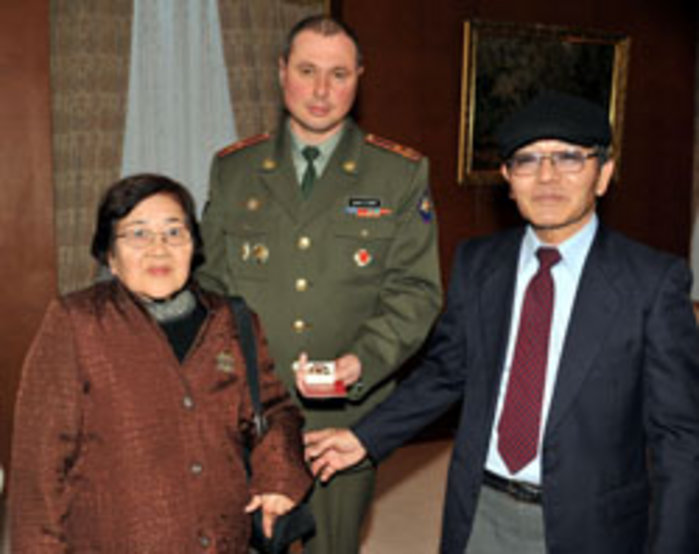
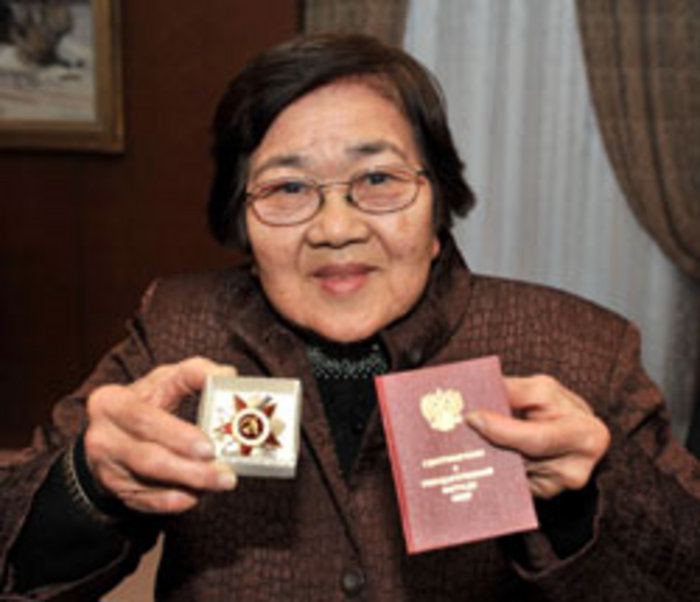
Proud moments: Tokuyama Toshiko (above left, and below) at the Russian Embassy in Tokyo on Jan. 13, 2010, as she received the Order of the Patriotic War (Second Class) posthumously awarded to her uncle, Miyagi Yotoku, in 1964. She is pictured above with a Russian military attaché and Omine Rinichi, a journalist who helped her lobby Moscow to present the Soviet-era medal. (Yoshiaki Miura Photos)

Of course, for most people around her, and most of the Japanese population, in fact, the knowledge that between 1933 and 1941 Miyagi Yotoku had spied for the Soviet Union against Japan, and that he had been a member of one of the most successful spy rings in history, meant only one thing: that this Okinawa-native was a traitor to be despised.

But Tokuyama, who is now 81, could never bring herself to doubt her uncle. For the last two decades, in fact, she and a small group of supporters have worked, and to a large extent succeeded, in reversing history's appraisal of Miyagi.

Was he a dedicated communist willing to betray his own country for the good of the Soviet Union? Or was he a more complex character: an idealist with a strong social conscience, perhaps, or a pacifist hoping to avert war between the USSR and Japan? Gradually Tokuyama and others have challenged the once prevalent view of Miyagi as a "treasonous communist," and they have managed to present a more nuanced picture of the man. Their efforts were given an unexpected, if slightly awkward, boost this month.

Two weeks ago, Tokuyama traveled from her home in Los Angeles to the Russian Embassy in Tokyo. There, in a low-key ceremony, she was presented — on her uncle's behalf — with a Soviet-era medal, the grandly-named Order of the Patriotic War (Second Class). Russia's belated recognition of its former spy, prompted, some believe, by the intervention of either President Dmitry Medvedev or Prime Minister Vladimir Putin, has precipitated another flurry of interest in the rapidly evolving legacy of a problematic man.

Tokuyama's affection for "Uncle Yotoku" has lasted a lifetime, but it grew out of just four months they spent in each other's company when Miyagi returned to his native town of Nago in Okinawa in 1937.

The catalyst for his visit was the 60th birthday of his father, Yosei (Toshiko's grandfather), and it represented one of the first times that the surprisingly itinerant extended Miyagi clan had all come together in one place.

Even the patriarch of the family, Yosei, had spent much of his life abroad, chasing work opportunities on farms in the Philippines, Hawaii and finally California. He had been a member of the first generation of Okinawans to venture to the United States, having arrived there in around 1906. Before heading abroad, he and his wife, Kamado, had two sons, one also named Yosei (Toshiko's father) and Yotoku. By 1919, both boys had joined their father in the United States — Yosei found work on a farm and Yotoku studied painting.

In 1928, the younger Yosei returned to Okinawa and stayed there just long enough to find a wife and have one child — the now elderly Toshiko. Soon after that he went back to the U.S. and then Mexico, leaving his daughter in the care of his parents. It was with them that she was living, aged 9, when her uncle visited from Tokyo in 1937.

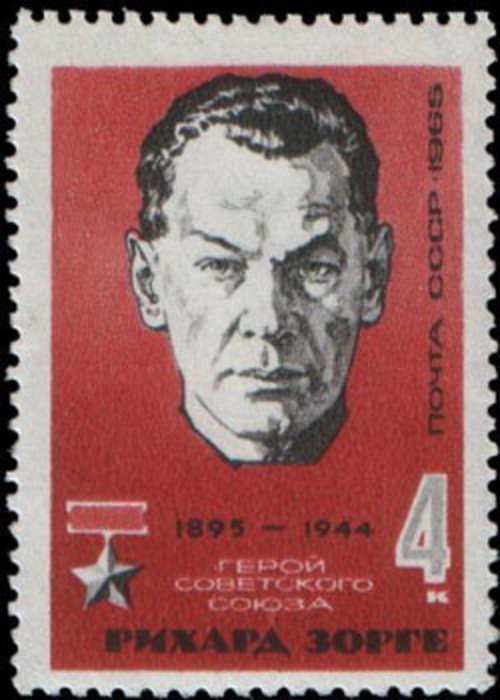
Stamp of honor: Richard Sorge, the Soviets' Tokyo masterspy executed in Tokyo in 1944, was commemorated on this 1965 4-kopeck Russian stamp.

Tokuyama remembers him clearly. "He was so kind and gentle," she recalled, adding that while he was in Okinawa she often watched him as he did a little work as an artist.

"He made two paintings during those four months," Tokuyama recalled. "One was a portrait for a neighbor and the other was a funeral portrait," she said.

Miyagi had been working as an artist in Tokyo, too — it had become an effective cover for the clandestine work that in 1933 brought him back from California to Japan: spying.

Miyagi can't have been too comfortable in Okinawa in 1937. He had left his colleagues — in particular, Ozaki Hotsumi, a journalist with the Asahi Shimbun newspaper, and his boss, Richard Sorge, a Russian with a German passport who was working as a journalist — at the very time that the political situation between Japan and China was reaching boiling point.

So much was happening that was of vital importance to Moscow: Regular military flare-ups between the Japanese and Chinese; the threat of Japanese incursions into Siberia; and the so-called Anti-Comintern Pact concluded in November 1936 between Nazi Germany and Japan that united the Soviet Union's western and eastern neighbors against it.

Tokuyama remembers the day that Yotoku's sojourn in Okinawa was cut short. Sorge, she said, sent a letter demanding the prompt return of his protege to Tokyo. "After he read it, Yotoku got my cousin to burn the letter," Tokuyama said.

Miyagi was gone shortly afterward, leaving behind two promises he was destined to break. One was to return a bag he borrowed from a painter friend, Terada Takeo, who went on to become a leading artist after the war. The other was to return to Okinawa to paint portraits of his niece and his other relatives.

Miyagi's adoption of the communist cause occurred while he was living in the U.S. in the 1920s, but the seeds of his proletarian social conscience had been sown as he grew up in Okinawa.

In his testimony to the Japanese police after his eventual arrest, in 1941, Miyagi explained, "I gained my first political consciousness at the age of 14 or 15 as I listened to my grandfather."

What his grandfather told him was about the history of their island home, which had been part of the Ryukyu Kingdom before it came under the influence of southern Japanese domains during the Edo Period and was formally annexed by Japan in 1879.

"My grandfather taught me that one should not oppress the weak," Miyagi told his police interrogators. "This provoked in me an antagonism toward the arrogant officials and physicians who came to Okinawa from Kagoshima (the Kyushu city from where Okinawa was administered)."

Miyagi headed to California in 1919, after discontinuing his studies at Okinawa Prefectural Normal School due to a chest ailment. Like many Okinawans who crossed the Pacific at the time, he hoped to find equality, freedom and opportunity in the United States. He did, to an extent, but he also found that many Americans looked down on him and his fellow Asian migrants. Around 1925, in Los Angeles, he established the Shakai Mondai Kenkyukai (Association for Research into Social Problems), a platform to try to improve their situation.

The group eventually changed its name to Reimei Kai (Society of the Dawn), and around 1927 it came under the influence of the Communist Party of the United States.

Nevertheless, Miyagi's political activities appear to have been tempered by his interest in art. Skilled at drawing since childhood, he had studied at two art schools since arriving America: the California School of Fine Arts (now the San Francisco Art Institute) and the San Diego Public Art School. And it appears there were some in his adopted country who recognized his talent. In the January 1930 edition of the New York-based journal, "The Art Digest," he is singled out in a review of an exhibition of 24 young Los Angeles-based Japanese artists: "Y. Miyagi is young, only 27 years of age. He has worked (in the United States) for the last ten years. He provides, in my opinion, the 'clou' of the show. He cannot be classified in any school. His portrait of a lady is beautifully designed and placed in the frame with rare sensitiveness. The sympathetic, intelligent and beautiful head is finely modeled and interpreted."

A year before that article, in 1929, Miyagi had found a way to combine his two passions. He and some friends joined together to form the Puroretaria Geijutsu Kai (Proletarian Arts Association) – and although it is difficult to ascertain exactly how this affected his artistic output, it seems likely he had resolved to put his artistic talent to use as a means for social activism.

Meanwhile, as the artist Miyagi was beginning to flirt with communism in California, the man who was to become his boss, Richard Sorge, was plying his trade of espionage in Shanghai. While working as a journalist there for the German newspaper Frankfurter Zeitung, he established contacts with members of the Chinese Communist Party and reported to Moscow on the rising tension between the Chinese and the growing number of Japanese soldiers then being stationed in the country.

Sorge was recalled to Moscow in 1932, and it wasn't long before his handlers in the Red Army's Fourth Department (its military-intelligence wing), set in motion a plan to have their Asia specialist sent to the country that had emerged as the most important in the region — Japan.

But as Sorge didn't speak any Japanese, it was clear he would need a Japanese assistant who was also fluent in English – if not Russian or German – and committed to Soviet ideals. The search led to the U.S., then to California — and finally to a promising painter-cum-activist named Yotoku Miyagi.

Tokuyama, Miyagi's niece, is well versed on how her uncle responded to the request from Moscow, channeled through the American Communist Party in autumn 1932, that he return to Japan as a spy.

"He refused," she said. "He had no experience in spying and he asked them to find someone more suitable."

When they pressed him, she continued, "he sought a commitment that it was only for a short time, and that as soon as a replacement was found he would be able to quit." Needless to say, a replacement was never found.

Miyagi left America in October 1933, found a place to stay in Tokyo and laid low. Then, following instructions he had been given in Los Angeles, he became an avid reader of a local English-language newspaper called The Japan Advertiser — a publication that seven years later was acquired by The Japan Times.

Art and artifice: A painting of Inagamurasaki, a coastal promontory near Kamakura, south of Tokyo, by Miyagi Yotoku. His work as an artist was convenient cover for his key role in the Sorge spy ring, and also provided him with a wide range of useful contacts. (Nago Museum)

Some time between Dec. 6 and 9, 1933, Miyagi came across the classified advertisement he had been told in Los Angeles to look out for in the Wanted to Buy section: "Ukiyoe prints by old masters. Also English books on same subject. Urgently needed. Give details, titles, authors, prices to Artist, c/o The Japan Advertiser, Tokyo."

He answered the advertisement and so came to be in contact with an intermediary, Branko Vukelic, who arranged his first meeting with Sorge.

The venue for that fateful encounter was an art museum in Ueno — probably the Tokyo Metropolitan Art Museum. Sorge's identification was a black necktie; Miyagi's was a blue one. And, just to make sure there was no mistake, they had each been supplied with consecutively numbered $1 bills.

Despite having no training, Miyagi took to spying quickly. By the time of his trip to Okinawa in 1937, he had become an accomplished pro.

For one thing, he had established a surprisingly diverse network of informants: Yasuda Tokutaro, a Tokyo physician who quizzed his prominent patients for information; Yamana Masazano, a former member of the Communist Party who Miyagi dispatched to various locations to make observations of military facilities; Yabe Shu, a secretary to an Imperial Army general named Issei Ugaki; and others.

Miyagi's success in cultivating informants stemmed in part from his commitment to the communist cause. If he was merely a left-leaning artist in the late 1920s, by 1936 he had developed into quite an ideologue, reportedly expressing his disapproval of one Manchuria-based collaborator by saying that "According to my standards, he was not a genuine communist because he was going to Manchuria to make money."

Despite his stringent standards, Miyagi's network ultimately became so diverse that he even received notice of orders placed for Japanese soldiers' uniforms — useful in determining whether the troops were to be dispatched north, to cold climes, or south.

His other job was to translate Japanese reports and newspaper articles into English for his boss, Sorge.

However, the first task that awaited Miyagi when he returned to Tokyo in mid-1937 was to analyze the reasons for a recent flare-up between Chinese and Japanese forces in China — the epochal, so-called Marco Polo Bridge Incident.

Miyagi's ultimate advice to Sorge was that the confrontation — which came about after a Japanese soldier went missing during night-time maneuvers — was largely engineered by the Imperial Japanese Army to direct attention away from domestic problems in Japan, and also to provide an excuse for further expansion of Japanese territory beyond that already grabbed in the northern region of Manchuria. Sorge duly relayed the information to the Soviet Union by radio.

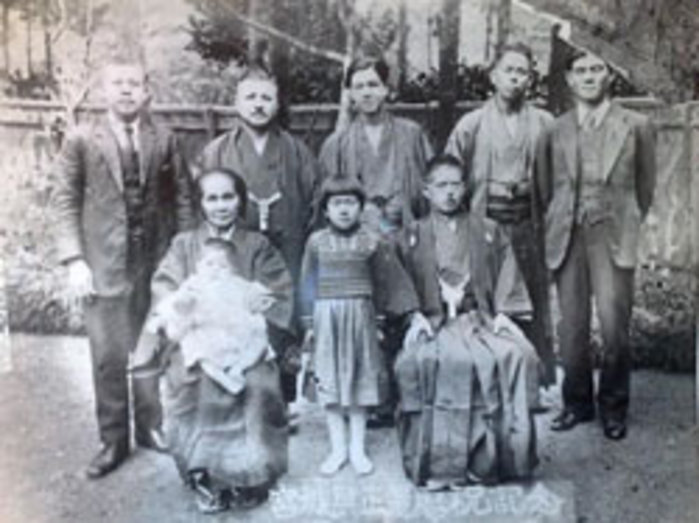
Family secrets: Members of the Miyagi family gathered in Nago, Okinawa, in 1937, during the spy Miyagi Yotoku 's visit to his home town at the time of his father's 60th birthday. His niece, Tokuyama Toshiko, then aged 9, is in the center of the front row, between her grandfather, Yotoku's father, Yosei, and her grandmother, Kamado. Her uncle Yotoku, then already a key member of Sorge's spy ring for four years, is on the far right. The writing on the photo reads: "In commemoration of the 60th birthday of Miyagi Yosei." (Tokuyama Toshiko Phtoo)

To the extent that the incident mushroomed into eight years of war in China, Miyagi's analysis was spot on.

For Sorge and his handlers in Moscow, however, there was another particularly interesting dimension to Miyagi's report: that Japan's latest engagement with China made northward military incursions into Soviet territory unlikely, at least for the moment.

As it turned out, Japan refrained from engaging the Soviet Union militarily for about one year. Then, in May and June, 1939, near the town of Nomonhan on the Manchurian- Mongolian border, the Emperor's forces launched a small-scale attack.

Sorge and his spies were unable to forewarn Moscow of the move, but once hostilities began, they swung into action.

Their key objective was to determine whether or not the attack was the first part of a large-scale push, or merely a tentative prod.

Working with one of his newest recruits, an Imperial Army corporal named Koshiro Yoshinobu, Miyagi determined that Japan was not committing large numbers of troops to the campaign and, most importantly, that no reinforcements were being sent from Japan. Hence, the conclusion was reached that this was not the start of a concerted campaign, and Sorge was able to convey as much to his Soviet masters.

Moscow, however, was unwilling to take any chances, and directed more than enough resources to counter the Japanese. By September 1939, they had prevailed.

Both Miyagi and journalist Ozaki — who by then, extraordinarily, had been working for two years as an adviser to Prime Minister Konoe Fumimaro (who had recently resigned) — next predicted that the unfortunate outcome of the so-called Nomonhan Incident would likely deter the Japanese from messing with the Soviets again. This and other analysis enabled Sorge to advise his handlers, in September 1941, that Japan would not invade the USSR.

Some historians have suggested that this was one of the most important pieces of intelligence gained in any theater of World War II, because it allowed the Soviets to divert troops from the eastern regions of the USSR to the west, where they could fend off, and ultimately repel, a German invasion that at one point took the Nazis to within sight of Moscow.

Sorge of course was not entirely reliant on Miyagi and his other Japanese collaborators.

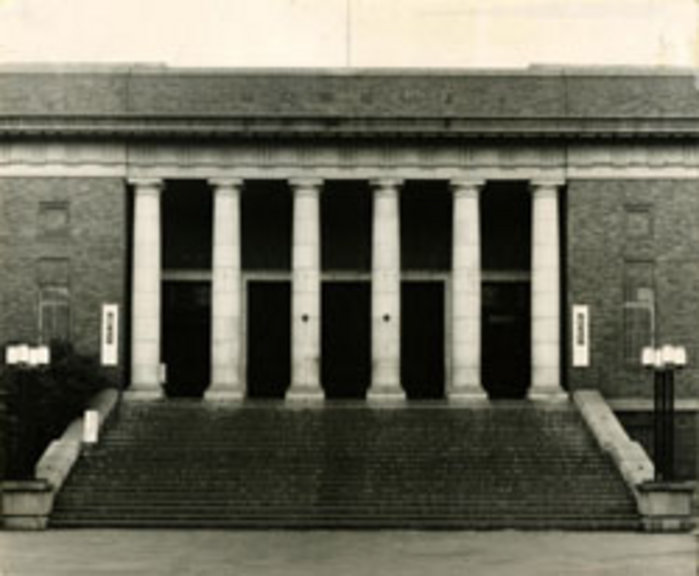
Crime scene: Tokyo Metropolitan Art Museum in Ueno prior to its rebuilding in the 1970s. Research by Yoneda Tomoko, an artist who has made a series of photographs about the Sorge spy ring, suggests that Miyagi first met Sorge here, in December, 1933, before going on to work for him until he was arrested in 1941. (Tokyo Metropolitan Art Museum)

One of his greatest achievements — as a supposedly German journalist in Tokyo — was gaining intelligence on Operation Barbarossa, the blitzkrieg advance that launched the Nazi invasion of the Soviet Union on June 22, 1941. Through his contacts in the German Embassy, he reportedly gave Moscow prior warning of that operation — and even correctly predicted its starting date to within days.

However, that intelligence — which should have accorded Sorge enormous kudos in Moscow — had been, unknown to him then, largely ignored. The reason was that his initial handler, the one-time head of the Red Army's Fourth Department, Ian Berzin, had fallen foul of the Soviet dictator, Josef Stalin, and been executed in 1938 in one of Stalin's many murderous and paranoid purges. Suspicion then fell on all Berzin's agents, and soon Stalin reportedly decided that Sorge was a double agent. After that, it is unclear how much of the information he provided to Moscow was acted upon.

By 1941, however, Sorge and his associates had more to worry about than how they were perceived in Moscow.

In September that year the Tokubetsu Koto Keisatsu (Special Higher Police) arrested one of Miyagi's associates, who one of their informants had told them was a spy. In a successful bid to clear her own name, that associate denounced Miyagi, who then named Ozaki and Sorge. By the end of October, all the members of Sorge's spy ring had been rounded up, and they had all made confessions.

Miyagi, who had never fully recovered from the chest ailment he suffered in childhood, died in Sugamo Prison in Tokyo in the middle of his trial in 1943. He was 40 years old. Ozaki and Sorge were tried, convicted of spying and eventually hanged, in 1944.

The tug-of-war struggle over Miyagi's reputation began almost as soon as he had passed away.

News of his demise and of his involvement in a spy ring arrived in his hometown of Nago in late 1943, in the form of a short notice in the Asahi Shimbun.

The local reaction was swift and ruthless. Miyagi was denounced as a traitor. The town office erased his family-registry entry, meaning that he had officially never existed, and the townsfolk ostracized his mother —Tokuyama Toshiko 's grandmother, Kamado.

"I was still a student and I had friends at school, so it was OK for me," Tokuyama explained. "But my grandmother had a terrible time."

Miyagi's niece never wavered in her support for her uncle. "We didn't even know what a spy was when we first heard the story," Tokuyama said. "It didn't matter what people said. To me, he was always my uncle and I never doubted him."

Vindication: At the Russian Embassy in Tokyo on Jan. 13, 2010, Russia's Ambassador to Japan, Mikail Bely, presents Tokuyama Toshiko with the Order of the Patriotic War (Second Class) awarded posthumously to her uncle, Miyagi Yotoku, in 1964. (Yoshiaki Miura Photo)

Nevertheless, things didn't improve for the members of the Miyagi clan who remained in Okinawa. By 1958, Tokuyama had had enough. On May 1 that year she left the island to join her father, who was then in Mexico.

"Because of the way the people in Nago were treating my grandmother," she said, "I decided I would never return."

Oddly enough, just one year before Tokuyama abandoned Nago, a chain of events was set in motion that would ultimately lead to a sharp reversal in her uncle's reputation.

In 1957, the French film director Yves Ciampi married Japanese actress Keiko Kishi. Three years later he made a film about Sorge and his fellow spies, titled "Qui êtes-vous Monsieur Sorge?" ("Who are you Mr. Sorge?"). Released in Europe in 1960, the film also came to the attention of then Soviet Premier Nikita Khrushchev, who saw it in Moscow in mid-1964.

Ironically, at this point in history, Sorge's tale was largely unknown in the Soviet Union — the lingering result of him having been denounced by Stalin. (The story was better known in the U.S., as the Occupation forces in Japan looked into it after the war, and released a report in 1949.)

Khruschev's reaction to the film is recorded in the memoir of a former Red Army general named Vyacheslav Bunin, portions of which were translated into Japanese and published in 2003 by the private Japan-Russia Historical Research Center under the title "Isshun" ("Moment").

According to Bunin, Khruschev saw the film and asked, "Why didn't we know anything about his activities? He's our spy. Why didn't we make such a great movie about him?"

The Soviet Premier commissioned a report and in late 1964 the Presidium of the Supreme Soviet decided that the long-forgotten Richard Sorge would be made a "Hero of the Soviet Union" — the nation's highest honor. The families of both Sorge and another deceased Russian member of the group, Branko Vukelic — who had arranged the first meeting between Sorge and Miyagi — would also be awarded the equivalent of ¥1.5 million each.

It was also decided that Ozaki Hotsumi and Miyagi Yotoku would be honored with the Order of the Patriotic War — an award for service in World War II. However, the next-of-kin of the Japanese spies were not informed of this.

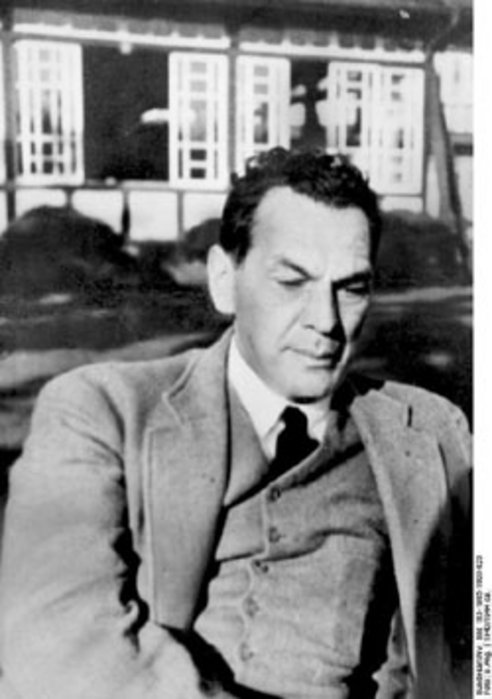
Mastermind: Soviet spy Richard Sorge pictured in Japan in 1940, a year before his arrest. (German Federal Archive)

The Soviet awakening to Sorge's story prompted a new wave of interest in the spy ring in Japan. One of the journalists to start snooping around was Rinichi Omine, a freelancer who, like Miyagi, hailed from Okinawa.

In 1990, Omine played a role in organizing an exhibition of paintings by Miyagi Yotoku that was held in Nago and Naha, Okinawa. According to Omine, it was this event that started to sway local opinion about the son they had renounced.

"When I first went to research Miyagi in Okinawa, the whole atmosphere was bad," the 72-year-old journalist recalled. "He was seen as a traitor. Some people said they had nothing to talk about. Others threw buckets of water at me."

But then, articles and essays written to coincide with the exhibition started filling out the details of Miyagi's life, in particular, the fact that his adoption of communism had stemmed in part from a desire to resist discrimination against Japanese and other Asian migrants in the United States.

In 2003, further reconsideration of Miyagi's life was made in a symposium held in Nago to commemorate the centenary of Miyagi's birth. The event, which was organized by Omine and others, was sufficient to tempt his niece Tokuyama back to Okinawa for a brief visit.

In 2006, a monument to the painter-spy was erected in a small park near Nago Museum. Articles in local newspapers at the time hailed him as "an artist who longed for peace," explaining that his ultimate goal in spying against his country was to avoid war between it and the USSR.

"With the monument, I felt we had managed to restore Miyagi's reputation in Japan," Tokuyama said.

What played on Tokuyama and Omine's minds, however, was Miyagi's reputation in Russia, the country, or at least the present-day manifestation of the country for which he gave his life.

Particularly grating was the fact that the Soviet members of the spy ring had been turned into national heroes.

About two years ago, Omine and Tokuyama began sending letters to Russia to try to ascertain what had happened to the awards that the Presidium of the Supreme Soviet had earmarked for Ozaki and Miyagi in 1964.

Drawing on Bunin's writings, they directed their inquiries to Vyacheslav Sivko, president of the Regional Public Fund for Support of Heroes of the Soviet Union and Russia, in Moscow.

Sivko's reply, which Tokuyama received in January last year, wasn't encouraging.

"In response to your inquiry, a specialist in the Department of Awards at the President of the Russian Federation explained to us that in the case of your uncle, who was awarded posthumously, the corresponding Order/Certificate of the President of the USSR was issued, but the actual medals and documents for them have not been produced, because the relevant person was no longer alive."

Not easily discouraged, Omine decided that there was only one course of action remaining: writing directly to President Dmitry Medvedev and Prime Minister Vladimir Putin.

With the help of a recently acquired Russian friend, Vera Varshavsky, and Tokuyama's daughter, San Diego-based Noriko Chung, the letters were prepared and sent in mid-2009. They were deliberately blunt, pointing out in particular Tokuyama's disappointment at the perceived unequal treatment of the Russian and Japanese members of Sorge's team.

The response came in late December. Omine received a letter from the Russian Embassy in Tokyo saying that the original medal intended for Miyagi Yotoku — an Order of the Patriotic War (Second Class) — along with its accompanying certification, had been "discovered" in a government building in Moscow. Both the medal and certificate were awaiting collection at the Tokyo embassy.

Omine and Tokuyama wasted no time. Omine flew in from his home in Okinawa; Tokuyama from hers in Los Angeles.

It was on the morning of their initial appointment at the Russian Embassy that they spoke to The Japan Times.

In his excitement, Omine had left both the Embassy's letter and the charger for his digital camera at home. Tokuyama, by contrast, was composed, but nevertheless thrilled at the thought of receiving the medal.

"When I get the medal I will take it down to Nago and donate it to the Nago Museum, where Yotoku's paintings are kept," she said. "They have all his things now."

The ceremony took place on the afternoon of January 13 — exactly 67 years since Miyagi died and 46 years since the Soviets had originally decided to honor him. The medal itself was a red enamel star emblazoned with a hammer and sickle and an inscription in Cyrillic that read "Patriotic War." The Russian Ambassador commended Miyagi's contribution to the "defeat of fascism," as a stout-looking military attache looked on. After thanking the Russians, Tokuyama Toshiko turned to the 20-odd Japanese journalists who had witnessed the ceremony.

"My uncle, Yotoku," she stated, "just wanted to contribute to peace."

Those interested in reading more about the Sorge spy ring may care to consult: "An Instance of Treason" by Chalmers Johnson (Stanford University Press, 1964). "Stalin's Spy" by Robert Whymant (I.B. Tauris Publishers, 1996) "Target Tokyo" by Gordon Prange and others (McGraw-Hill, 1984).

Edan Corkill is a staff writer in the arts, entertainment and features department of The Japan Times. This is a revised and expanded version of an article that appeared in The Japan Times on January 31, 2010.

Chalmers Johnson is the author of An Instance of Treason and of three books on the crises of American imperialism and militarism. They are Blowback (2000), The Sorrows of Empire (2004), and Nemesis: The Last Days of the American Republic (2006). All are available in paperback from Metropolitan Books.

Recommended citation: Edan Corkill and Chalmers Johnson, "Sorge's Spy is Brought in From the Cold. A Soviet-Okinawan Connection," The Asia-Pacific Journal, 6-1-10, February 8, 2010.

2010-02-01

6,000 rally in Tokyo against Futenma relocation

Japan Today

TOKYO —Some 6,000 people gathered Saturday in Tokyo to rally against relocating the U.S. Marine Corps’ Futenma Air Station within Okinawa, as debate on the issue intensifies following the local election victory of a relocation opponent. Consumer affairs minister Mizuho Fukushima, who took part in the rally, reiterated her resolve to see the base moved out of Okinawa or Japan altogether. Prime Minister Yukio Hatoyama has said all options remain open, including the current plan to relocate it within Okinawa, until a final decision is taken in May.

‘‘I hope to win the struggle in terms of having the land for the Futenma base returned and seeing that no more burdens are placed on Okinawa,’’ Fukushima said in an address to the gathering, which was organized by civic groups such as Peace Forum and included more than 100 participants from Okinawa.

‘‘We have several months to go before reaching a conclusion at the end of May, and we will definitely win with all our might,’’ said the head of the small ruling coalition partner Social Democratic Party.

2010-01-26

Democracy Now! Headlines for January 25, 2010

Democracy Now!

150,000 Bodies Buried in Haiti; Death Toll Could Top 300,000

Haitian authorities say more than 150,000 bodies have been buried in Haiti since the devastating January 12th earthquake. Haiti’s Communications Minister Marie-Laurence Jocelyn Lassegue suggested the death toll could rise to 300,000. Lassegue said, “Nobody knows how many bodies are buried in the rubble.” As many as 800,000 Haitians are now homeless in the capital of Port-au-Prince. To deal with the housing crisis, Haitian officials have announced plans to house 400,000 survivors in tent cities outside the capital of Port-au-Prince, but the International Organization for Migration said it could take weeks to search out sites suitable for the tent cities. The organization says 100,000 tents are still needed. An estimated 200,000 residents of Port-au-Prince have already fled for the countryside or other cities in Haiti. Up to 100,000 people have returned to the region around the coastal city of Gonaives in northern Haiti, a city abandoned by many after two devastating floods in six years. Many survivors of the earthquake have still not received medical attention. Dr. Mill Etienne is a Haitian American neurosurgeon aboard the US Navy’s floating hospital, The Comfort.

Dr. Mill Etienne: “Many of these patients, because their legs, for example, were crushed a week ago, they didn’t get immediate medical attention. A lot of them were stuck in a building or a house for two, three, four, five days before they were discovered. So what happens is, for a lot of those patients, their legs are dying. And having that dead leg there puts you at increased risk for infection. And that infection in the leg can actually kill the patient. So we are having to do a lot of amputations.”

Oxfam Calls for International Community to Cancel Haiti’s $890 Million Debt

Haiti’s Prime Minister Jean-Max Bellerive, Secretary of State Hillary Clinton and others will take part in closed-door talks today in Montreal to map out key priorities for rebuilding Haiti. Oxfam is calling on foreign ministers attending the talks to cancel Haiti’s outstanding $890 million international debt.

Hope for Haiti Telethon Raises $57 Million

On Friday, the Hope for Haiti telethon was broadcast across the United States. The event, organized by George Clooney, raised $57 million for relief organizations in Haiti.
So far the world’s nations have pledged some $1 billion in emergency aid to Haiti. The amount of money being sent to help Haiti pales in comparison to the US war budget. In 2007 the economist Joseph Stiglitz and Linda Bilmes estimated the war in Iraq was costing the United States $720 million a day.

Number of Children in Poverty in US Increases by 2.5 Million Since 2000

A new report on child poverty has found more than 13 million American children now live in families with incomes below the official federal poverty level of $22,000 a year for a family of four. The number of American children living in poverty has increased by 2.5 million over the past ten years. The National Center for Children in Poverty says another 16 million children live in low-income families but are ineligible for public benefits because they live in households that earn slightly more than $22,000 a year.

Japanese Voters Back Anti-US Base Mayoral Candidate

The Pentagon’s plans to open another military base on the Japanese island of Okinawa has been dealt a setback. Voters in the city of Nago have elected a mayor who campaigned on a promise to oppose the base. The US has more than 47,000 troops in Japan; half of them are in Okinawa.

Netanyahu: Israel Will Retain Parts of West Bank Forever

In news from the Middle East, Israeli Prime Minister Benjamin Netanyahu said Sunday that Israel would retain parts of the occupied West Bank forever. Netanyahu made his comment just hours after meeting with George Mitchell, the Obama administration’s Middle East envoy. Speaking at a settlement south of Jerusalem, Netanyahu said, "Our message is clear: We are planting here. We will stay here. We will build here. This place will be an inseparable part of the state of Israel for eternity.”

Haitian Activist Jean Montrevil Released from ICE Detention

And prominent Haitian community activist has been released from jail after being held for three weeks in detention by Immigration and Customs Enforcement. Jean Montrevil’s scheduled deportation was indefinitely put off after the earthquake in Haiti. Since late December, immigrant rights groups and clergy have organized a series of protests calling for Montrevil’s release.

2010-01-25

Guam fears influx of US military personnel

PressTV

The ethnic majority in US territory of Guam fear the US planned influx of military personnel will swamp the original inhabitants of the island.

Washington is planning to relocate some 19,000 personnel and their families to Guam from southern Japan.

"This proposed military build-up, with our current political status, will result in the cultural and racial genocide of the Chamorro people," said Frank J. Schacher, the chairman of the Chamorro Tribe Inc, referring to the indigenous people who make a third of the present population of the island.

"It is our island, our ancestral remains, our sacred artifacts, our waters, our culture, and our right to exist as a race that would be destroyed by these intended actions," he added.

The island, east of the Philippines, was taken over by the United States in 1898 and its people are considered statutory US citizens.

Schacher, a 10-year veteran of the US Air Force, had previously warned that "by 2014, we are going to have an additional 78,000 active duty military, military dependants, civil service…. After 30 days on this island, they will be eligible to vote in any of our elections."

Some 8,000 of the troops are to be taken out of the Japanese island of Okinawa, where locals have for long protested the presence of US military personnel who are allegedly involved in crime, pollution, noise and accidents in the Japanese territory.

2010-01-14

Democracy Now! Headlines for January 13, 2010

Democracy Now!

Witnesses: NATO Troops Kill Afghan Protesters

In Afghanistan, villagers in southern Helmand province say NATO troops opened fire on a protest Tuesday, killing thirteen people and wounding more than two dozen others. The alleged attack took place in Garmsir, a town in the southern Helmand province under occupation by US Marines. The victims had apparently gathered to protest a NATO raid in their town. One resident said he witnessed troops firing into the crowd.

Resident: “In this demonstration, thirteen people died, and twenty-five are wounded. The situation is very bad, and the protest is still going on. People are very angry with foreigners because they have desecrated our holy Koran. They also fired on demonstrators. I repeat that many people died and were wounded during the protest.”

16 Killed in US Drone Attack in Afghanistan

NATO, meanwhile, has announced it killed sixteen people this week in a rare drone attack inside Afghanistan. NATO says the victims were all militants based in southern Afghanistan. In an interview with the Wall Street Journal, a “senior US military official” said he expects an escalation of drone attacks inside Afghanistan in the coming months. The top US oversight investigator in Afghanistan has revealed only one-fourth of current corruption probes involve strictly Afghan suspects. The investigator, Raymond DiNunzio, says the remaining three-quarters involve at least one Western suspect.

Report: Obama to Request $33B for Wars

The Associated Press is reporting President Obama plans to ask Congress for an additional $33 billion to fight the wars in Iraq and Afghanistan next year. The request would come on top of an expected $708 billion sought for the Pentagon, the first time a Defense Department budget request would exceed $700 billion.

1 in 8 Americans Receiving Food Stamps

The number of Americans receiving food stamps continues to break all-time records. On Tuesday, the Agricultural Department said 37.9 million people—one in eight Americans—received food stamps in October, the ninth consecutive month to see a record increase.

Study Links Monsanto GM Corn to Organ Failure

A new study claims to have uncovered new health effects caused by genetically modified corn from the agricultural giant Monsanto. The International Journal of Biological Sciences says GM corn helped cause organ damage in rats. The study’s author called Monsanto’s GM methods “a very serious mistake, dramatic for public health.”

Japan Delays Decision on Moving US Base

Japan continues to resist US pressure on relocating a US military base on the island of Okinawa. The Japanese government has said it wants to move the base completely off the island of Okinawa, while the US wants to maintain a base somewhere else on the island. Tens of thousands of Okinawa residents have taken part in ongoing protests against the base. On Tuesday, Secretary of State Hillary Clinton failed to reach an agreement in a meeting with Japan’s Foreign Minister.

Secretary of State Hillary Clinton: “At the end of the day, I am confident that we will resolve this matter in a way that reflects the very best of our alliance, the strength of that alliance for the next fifty years, and provides the security guarantees that the Japanese people are looking for.”

The Obama administration had been lobbying for an immediate decision on the base but now says it will respect Japan’s request to wait until May.

Israel Arrests Anti-Wall Activists

In Israel and the Occupied Territories, two members of the Popular Committee Against the Wall have been arrested in the West Bank village of Ni’ilin. Ibrahim Amirah and Hassan Mousa are the latest in a number of activists arrested by the Israeli military for organizing against the Israeli separation wall through the West Bank.

Miep Gies Dies at 100

And Miep Gies, the last surviving link to the Nazi Holocaust diarist Anne Frank, has died. She was 100 years old. Gies helped hide Frank and her family for over two years during the Second World War. Gies hid and preserved Frank’s diaries and later gave them to her father Otto, the only surviving member of the Frank family.