The Nation
NEW YORK – The trial of Aafia Siddiqui has made progress over the past four days, with FBI experts confirming that the M-4 rifle the Pakistani neuroscientist allegedly used to shoot at US investigators in Afghanistan does not have her fingerprints, the casing of the two fired bullets were not found, nor their projectiles or fragments discovered from the wall of the room where the incident took place. In addition, Carlo Rosati, an FBI firearms expert said on Friday, the fourth day of the trial in a Manhattan federal court before it adjourned for the weekend, he wasn’t sure the rifle was ever fired at the crime scene. The three-member defence team retained by the Pakistan government to defend Ms Siddiqui also brought out contradictions in the testimonies given by government witness put on the stand since Tuesday, when the trial began.
For instance, a former Afghani interpreter hired by US Special Forces contradicted the version of the incident in Ghazni given by a US Army captain about the position of Ms Siddiqui while allegedly aiming the rifle. While interpreter Ahmad Gul told the court that the Pakistani neuroscientist was standing with the gun in her hand, Capt Robert Snyder had said that she was in kneeling position. But the prosecution continues to insist that Ms Siddiqui had fired the gun. In his testimony on Friday, Rosati, the firearms expert, said he had thoroughly examined the weapon, the curtain from a room of Ghazni police station where the shooting incident took place and the debris of its wall where two bullets reportedly hit, but found no evidence that gunshots leave behind.
Ms Siddiqui is charged with snatching a US warrant officer’s rifle in mid-2008 while she was detained for questioning in Afghanistan’s Ghazni province and firing it at FBI agents and military personnel. None of them were hit. Pointedly asked by Charles Swift, the lead defence lawyer, if he was certain the M-4 rifle was ever fired at the crime scene, he said he could not say that with absolute certainty. An FBI forensic expert has already confirmed he found no fingerprints of Ms Siddiqui on the M-4 rifle when the weapon was produced in the court Thursday. Rosati, the firearm expert, said there was no gunshot residue on the curtain behind which Ms Siddiqui was stated to be sitting, nor he found any projectiles or fragments from the part of the bullet-hit wall built with stones and hard mud.
Based on the texture and content of the debris, Rosati said a bullet fired from an M-4 rifle into that kind of wall might get shattered or fragmented. However, under cross examination by defence lawyer Swift, the FBI expert conceded that a key element of the bullet - a steel tip that penetrates hard surfaces and never fragments - should have remained intact. Rosati did confirm that the 9-mm pistol that the US Army chief warrant officer used to shoot Ms Siddiqui, along with its two recovered, cases recovered at the crime scene, were fired. Swift, one of three lawyers retained by the Pakistan government who previously worked for the US Navy in the area of criminal defence, retained his reputation as a sharp trial attorney. He has been quick in identifying inconsistencies in the witnesses’ testimonies.
Meanwhile, Ms Siddiqui was again escorted out of the courtroom after saying she could help bring peace to Afghanistan, but that her lawyers’ don’t let her testify. “If you follow the mercy of mankind...they want to take away my right to testify. I’ve asked for it,” Ms Siddiqui told spectators during a break in the case. Please, I know you’ll take me out,” she told US marshals as they motioned to move her to a holding cell outside the courtroom. “I am not an enemy. I didn’t shoot anyone. I can bring peace with Afghanistan and the Taliban in one day, God willing,” she said. “There is no use for revenge and forgiveness is necessary”. Before Friday’s session ended, Judge Richard Berman reminded jurors that Ms Siddiqui’s trial was limited to attempted murder, not on charges of terrorism or involvement in any chemical or biological project. A section of the American press has consistently been portraying her as a terrorist, with headlines like: “Lady al-Qaeda”.
He also said that the trial was proceeding according to the schedule, and expects testimonies to conclude by the end of next week after which the jurors would begin consultations. At that stage, Swift, the lead lawyer, told judge Berman that the extra security measures, about which he had protested on Thursday, were still in place on Friday. He asked him to order the withdrawal of the additional measures that included the production of personal identification by visitors to the trial. He said the tougher measures violated the right of his client to a free and open trial.
Judge Berman said he would discuss the issue with the building security management, but asked the defence lawyer to submit his complaint in writing. Swift said the security people were saying that orders for the additional measures, in fact, came from the judge Berman. The judge did not respond to that comment. The trial of Ms Siddiqui is taking place under heavier-than-usual security. On Wednesday, a metal detector was put in place outside the 21st-floor courtroom, in addition to the ones already on the ground floor. Shahid Comrade, general secretary of the Pakistan-USA Freedom Forum, also protested the tough security measures in a statement issued on Friday.

2010-01-25

Guam fears influx of US military personnel
PressTV
 The ethnic majority in US territory of Guam fear the US planned influx of military personnel will swamp the original inhabitants of the island.
Washington is planning to relocate some 19,000 personnel and their families to Guam from southern Japan.
"This proposed military build-up, with our current political status, will result in the cultural and racial genocide of the Chamorro people," said Frank J. Schacher, the chairman of the Chamorro Tribe Inc, referring to the indigenous people who make a third of the present population of the island.
"It is our island, our ancestral remains, our sacred artifacts, our waters, our culture, and our right to exist as a race that would be destroyed by these intended actions," he added.
The island, east of the Philippines, was taken over by the United States in 1898 and its people are considered statutory US citizens.
Schacher, a 10-year veteran of the US Air Force, had previously warned that "by 2014, we are going to have an additional 78,000 active duty military, military dependants, civil service…. After 30 days on this island, they will be eligible to vote in any of our elections."
Some 8,000 of the troops are to be taken out of the Japanese island of Okinawa, where locals have for long protested the presence of US military personnel who are allegedly involved in crime, pollution, noise and accidents in the Japanese territory.
 The ethnic majority in US territory of Guam fear the US planned influx of military personnel will swamp the original inhabitants of the island.
Washington is planning to relocate some 19,000 personnel and their families to Guam from southern Japan.
"This proposed military build-up, with our current political status, will result in the cultural and racial genocide of the Chamorro people," said Frank J. Schacher, the chairman of the Chamorro Tribe Inc, referring to the indigenous people who make a third of the present population of the island.
"It is our island, our ancestral remains, our sacred artifacts, our waters, our culture, and our right to exist as a race that would be destroyed by these intended actions," he added.
The island, east of the Philippines, was taken over by the United States in 1898 and its people are considered statutory US citizens.
Schacher, a 10-year veteran of the US Air Force, had previously warned that "by 2014, we are going to have an additional 78,000 active duty military, military dependants, civil service…. After 30 days on this island, they will be eligible to vote in any of our elections."
Some 8,000 of the troops are to be taken out of the Japanese island of Okinawa, where locals have for long protested the presence of US military personnel who are allegedly involved in crime, pollution, noise and accidents in the Japanese territory.
Sheikh Jarrah: Settlers throw urine bottles, activists arrested
International Solidarity Movement
Thursday, January 22nd, settlers occupying the Gawi and Al-Kurd family’s homes were reported to be harassing and attempting to provoke the evicted Palestinians and solidarity activists to a violent response. Other settlers stood by with film equipment, ready to record any response to their provocation. The evening’s heckling resulted in the arrest of Marwan Abu al Saber. Al Saber was released later that night.
Settler harassment of neighborhood residents continued and during the night four chairs were stolen by settlers from the Al-Kurd tent. In the last two weeks they have also stolen an ISM”ers shoes and a shelf from the tent. Thursday night’s theft was reported to the police but no action was taken.
Friday morning a young settler boy in the Al-Kurd home threw bottles from the home towards the Al-Kurd tent. One bottle, directed at a solidarity activist who was filming nearby, contained urine.
The rest of the day was quiet and the weekly, nonviolent demonstration began as usual. Police closed the street and when demonstrators tried to enter the area, they were arrested. 15 Israeli activists were arrested as they tried to reach the Gawi and Al-Kurd tents. Access to the nearby Orthodox Jewish tomb was also restricted however access was granted for settlers and Jewish Israelis. At the barrier to the tomb, a few young orthodox Jewish boys began throwing stones at a Palestinian woman from the neighborhood. When it became apparent that the police were condoning these actions, neighborhood men tried to prevent the boys from throwing stones by pushing the boys away. Police reacted immediately to the Palestinian men and arrested Muhamad Zamamiri and Muhand Jalejel. Zamamiri was released Saturday without conditions but Jalajel stayed in jail until Sunday evening, was given a 1.500 Shekel fine and one month of house arrest. One ISM activist was also arrested while filming.
Arrestees were taken to the Russian Compound where most were detained for 24 hours. ISM actvist Kim Reis Jenson from Denmark was seen by a judge at 8pm on Saturday night and charged with attacking a police officer and disturbing police officer’s work. Later in the evening Jenson was released without being charged however the police still have his passport. It is unusual for police to withhold passports and when he will get it back remains unclear. Israeli activists were also released with their trial set for Tuesday January 26, 2010. Palestinian Muhand Jalejel was held for 48 hours.
Background on Sheikh Jarrah
Approximately 475 Palestinian residents living in the Karm Al-Ja’ouni neighborhood of Sheikh Jarrah, located directly north of the Old City, face imminent eviction from their homes in the manner of the Hannoun and Gawi families, and the al-Kurd family before them. All 28 families are refugees from 1948, mostly from West Jerusalem and Haifa, whose houses in Sheikh Jarrah were built and given to them through a joint project between the United Nations Relief and Works Agency (UNRWA) and the Jordanian government in 1956.
So far, settlers took over houses of four Palestinian families, displacing around 60 residents, including 20 children. At present, settlers occupy all these houses and the whole area is patrolled by armed private security 24 hours a day. The evicted Palestinian families, some of whom have been left without suitable alternative accommodation since August, continue to protest against the unlawful eviction from the sidewalk across the street from their homes, facing regular violent attacks from the settlers and harassment from the police.
The Gawi family, for example, had their only shelter, a small tent built near their house, destroyed by the police and all their belongings stolen five times. In addition, the al-Kurd family has been forced to live in an extremely difficult situation, sharing the entrance gate and the backyard of their house with extremist settlers, who occupied a part of the al-Kurd home in December 2009. The settlers subject the Palestinian family to regular violent attacks and harassment, making their life a living hell.
The ultimate goal of the settler organizations is to evict all Palestinians from the area and turn it into a new Jewish settlement and to create a Jewish continuum that will effectively cut off the Old City form the northern Palestinian neighborhoods. On 28 August 2008, Nahalat Shimon International filed a plan to build a series of five and six-story apartment blocks – Town Plan Scheme (TPS) 12705 – in the Jerusalem Local Planning Commission. If TPS 12705 comes to pass, the existing Palestinian houses in this key area would be demolished, about 500 Palestinians would be evicted, and 200 new settler units would be built for a new settlement: Shimon HaTzadik.
Implanting new Jewish settlements in East Jerusalem and the West Bank is illegal under many international laws, including Article 49 of the Fourth Geneva Convention. The plight of the Gawi, al-Kurd and the Hannoun families is just a small part of Israel’s ongoing campaign of ethnic cleansing of the Palestinian people from East Jerusalem.
Legal background
The eviction orders, issued by Israeli courts, are a result of claims made in 1967 by the Sephardic Community Committee and the Knesseth Yisrael Association (who since sold their claim to the area to Nahalat Shimon) – settler organizations whose aim is to take over the whole area using falsified deeds for the land dating back to 1875. In 1972, these two settler organizations applied to have the land registered in their names with the Israel Lands Administration (ILA). Their claim to ownership was noted in the Land Registry; however, it was never made into an official registry of title. The first Palestinian property in the area was taken over at this time.
The case continued in the courts for another 37 years. Amongst other developments, the first lawyer of the Palestinian residents reached an agreement with the settler organizations in 1982 (without the knowledge or consent of the Palestinian families) in which he recognized the settlers’ ownership in return for granting the families the legal status of protected tenants. This affected 23 families and served as a basis for future court and eviction orders (including the al-Kurd family house take-over in December 2009), despite the immediate appeal filed by the families’ new lawyer. Furthermore, a Palestinian landowner, Suleiman Darwish Hijazi, has legally challenged the settlers’ claims. In 1994 he presented documents certifying his ownership of the land to the courts, including tax receipts from 1927. In addition, the new lawyer of the Palestinian residents located a document, proving the land in Sheikh Jarrah had never been under Jewish ownership. The Israeli courts rejected these documents.
The first eviction orders were issued in 1999 based on the (still disputed) agreement from 1982 and, as a result, two Palestinian families (Hannoun and Gawi) were evicted in February 2002. After the 2006 Israeli Supreme Court finding that the settler committees’ ownership of the lands was uncertain, and the Lands Settlement officer of the court requesting that the ILA remove their names from the Lands Registrar, the Palestinian families returned back to their homes. The courts, however, failed to recognize new evidence presented to them and continued to issue eviction orders based on decisions from 1982 and 1999 respectively. Further evictions followed in November 2008 (Kamel al-Kurd family) and August 2009 (Hannoun and Gawi families for the second time). An uninhabited section of a house belonging to the al-Kurd family was taken over by settlers on 1 December 2009.
Israeli Occupation Forces fire on Iraq Burin
International Solidarity Movement
Israeli Occupation Forces opened fire on Iraq Burin once again, following a settler attack that has become almost a weekly routine for the village. One villager was injured and treated at the hospital after being struck in the thigh by a tear gas canister.
An expectant atmosphere hangs over the village each Saturday now. The peaceful silence, punctuated only by donkey brays or the sound of children playing, offers a strange prelude to what each resident knows is coming. ISM activists have been maintaining a presence in Iraq Burin over the Saturday period – the Jewish religious holiday of Shabbat – but better known in the Occupied Territories for the territorial violence waged on this day by Israeli settlers on the rural Palestinian population.
Israeli military were sighted positioning themselves on the hill to the south from approximately 12pm, drawing onlookers from the village. A group of 15 settlers appeared on the hillside, where a long stand off took place between the village’s youth and the settlers from across the valley.
The settlers made frequent and provocative incursions half-way down the hill, returning to top only to coordinate with the IDF soldiers. The soldiers fired one tear gas canister at two men sitting at the bottom of the hill and then seemed to retreat.
After an hour-long lull, the settlers appeared about one kilometer to east at the crest of the hill. This time they were brandishing slings and began to launch their projectiles at some shabab holding their ground 50 meters down the hill. The IDF soldiers seemed to enjoy this spectacle, as they loafed 200 meters directly to the east, watching the scene for nearly half an hour. The soldiers then began to launch tear gas into the group of Palestinians on the hill who were already being bombarded with rocks slung by the handful of settlers up hill.
The soldiers shot two canisters of tear gas across the small valley and into the crowd of spectators which was comprised of young children, old men and internationals. There was a lull in the violence as the IDF soldiers escorted the settlers up the hill and back to their settlements. The sharp twang of ammunition bouncing off the tin walls of the barn behind the villagers initiated a hasty retreat of all those present on or near that hillside.
The reason for such urgency in flight is lost to an outsider, but for the locals it is familiar dance. Three Humvees quickly barreled through the entire village and rapid successions of tear gas, sound grenades and rubber-coated steel bullets could be heard rocketing towards the hillside everyone had just vacated.
Once the soldiers realized that everyone had left the hillside, they began to spread terror throughout the village upon their exodus. Volley after volley of tear gas grenades flew into the village, bouncing off homes and threatening to spray families seeking shelter with broken glass. These volleys were punctuated with two to three sound grenades exploding in rapid succession and the firing of rubber-coated steel. Their retreat was made difficult by the lines of boulders that happened to find themselves in the middle of the road every 50 meters.
As they left the village, the soldiers shot tear gas blindly through the black, billowing smoke of a flaming tire. Jubilant shouts arose as they disappeared over the hillside, the villagers’ eyes still streaming from the tear gas.
2010-01-24
Uri Avnery's Column - The Liebarak
by Uri Avnery
Gush Shalom
THE BUSINESS is registered in the name of Binyamin Netanyahu. But the reality is different.
Gush Shalom
THE BUSINESS is registered in the name of Binyamin Netanyahu. But the reality is different.
Netanyahu has never been more than a slick patent medicine salesman. That is a type that appears frequently in American Westerns and sells an elixir that is good for everything: against the flu and against tuberculosis, against heart attacks and against lunacy. The main weapon of the vendor is his tongue: his stream of words builds castles in the air, blows up glistening bubbles and silences all doubt.
Since the election almost a year ago, his biggest (literally) achievement has been the setting up of a cabinet: 30 ministers and a bunch of deputies, most of them without any perceptible duties, some of them in charge of ministries for which they are the most unsuited of all possible candidates. From then on his main occupation has been the one in which he is most adept: political survival.
In this governmental zoo, the one really important creature is the Liebarak – a two-headed monster that terrifies all the other animals. This animal is 50% Lieberman, 50% Barak, 0% human.
WHEN LIEBERMAN first appeared on the stage, many looked on him with disdain. Such a person, they decided, has no chance in Israeli politics.
For ten years, he has been under investigation by the police on suspicion of corruption, receiving money from mysterious foreign sources and more.
Moreover, in the eyes of many Israelis, he is the most un-Israeli figure imaginable. They have tagged him permanently as a “new immigrant”, even though he has been here for over 30 years. They consider his outward appearance, body language and dialect as blatantly “un-Israeli”, belonging to someone who is “not one of us”. How can Israelis vote for such a person?
Lieberman is a settler based in Nokdim, a settlement near Bethlehem, and the settlers are not popular in Israel. He is openly racist, a hater of Arabs who despises peace, a man whose declared aim is to rid Israel of the Arabs. True, there is in Israel (as in any country) a lot of silent racism, partly unconscious, but this racism is denied. Israelis - it was believed - will not vote for an outright racist.
The last elections put an end to this belief. Lieberman’s party won 15 Knesset seats, two more than Barak’s party, and became the third biggest Knesset faction. Not a few “real” Israeli youngsters, Sabras through and through, voted for him. They saw him as a good address for their protest vote.
The establishment was not too upset. OK, so there was a protest vote. In every Israeli election campaign there appears an election list from nowhere that wilts the next day, like the gourd of the prophet Jonah. Where are they all now?
But Lieberman is not General Yigael Yadin, who created the Dash party, or Tommy Lapid, the leader of Shinui. He is a man of brutal power, lacking any scruples, a man ready to appeal – as Joseph Goebbels put it – to the most primitive instincts of the masses.
We may yet see in Israel a coalition of all the malcontents and the angry, as the Bible says about David when he fled from King Saul: “And every one that was in distress, and every one that was in debt, and every one that was discontented, gathered themselves around him, and he became a captain over them.” (1 Samuel 22:2). Lieberman’s home turf is the community of immigrants from the former Soviet Union who have not been absorbed into Israeli society and who live in a spiritual and social ghetto. They may be joined by other sectors: the settlers, the Oriental Jews who feel that the Likud betrayed them, young people who see him as a man who expresses openly what they believe in secret: that the Arabs should be expelled from the state, and from the entire country.
Lieberman’s un-Israeli appearance may yet turn out to be an advantage for him. A person who is so un-Israeli may become the ideal leader of a camp united by its hatred of the “elites”, the Supreme Court, the police, the media and the other pillars of Israeli democracy.
The police investigations, too, may elevate him in the eyes of this public. They believe that he is being persecuted by the hypocritical elites. The dark cloud of suspicion did not deter Netanyahu from giving him control of both the Ministry of Police and the Ministry of Justice, the two ministries charged with upholding the rule of law, which are now under the direction of his lackeys.
This danger should not be underrated. Other historical leaders of his ilk were at first considered clowns and ridiculed, before they came to power and wrought havoc.
BUT THE second head of the Liebarak is more dangerous than the first. The danger of Lieberman lies in the future. The danger of Ehud Barak is immediate and real.
This week, Barak did something that should turn on a another red light. On the demand of Lieberman, Barak accorded the Settlers’ college in Ariel the status of a university.
Unlike the “foreign” Lieberman, Barak comes from the epicenter of old-time Israel. He grew up in a kibbutz, was a commander in the elite “General Staff commando” and speaks perfect Hebrew with the right intonation. As a former Chief of Staff and a present Minister of Defense, he represents the might of the most formidable sector in Israel: the army.
Lieberman has not yet succeeded in hurting the chances of peace, except by talking. Barak has acted. I once called him a “peace criminal”, in contradistinction to a “war criminal” – though nowadays many would accord him this distinction, too.
The fatal blow dealt by Barak to the chances of peace came after the 2000 Camp David conference. To recount briefly: when he was elected in 1999 with a landslide majority, on the wave of enthusiasm of the peace camp and with the help of clear peace slogans (“Education instead of Settlements!”), he induced Presidents Bill Clinton and Yasser Arafat to meet him at a summit conference. In a typical mixture of arrogance and ignorance, he believed that if he offered the Palestinians the chance to found a Palestinian state, they would give up all their other claims. His offers were indeed more far-reaching than those of his predecessors, but still far from the minimum acceptable to Palestinians. The conference failed.
Coming home from Camp David, he did not make the usual announcement (“Much progress has been achieved and negotiations will continue…”), nor an unusual one (“Sorry, I was wrong, I had no idea!”) Rather, he coined a mantra that has since become the center of the national consensus: “I have turned every stone on the way to peace / I have offered the Palestinians everything they could ask for / They have rejected everything / We Have No Partner For Peace.”
This declaration by the leader of the Labor Party, who often calls himself “the head of the peace camp”, dealt a mortal blow to the Israeli peace forces, who had hoped so much from him. The vast majority of the Israelis believe now with all their heart that “we have no partner for peace”. Thereby he opened the way for the ascent to power of Ariel Sharon and Binyamin Netanyahu.
Throughout his time in office, Barak established and enlarged settlements. On his orders, the Commanding Officer of Central Command issued a permit for a radio station of the settlers (which has lately started to broadcast, after a long delaying fight by Gush Shalom against it.) In this respect, too, he has trumped Lieberman. His decision about the Ariel university fits into this pattern.
“WAIT A MINUTE!” a sensible person may ask. “What has this to do with Barak? He is the Minister of Defense, isn’t he, and not the Minister of Education!”
Ariel is occupied territory. In the occupied territories, the army is the sovereign power. Barak is in charge of the army. The directive to upgrade the Ariel College was given by Barak to the commanding officer. As Yossi Sarid, a former Minister of Education, pointed out, the “Ariel University Center” is the only civil university in the democratic world set up by the army.
An Israeli academic institution has to go a long way before being accorded university status by the competent authorities. There are many colleges in Israel, far more outstanding than the Ariel College, which aspire to this status. In the occupied territories, a general’s approval is enough.
This fact throws light on the unprecedented Israeli invention: the Eternal Occupation.
An occupation regime is by its nature a temporary situation. It comes into being when one side in a war conquers territory of the other side. The occupying power is supposed to rule it, under detailed international laws, until the end of the war, when a peace agreement must decide the future of the territory.
A war may last some years, at most, and therefore the occupation is a temporary matter. Successive Israeli governments have turned it into a permanent situation.
Why? At the outset of the occupation, the then Minister of Defense, Moshe Dayan, discovered that the occupation is really an ideal situation. It gives the occupier absolute power without any obligation to accord the inhabitants any citizenship rights whatsoever. If Israel were to annex the territories, it would have to decide what to do with the population. That would create an embarrassing situation. The inhabitants of East Jerusalem, which was formally annexed to Israel in 1967, did not receive citizenship, but only the status of ”residents”. Successive Israeli governments have been afraid that the world would not accept a “democratic” state in which a third of the population have no rights.
A status of occupation solves all these problems. The inhabitants of the occupied territories have, de facto, no rights whatsoever – neither national, nor civil, nor human. The Israel government builds settlements wherever it sees fit, also contrary to international law, and now it is setting up a university, too.
(Lately an original proposal was put forward by Sari Nusseibeh, the president of the Palestinian al-Quds University in annexed East Jerusalem: the Palestinians should demand that Israel annex all the occupied territories, without demanding citizenship. Nusseibeh hopes, so it seems, that in the long run Israel would not be able to withstand international pressure and would be compelled to accord them citizenship, and then the Palestinians would already be the majority in the state and able to do what they want. I appreciate Nusseibeh very, very highly, but feel the gamble would be too risky.)
THE SPANISH government has already declared a boycott of the Ariel college and cancelled its participation in an international architectural competition run by Spain.
I hope that more governments and academic institutions will follow this example and declare a boycott on this “university”.
True, the Liebarak couldn’t care less. This two-headed monster is indifferent to boycotts. But an academic institution cannot be indifferent to a boycott by its peers around the world. And if the Israeli academic community does not rise up against this prostitution of its ideals by the setting up of a university of the settlers under military auspices - it is inviting a boycott on all Israeli universities.
“Thieves Go Home – Sheikh Jarakh is Palestine!”
Gush Shalom
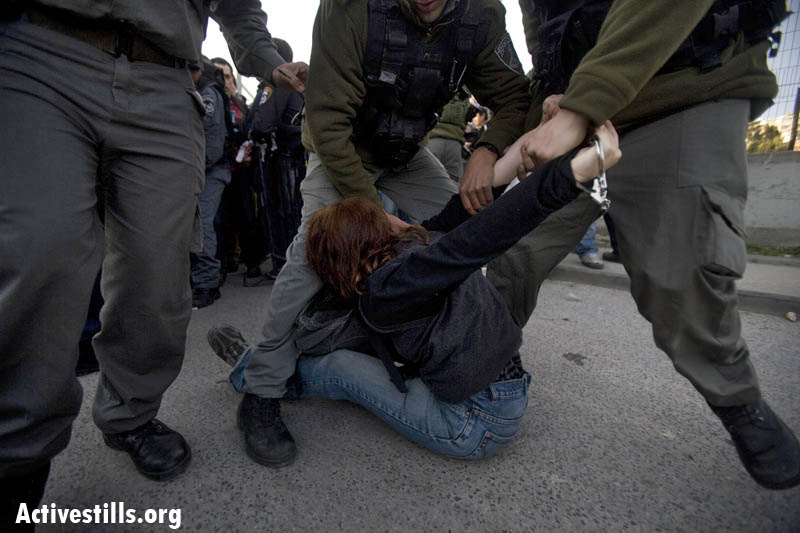
This was the largest demonstration yet in Sheikh Jarakh, were for some time now a demo is taking place every Friday, much like the demos in Bil’in, Nilin and other places.
The Friday before, the police had brutally squashed the protest and arrested 11 demonstrators, among them the director of the Association for Human Rights. Contrary to their usual treatment of peace demonstrations, the media this time covered the event extensively. The behavior of the police upset many who generally do not take part in demonstrations. This time they felt they must take part.
So almost a thousand protesters gathered today (Friday, 22.1.10) in an empty plot opposite Sheikh Jarakh, a few dozen yards away from the houses from which Palestinian families had been thrown out in order to allow settlers to move in. Side by side with the old battle horses one could see people for whom this was the first time. Among those who came was former minister Yossi Sarid. Also present were the painter Uri Lifshitz and several professors from the Hebrew University, whose buildings could be seen on a nearby hill. More or less young people stood besides more or less old ones, with the young shouting slogans, whistling with whistles specially donated for this purpose, singing and drumming. Almost all were Jewish.
One protester brought flowers and tried to deliver them to the police commander, who froze and did not move a muscle in his face. She put the flowers at his feet, where they remained, until, in the end, one of the protesters claimed them as booty.
The police dictated the place and the time: across the road, until 4 p.m. “One minute after 4, I shall disperse the demonstration by force,” the commander announced. On the hill opposite, a large detachment of border police was waiting.
But the protesters were not in the mood for dictates. After demonstrating for some time at the appointed place, shouting slogans, singing and whistling, at ten minutes after 4 they moved forward, crossed the road and marched towards the disputed houses. They were, however, stopped by a chain of border police. At this stage, a number of protesters were already arrested, while their comrades shouted and whistled.
For two more hours, until darkness descended, there were several such incidents – the police arrested protesters, the demonstrators shouted slogans (“A brave policeman beats demonstrators”). One protester was thrown to the ground and then she was arrested and dragged to the police car like all the rest.
All though the demo, ultra-Orthodox Jews in their Shabbat attire with their children pushed their way through the crowd on their way to the nearby grave of the Righteous Rabbi Shimon. Nobody hurt them. From time to time they were greeted with loud shouts of “Thieves, go home!” because the grave is located in occupied territory. The story that was published, that demonstrators had attacked them, was a blatant lie.
“We are protesting against the injustice done to the Palestinian families that were evicted,” Uri Avnery told the many Israeli and foreign reporters on behalf of Gush Shalom, “The eviction is based on the argument that these houses were bought by Jews a hundred years ago, long before the 1948 war. If every Jerusalemite were to get back the house he owned before 1948, half the Jewish population of West Jerusalem would have to be evicted, since they live in houses from which the Arabs were expelled during the 1948 war.”
Avnery added that the declared aim of the settlers is to Judaize East Jerusalem, in order to make peace impossible forever. “Everybody knows that there will be no peace without a Palestinian state with East Jerusalem as its capital.”
2010-01-23
Robert Fisk's World: The never-ending exodus of Christians from the Middle East
by Robert Fisk
The Independent
One of the oldest sects in the world is still fleeing sectarian violence for the West
The Independent
One of the oldest sects in the world is still fleeing sectarian violence for the West
I have usually found that the closer a religious Christian, Jew or Muslim comes to the Middle East, the madder they become. The most avuncular Shropshire vicar, the kindest Jewish moderate, the most secular Muslim – dump them within a thousand miles of Jerusalem and they have the eyes of Lord Blair of Kut-al-Amara, that crazed, glazed, faith-based lunacy that must have inhabited the eyes of the Crusaders when they slaughtered their way across the Holy Land, dropping off near modern-day Homs in modern-day Syria to consume – literally – some of their Arab enemies. Orthodox priests fight each other over Christ's tomb; Israeli settlers claim that the Koran is not "a valid document" and local Muslims fully intend to "Islamicise" the world.
Was I the only one to react with a total lack of surprise to the news that Muslim Afghan soldiers are fighting Muslim Taliban fighters with a coded inscription on their rifle sights from the Bible's Book of John? Could Holman Hunt – who also went batty in the Middle East – have imagined that his Light of the World (Jesus, no less, painted in 1854) would be guiding the path of American as well as Afghan army bullets into the hearts of the Muslim Taliban? Possibly. So it turns out that another bunch of religious nutters, the makers of Trijicon rifle sights in the United States, believe the inscription is "part of our faith and our belief in service to our country".
Not since the Serbs and Lebanese Phalangists set off to massacre and rape their Muslim enemies over the past three decades with pictures of the Virgin Mary on their rifle butts has there been anything so preposterous. No doubt, our brave Dutch newspaper cartoonist – he of bomb-in-the-Prophet's-hat humour – will now sketch Jesus using a clip of 7.62 ammo to bang on the door of that wretched cottage in the Hunt portrait. Indeed, 'twas I who first spotted two American M(12A)1 Abrams tanks parked in central Baghdad in 2003 with "Crusader 1" and "Crusader 2" painted on their barrels. But since the man who sent them there – check out Bush's lunatic conversation with Chirac – believes in Gog and Magog, what's new? Don't tell me no one in the Pentagon (or the British Ministry of Defence, which has an order in for another 400 Trijicon sites) didn't query that weird "JN8:12" on the equipment.
No wonder then – and here's a real tragedy – that Christians are in a state of perpetual exodus from the Middle East. In Egypt, six Coptic Christians were killed at Christmas – along with a Muslim policeman – when local Muslims attacked them. The Copts are maybe 10 per cent of their country's 80 million people but they are heading in droves for America. One problem they have is seeking official permission to build churches in Egypt – and if they get this permission, sure enough, up will pop a mosque right next door.
Courtesy of that great Bible-reader George W Bush, the Christians of post-invasion Iraq – one of the oldest sects in the world – are still fleeing sectarian violence for the West. They've been murdered and burned out of their homes. Why, even the head of the superior Islamic council of Iraq, Ammar al-Hakim, turned up in Beirut this week to tell the Maronite Catholic patriarch of Lebanon that he was doing "all he could" for his Iraqi Christian brothers and sisters. Algerian Islamists have just burned a Christian Protestant church in an apartment in the Berber city of Tizi Ouzou. But as an Algerian police officer said to the local AP man in the town a few days ago, "What happened is appalling, but the apartment wasn't an authorised house to practise a religion..." So that's OK then.
There's not much point, of course, in looking for the last known resting place of one and a half million Christian Armenians, because they were mass-slaughtered by the Turks in 1915 – although neither Bush nor his successor will call it a genocide because they are frightened of Muslim Turkey. Yup, the "era of martyrdom" started by Diocletian in AD284 just goes on and on.
The Christians of Lebanon would say the same, forgetting their own murderous militias of the civil war. But wasn't it the largely Muslim Palestinians who in that same war claimed that the "road to Jerusalem" passed through Ayoun el-Siman, the very Christian heartland of Lebanon? Please note how I have not touched upon the anti-Christian savagery of Nigeria – whose revolving presidency is currently held by a Muslim who is under permanent medical attention in Saudi Arabia, the seat of Wahhabism – nor of Malaysia, where Christians are now under attack for being allowed to call their God "Allah". The fact that Muslims and Christians both believe in the same deity has no apparent value. Indeed, in God's name – quite literally – the very name of the very patriarch of the Lebanese church is Nasrallah Sfeir – the "allah" bit meaning exactly what it sounds like. Ye Gods, I suppose we must say!
But I was heartened to read a fine article by my wise old journalist friend Jihad Zein in the Lebanese newspaper An Nahar last week. He believes that governments in the Muslim world have been repressing societies but – and I hope I have grasped his complex argument correctly – repressed societies are now repressing minorities. He points out that the exodus of Christians from neighbouring Muslim countries have actually thickened the Christian populations of Damascus and Aleppo in Syria. The 1914-18 war had a direct demographic impact on the Middle East's Christians, quite apart from the Armenian genocide.
The British tolerated – and in some cases actually covered up – the genocide of Assyrians in northern Iraq by their installed Iraqi monarch's army in 1933. I've read that some of King Faisal's soldiers had originally also fought in the Ottoman army, so practised the art of killing Christians by slaughtering Armenians – just as some German officers in the Ottoman army who witnessed the Armenian genocide thus learned how to murder the Jews of Europe a quarter of a century later. In any event, the Zein thesis is that Middle East governments have abandoned the idea of cultural authority in the interests of safeguarding the security of their political society. The Fisk thesis is that minorities don't count any more.
But don't bet on it. Was it not the army of Israel which named its 1996 bombardment of Lebanon "Grapes of Wrath", an operation which included the atrocity at Qana, when 106 Lebanese civilians, more than half of them children and including mothers and old men, were torn to bits by Israeli shells? And did not Grapes of Wrath take its name from chapter 32, verse 25 of the Book of Deuteronomy in which it is said that "the sword without, and terror within, shall destroy both the young man and the virgin, the suckling also with the man of grey hairs". All in all, a good description of the massacre at Qana. Or of those innocent Afghan villagers torn to bits in Nato's heroic air strikes. Indeed, I wouldn't be surprised to hear that DY32:25 is inscribed on Nato's bombs. Work that one out.
Subscribe to:
Posts (Atom)