2017-10-12

A Silenced Israeli Critic

by Rick Sterling
Consortiumnews.com

Despite the U.S. media’s extensive coverage of Israel, what Miko Peled says is seldom heard by Americans, although he was born in Jerusalem and comes from a famous Israeli family. Peled’s grandfather was one of the signers of the Israeli founding documents. His father was a soldier in the war which led to the creation of Israel and later a senior army general during the 1967 war. And one of Peled’s nieces was killed in a suicide bombing attack.
Miko Peled, author of The General’s Son.
However, in contrast to what one might expect, Miko Peled is a voice of sharp criticism of Israel and Israeli policies. He does not mince his words. Israel is a “settler colonial state” and Israel does NOT have a “right to exist” as an apartheid state with preferential treatment based on ethnicity.
Peled does not speak in the abstract; he gives specific examples to demonstrate what he says. Palestinians in the West Bank have no consistent running water while settlers enjoy unlimited drinking water plus swimming pools and water for green lawns. The situation in Gaza is even worse. The two million residents of the tiny Gaza strip endure horrific conditions. Babies with medical conditions die while just a few miles away, Israeli babies with the same conditions will live.
Peled does not limit his criticism to the “Occupied Territories,” He says all of the state should be called Palestine with equal rights and opportunities for all. Peled pokes fun at the claims that Jews anywhere have a “right to return” because of a supposed 2,000-year-old claim and entitlement. These claims are based on the Old Testament not scientific history.
In contrast with the myth, most Israeli citizens have zero DNA connection to the region. Peled humorously points to the irony of Zionists who claim a 2,000-year-old “right” to the land as they deny and denigrate the rights and claims of Palestinians who were expelled in 1948 and after.
As Peled explains, most Israelis are quick to tell Palestinians to “get over it” despite the fact that Palestinian claims are well documented and only go back 70 years, not 2,000. Unknown to most Americans, about half a million Palestinians languish in Lebanon, waiting for the time when they return to their villages in Palestine from which they were expelled in 1948 and after. The actual history of those events has been clearly documented by the Israeli historian Ilan Pappe.
But Peled is not entirely pessimistic. Indeed, he thinks that it is better that the pretense of a “two-state solution,” which has been used as an excuse to justify the current situation, is openly dismissed by President Trump and Israeli Prime Minister Benjamin Netanyahu. Things are now clarified, leaving two paths to the future. One, a supremacist “democracy” for Jews and continuing occupation and oppression for the Palestinians or, two, a one-state democracy for all.
Peaceful Resistance
While acknowledging that most Israelis today reject the idea of equality for Palestinians, Peled recalls how quickly the change from apartheid to democracy happened in South Africa. He says if they could overcome apartheid in South Africa, why is this not possible in Israel/Palestine?

Palestinian boys prepare to welcome Women’s Boat to Gaza, which was intercepted by the Israeli naval blockade on Oct. 5, 2016.
In the 1980s and early 1990s, the international Boycott Apartheid campaign helped to end open racism in South Africa. Around the world, there is a similar peaceful and non-violent campaign pressing for the end of open racism in Israel. It’s called “BDS” for Boycott, Divestment and Sanctions. The goal is to pressure Israel to abandon its apartheid policies just as South Africa did.
Making clear his own stand, Peled wore a large BDS button on his lapel. For those who mistakenly believe that Israel is a progressive force internationally, the reality is that Israel was one of apartheid South Africa’s closest allies.
For taking the stance he does, and especially because of his family roots, Miko Peled has been vilified and threatened. It takes great courage to follow his beliefs as he has. His family is apparently with him.
In his memoir, The General’s Son: Journey of an Israeli in Palestine, he describes how his mother refused to take furniture or property of Palestinians who had been expelled from Jerusalem in 1967, as many other prominent Jewish families were doing.
Peled describes his father’s evolution from military general to an advocate for peace and respect for Palestinians. And he describes the reaction of his sister and how she blamed Netanyahu and racist policies for the death of her daughter. Miko Peled demonstrates courage and integrity. Through his writing and speeches, he exposes racist policies in Israel and the U.S. He seeks a better future even if it sometimes appears hopeless and provokes slander and personal threats against himself.
On Oct. 6, Peled spoke in Lafayette, California, in an event sponsored by Mt Diablo Peace & Justice Center (MDPJC) with co-sponsorship by Jewish Voice for Peace and others. Peled’s book is published by Just World Books. A video of his Lafayette presentation, including the introduction by St Mary’s College Professor Hisham Ahmed, is posted at the Mt Diablo Peace & Justice Center website.
Rick Sterling is an investigative journalist based in the San Francisco East Bay. He can be contacted at rsterling1@gmail.com

2017-10-09

America’s Long History of Warfare and Murder

by Lawrence Davidson
Consortiumnews.com

If you go to the Wikipedia page that gives a timeline of U.S. foreign military operations between 1775 and 2010, you are likely to come away in shock. It seems that ever since the founding of the country, the United States has been at war. It is as if Americans just could not (and still cannot) sit still, but had to (and still have to) force themselves on others through military action.
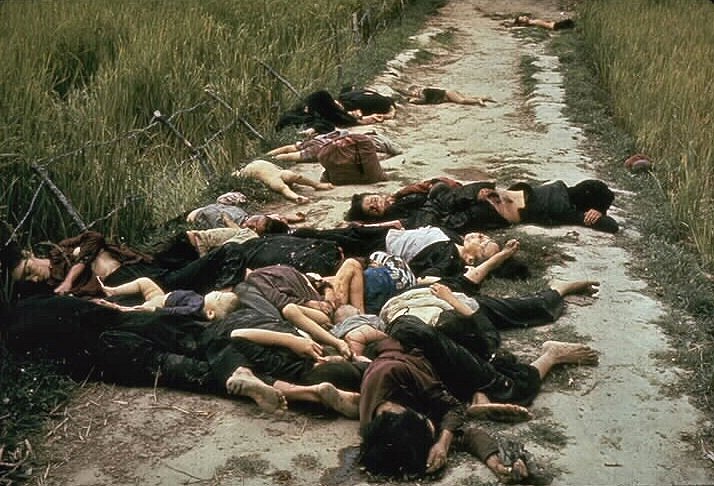
Photos of victims of the My Lai massacre in Vietnam galvanized public awareness about the barbarity of the war. (Photo taken by U. S. Army photographer Ronald L. Haeberle)
Often this is aimed at controlling foreign resources, thus forcing upon others the consequences of their own capitalist avarice. At other times the violence is spurred on by an ideology that confuses U.S. interests with civilization and freedom. Only very rarely is Washington out there on the side of the angels. Regardless, the bottom line seems to be that peace has never been a deeply ingrained cultural value for the citizens of the United States. As pertains to foreign policy, America’s national culture is a war culture.
It is against this historical backdrop that the recent Ken Burns 18-hour-long documentary on the Vietnam War comes off as superficial. There is a subtle suggestion that while those American leaders who initiated and escalated the war were certainly deceptive, murderously stubborn and even self-deluded, they were so in what they considered to be a good cause. They wanted to stop the spread of Communism at a time when the Cold War defined almost all of foreign policy, and if that meant denying the Vietnamese the right of national unification, so be it. The Burns documentary is a visual demonstration of the fact that such a strategy could not work. Nonetheless, American leaders, both civilian and military, could not let go.
What the Burns documentary does not tell us – and it is this that makes the work superficial – is that none of this was new. Almost all preceding American violence abroad had been rationalized by the same or related set of excuses that kept the Vietnam slaughter going: the Revolutionary War was about “liberty,” the genocidal wars against the Native Americans were about spreading “civilization,” the wars against Mexico and Spain were about spreading “freedom,” and once capitalism became officially synonymous with freedom, the dozens of bloody incursions into Central and South America also became about our “right” to carry on “free enterprise.” As time went by, when Washington wasn’t spreading “freedom,” it was defending it. And so it goes, round and round.
A Ghastly Process 
Understanding the history of this ghastly process, one is likely to lose all faith in such rationales. However, it seems obvious that a large number of Americans, including most of their leaders, know very little of the history of American wars (as against knowing a lot of idealized pseudo-history). That is why Ken Burns and his associates can show us the awfulness of the Vietnam War to little avail. The average viewer will have no accurate historical context to understand it, and thus it becomes just an isolated tragedy. While it all might have gone fatally wrong, the American leaders were assumed to be well intentioned.
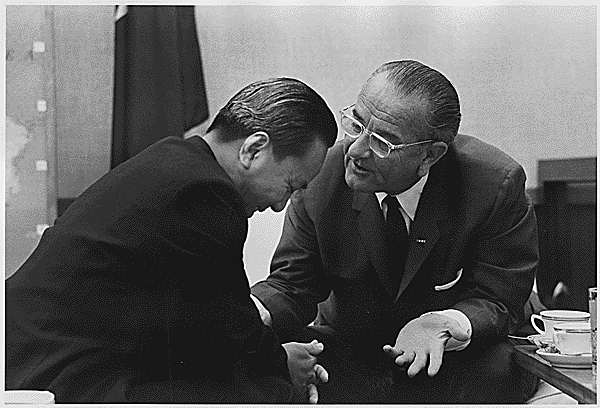
President Lyndon Johnson meeting with South Vietnamese President Nguyen van Thieu on July 19,1968.
Describing the Vietnam War in terms of intentions is simply insufficient. In the case of war the hard-and-fast consequences of one’s actions are more important than one’s intentions. The United States killed roughly 2 million Vietnamese civilians for ideological reasons that its own leaders, and most of its citizens, never questioned.
Most of its citizens, but not all. There was, of course, a widespread and multifaceted anti-war movement. The anti-war protesters were, in truth, the real heroes, the real patriots of the moment. Along with the accumulating body bags, it was the anti-war movement that brought an end to the slaughter. However, once more Burns’s documentary comes off as superficial.
Burns leaves the viewer with the impression that the only truly legitimate anti-war protesters were veterans and those associated with veterans. But those were only a small part of a much larger whole. Yet the millions of other Americans who protested the war are essentially slandered by Burns. The documentary presents them as mostly Communist fellow-travelers. We also see various representatives of that non-veteran part of the movement apologize for their positions. There is the implication that the movement had bad tactics.
Here is an example: one of the points that the Burns documentary makes is how distasteful was the labeling of returning soldiers as “baby killers.” Actually this did not happen very often, but when it did, one might judge the charge as impolitic – but not inaccurate. You can’t kill 2 million civilians without killing a lot of babies. If we understand war in terms of the death of babies, then there might be fewer wars.
U.S. leaders also sent 58,000 of their own citizens to die in Vietnam. Why did these citizens go? After all, this was not like World War II. North Vietnam had not attacked the United States (the Bay of Tonkin incident was misrepresented to Congress). The Vietcong were not Nazis. But you need an accurate take on history to recognize these facts, and that was, as usual, missing. And so, believing their politicians, the generals, and most of their civic leaders, many draftees and volunteers went to die or be maimed under false pretenses.
The inevitable post-war disillusionment was seen by subsequent U.S. leaders as a form of mental illness, and they labeled it “the Vietnam Syndrome.” The “syndrome” was as short-lived as popular memory. In March 2003, President George W. Bush invaded Iraq under false pretenses and U.S. forces proceeded to kill half a million civilians.
In the end, American behavior in Vietnam was not just tragically flawed – it was criminal. But it was also historically consistent – an expression of a long-standing and deep-seated war culture, a culture that still defines the American worldview and has become the very linchpin of its domestic economy. That is why the wars, large and small, never stop.
A Gun Culture, Too
America’s propensity to violence in other lands is but one side of a two-sided coin. Callous disregard for civilian lives abroad is matched by a willful promotion of violence at home. That willful promotion is the product of a right-wing ideological orientation (stemming from a misreading of the Second Amendment to the U.S. Constitution) that demands a nearly open-ended right of all Americans to own an almost unlimited number and types of firearms. The result is gun regulation laws that are embarrassingly ineffective.
Air Force F-105s bomb a target in the southern panhandle of North Vietnam on June 14, 1966. (Photo credit: U.S. Air Force)”
Again, the consequences of this position are much more profound than any claim that its supporters’ intentions are to defend citizens rights to own guns. Since 1968 about as many Americans have been killed in-country by gun violence (1.53 million) as have died in all of America’s wars put together (1.20 million). The numbers are too close to be dismissed as coincidence. Both reflect a culture of exceptionalism that grants at once the United States government, and its citizens, extensive rights to act in disregard of the safety and security of others.
You would think Americans would recognize an obvious contradiction here. You cannot maintain a safe population and, at the same time, allow citizens the right to own and, largely at their own discretion, use firearms. Nonetheless, some Americans imagine that they have squared this circle by claiming that their guns are for “self-defense” and therefore do make for a safer society.
This is just like the U.S. government’s constant exposition that all its violence is committed in the name of civilization and freedom. In both cases we have a dangerous delusion. Ubiquitous gun ownership makes us unsafe, just as does the endless waging of war.
The inability to see straight is not the sort of failing that can be restricted to one dimension. If you can’t grasp reality due to ideological blinkers or historical ignorance, you are going to end up in trouble both at home and abroad – not just one place, but both.
And, the more weaponized you are, both as a state and as a citizen, the greater the potential for disaster. In the end the United States cannot stop killing civilians abroad unless it finds the wisdom to stop killing its own citizens at home – and vice versa. That is the U.S. conundrum, whether America’s 320 million citizens realize it or not.
Lawrence Davidson is a history professor at West Chester University in Pennsylvania. He is the author of Foreign Policy Inc.: Privatizing America’s National Interest; America’s Palestine: Popular and Official Perceptions from Balfour to Israeli Statehood; and Islamic Fundamentalism. He blogs at www.tothepointanalyses.com.

2017-10-08

A Sick Country Filled With Guns

by Jeremy Scahill
The Intercept

WE LIVE IN a sick country. A country where it’s legal for someone to purchase 30 assault weapons and unlimited ammunition, weapons that really only have one purpose: to hunt and kill other human beings. A country where a cabal of high-powered lobbyists, bought-off politicians, and gun manufacturers profits off of massacres, where the meaning of the Second Amendment has been twisted so intensely that it no longer matters why it was written or what it was actually intended for.
The leaders of the National Rifle Association, who would be viewed as terrorist enablers and promoters in a sane society, they don’t like the first part of the Second Amendment — so much so that they don’t include it in their very public memorializing of their Holy Bible of gun addition.
The version of the Second Amendment displayed at the NRA’s headquarters doesn’t include the first half of the Second Amendment. The NRA only wants you to focus on the second half, which says, “… the right of the people to keep and bear Arms, shall not be infringed.” The first part of the Second Amendment, which the NRA finds too inconvenient to include, states, “A well regulated Militia, being necessary to the security of a free State …”
Was the Las Vegas shooter a member of a well-regulated militia? No. Were any of the murderers who shot up schools or religious assemblies or workplaces members of a well-regulated militia? No. And regulated — that’s an interesting word, because no thoughtful person can really argue that guns in the United States are actually regulated in any meaningful way. In this country, you can buy dozens of assault weapons. You can store enough guns and ammunition in your garage to wage a small war. Why? Because the Second Amendment has been laundered through lobbyists, and some Supreme Court justices, to mean something it does not mean.
The coalition that fans the flames of fear and promotes the idea that guns keep us safe — that the solution to gun violence is more guns — makes a shitload of money off of all this death and misery. And they will make more money off of the Las Vegas massacre.
You can murder 20 innocent children between the ages of 6 and 7 at Sandy Hook Elementary School and these villains are unmoved in their belief in the golden calf of assault rifles. “If only the teachers had been armed, those kids might be alive today. Now let’s check out our stock prices.”
Each time we’re faced with a new mass murder with guns, in this case 58 killed and more than 500 wounded, we end up in the same place: “Let’s pray. Let’s tweak this or that law. Let’s talk about using acoustic sensors to detect gunshots. Let’s put armed private security in schools. Let’s use the terrorist watchlist to deny gun purchases. Let’s have more surveillance, more religious and racial profiling.” Which is absurd, given that most mass shooters are white.
None of what most politicians and TV pundits offer up in the aftermath of these killings is going to do anything to solve the real issue: We are a nation filled to the brim with guns, including assault weapons that are actually meant for assaulting people. Not for hunting. Not for sport, unless your sport is murder.
Watch what happens in Congress in the coming days. Empty platitudes. Bullshit proposals: “We must do something about this.” And, of course, a lot of prayer. But none of that is going to change to the fact that we live in a sick society that believes guns bring us security. A nation that has been taught by powerful, twisted people that guns aren’t part of the problem. That everything except guns — and how easy they are to get — is the problem. Mental illness is the problem. Muslims are the problem. Gangbangers in Chicago are the problem. Not having a gun is the problem. And when these mass shootings happen, most of the time, the shooter is a white man. We want to know who he was, why did it, what his motive was, as we should. But compare that to how black victims of police killings are treated in the media: “Well, did they do drugs? What were they wearing? Did they have a criminal record? Did they listen to hip hop? Where are the fathers?”
After he was killed by George Zimmerman, Trayvon Martin was characterized as a thug, his hooded sweatshirt somehow evidence that he was scary or menacing. That’s how black victims are portrayed. After police shot Tamir Rice, the head of Miami’s police union called the 12-year-old a thug, saying that if you act like a thug, you’ll get treated like one.
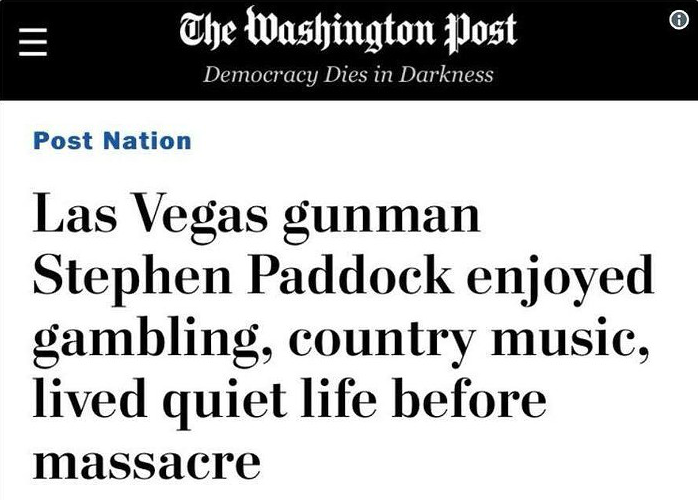
Contrast that with some of the stories we’ve seen about the Las Vegas shooter — not victim — shooter! One headline (since changed) in the Washington Post said he “enjoyed gambling, country music, lived quiet life before massacre.” Black victim is a thug; white shooter is a character from a country western song who just happens to murder 58 people. It’s sick. And this is a pattern.
What if mass shootings carried out by white men were covered the same way that stories involving shooters of other races are covered on a daily basis in this country? White-on-white crime. Let’s investigate country music and its violent lyrics. Let’s find some white people brave enough to speak out on this pandemic of white men carrying out mass shootings at an alarming rate. And let’s make them speak for their entire race.
We all know why the narratives are different. And another thing: We’re hearing once again that this is the most deadly mass shooting in U.S. history. It’s just not true. There are several examples of white gunmen killing huge numbers of black people. The 1917 East St. Louis massacreresulted in an estimated 100 black people being shot and lynched; in 1873, between 60 and 150 black people were massacred in Colfax, Louisiana. We don’t even know the exact numbers of Native Americans killed in mass shootings since the founding of the United States: Hundreds were killed in places like Sand Creek, Clear Lake, and Wounded Knee.
Donald Trump, who boasts that he’ll be the best friend the NRA could possibly have in the White House, suddenly found God when he first addressed the Las Vegas shooting. Let’s be real: Trump’s deepest connection to the Bible is watching Charlton Heston as Moses. But religious Trump, who speaks from the Scriptures, was praised for his perfect tone across the media. Specifically, on CNN: “Just what we needed to hear.”
A big part of our problem on guns is how it’s discussed in the media. Presidents who get prayerful are praised instead of held accountable for the role they play in sustaining this nation’s gun addiction, in promoting the gun industry that profits off of murder. When the shooter is an Arab or a Muslim, they are often immediately branded as a suspected terrorist. After Las Vegas, the president and other politicians called this shooter “deranged” or “insane” or another word that’s lost all meaning — “evil.”
When it’s a Muslim shooter, it’s perfectly acceptable to talk about what the U.S. response should be: watchlisting, banning people from entering the country, surveillance of mosques. But when white people do the killing, don’t talk about guns. That’s politicizing the tragedy, disrespecting the victims. Whether it’s someone inspired by ISIS murdering his coworkers or a white man shooting up a school or a white man gunning down Sikhs because he thought they were Muslims, they all do it with guns.
We don’t need prayers. We don’t need fake unity over the tragedy. We need to look at the common factor in all of these heinous acts of mass murder: guns. Anything else is just putting a Band-Aid on a gaping, infected, and lethal wound on our society.

2017-10-02

A Tale of Two Stories

by Uri Avnery
Gush Shalom

THIS IS the story: at 7 o'clock in the morning, an Arab approaches the gate of Har Adar, a settlement close to the Green Line near the Israeli-Arab village of Abu Ghosh.
The man is a "good Arab". A good Arab with a work permit in the settlement. He lives in the nearby West Bank Arab village of Beit Surik. He received a work permit there because he fits all the criteria – he is 37 years old, married and father of four children. The inhabitants of Har Adar know him well, because he has been cleaning their homes for years.
This Tuesday morning he arrived at the gate as usual. But something aroused suspicion among the guards. He was wearing a jacket, though the weather was quite hot on this early autumn day. The guards asked him to remove his jacket.
Instead, the man took out a loaded pistol and shot three of the guards in the head at close range – two civilian guards and a member of the semi-military Border Guards. One of the victims was himself an Arab. Another security officer, the local commander of the guards, was severely wounded. Since the assailant had never received military training, the precision of his shots was astounding. The pistol had been stolen 15 years ago.
All Israel was shocked. How could this happen? A good Arab like this? An Arab with permits? Why would he do such a thing in a place where he was well liked and well treated? Where he played with the children? And that after he was thoroughly vetted by the Security Service, which has innumerable Arab spies and is considered well-nigh infallible?
Something extraordinary must have happened. Someone must have incited him against the Jews and the nice people of Har Adar, who had treated him so well. Perhaps the UN speech by Mahmoud Abbas. Or perhaps some secret contacts with Hamas. "Incitement!" cried Binyamin Netanyahu.
But then another fact emerged, which explained everything. The man had quarreled with his wife. He had beaten her up, and she had escaped to her family in Jordan, leaving the four children behind.
So, obviously, he had become temporarily unhinged. In a state of mental derangement he had forgotten the kindness of the Har Adar people. Just a unique case, that need not trouble us further.
But it all shows that you can't trust the Arabs. They are a bunch of murderers. You cannot make peace with them until they change completely. So we must keep the occupied territories.
THAT IS the story. But there is another story, too. The story as seen by the man himself.
From his home in neighboring Beit Surik, the man – whose name was, by the way, Nimr ("leopard") Mahmoud Ahmed al-Jamal – could see Har Adar from his home every day when he woke up. For him, as for every Arab, it was a flourishing Jewish settlement, built on expropriated Arab land. Like his own village, it belonged to the Palestinian West Bank which is occupied territory.
He had to get up in the darkness of the night in order to get to Har Adar on time – 7.00 o'clock in the morning – and work hard until late in the night, arriving home at about 10 o'clock. This is the lot of tens of thousands of Arab laborers. They may look friendly, especially when their livelihood depends on it. They may even be really friendly to benevolent masters. But deep in their hearts they cannot forget for a moment that they are cleaning the toilets of the Jews who came to Arab Palestine and occupied their homeland.
Since most of the agricultural land of their villages has been expropriated for Jewish settlements, they have no choice but to work in these low-status jobs. There is no industry to speak of in the West Bank. Wages are minimal, often below the legal minimum wage in Israel proper (some 1500 dollars per month). Since they have no choice, they are not far from being slaves. Like the nice slaves in "Gone with the Wind".
Such a man may be at peace with this reality, but if something bad happens, he may suddenly become upset with his status and decide to become a martyr. Nimr left behind a letter in which he defended his wife and absolved her from any responsibility for the deed he had planned for the next day.
SO THESE are the two stories, which have very little in common.
The people of Har Adar are completely shocked. Since they live 20 minutes drive from Jerusalem, they do not consider themselves settlers at all, but Israelis like any other. They don't really see the Arabs all around them as people like themselves, but as primitive natives.
The Har Adar people are not like the fanatical, religious and nearly fascist people in some settlements. Far from it. Har Adar people vote for all parties, including Meretz, the left-wing Zionist party which advocates the return of the occupied territories to the Palestinians. This is not seen as including Har Adar, of course, since there is a consensus among Zionists, right and left, that the settlements close to the Green Line should be annexed to Israel.
Har Adar people can rightly be proud of their achievements. From the air, the place looks very orderly. It has 3858 inhabitants. Their average income is about 5000 dollars a month, well over the national Israeli average (some 3000 dollars). Their local council is the third most efficient in the entire country.
Located in the mountainous area around Jerusalem, it has a beautiful landscape. It also has man-made amenities: a library, a youth club, a skate-park and an amphitheater that seats 720 people. Even for an average Israeli, this is paradise. For the Arabs around, who cannot enter without a special permit, it is a perpetual reminder of their national disaster.
Of course, like other settlements, Har Adar is not located on land that was empty. It occupies the location on which stood a village called Hirbat Nijam, a village which already stood there in Persian-Hellenistic times, some 2500 years ago. Like most Palestinian villages, they were Canaanite, then Judean, then Hellenist, then Byzantine, then Muslim, then crusader, then Mameluk, then Ottoman, then Palestinian – without the population ever changing. Until 1967.
WHEN NIMR was born, all this long history was long forgotten. What remained was the reality of the Israeli occupation.
This now looks like the normal state of things. The members of Har Adar are happy, feeling secure and well guarded by the efficient Security Service, the Border Guard and local mercenaries, mostly Arab citizens of Israel. Neighbors like Nimr seem content, and probably are, if they are lucky enough to have a job and a work permit, even with pitiful wages. The historical grudge lies deeply buried within their consciousness.
And then something happens, something that may be quite irrelevant – like the escape of his wife to Jordan – to bring it all up. Nimr the lowly laborer suddenly becomes Nimr the freedom-fighter, Nimr the martyr on his way to paradise. All his village respects his sacrifice and his family.
Israelis are furious that the families of "martyrs" are paid an allowance by the Palestinian Authority. Binyamin Netanyahu accuses Mahmoud Abbas (Abu Mazen) of incitement to murder with these payments. But it is quite impossible for Abbas to annul them – the outrage reaction of his people would be tremendous. Martyrs are holy, their families respected.
THE DAY after Nimr's dastardly terrorist act and/or heroic martyrdom, a grandiose national ceremony took place in another settlement.
All the country’s major dignitaries, led by the President and the Prime Minister, assembled to commemorate the 50tth anniversary of "our return to our homeland, Judea and Samaria, the Jordan Valley and the Golan Heights".
Missing in the list is the Gaza Strip, which Israel has evacuated, leaving behind a tight land and sea blockade aided by Egypt. In the Strip there are about two million Palestinians. Who the hell wants them?
All hell broke loose when the President of the Supreme Court, who was supposed to send a judge to represent the court at this ceremony, canceled his attendance because of the highly propagandist style of the event. She decided that this is party propaganda, in which her court would not take part.
ALTOGETHER, NOT a day of quiet in this country, a state without borders and without a constitution, where every story has two totally different sides, where nice and quiet people suddenly become raging martyrs.
There will be no quiet until there is peace, with each of the two peoples living in their own state, a situation where real friendship has a chance of blooming.

2017-09-29

The Ken Burns Vietnam War Documentary Glosses Over Devastating Civilian Toll

by Nick Turse
The Intercept

“I THINK THAT when Americans talk about the Vietnam War … we tend to talk only about ourselves. But if we really want to understand it … or try to answer the fundamental question, ‘What happened?’ You’ve got to triangulate,” says filmmaker Ken Burns of his celebrated PBS documentary series “The Vietnam War.” “You’ve got to know what’s going on. And we have many battles in which you’ve got South Vietnamese soldiers and American advisors or … their counterparts and Vietcong or North Vietnamese. You have to get in there and understand what they’re thinking.”
Burns and his co-director Lynn Novick spent 10 years on “The Vietnam War,” assisted by their producer Sarah Botstein, writer Geoffrey Ward, 24 advisors, and others. They assembled 25,000 photographs, feature close to 80 interviews of Americans and Vietnamese, and spent $30 million on the project. The resulting 18-hour series is a marvel of storytelling, something in which Burns and Novick take obvious pride. “The Vietnam War” provides lots of great vintage film footage, stunning photos, a solid Age of Aquarius soundtrack, and plenty of striking soundbites. Maybe this is what Burns means by triangulation. The series seems expertly crafted to appeal to the widest possible American audience. But as far as telling us “what happened,” I don’t see much evidence of that.
Like Burns and Novick, I also spent a decade working on a Vietnam War epic, though carried out on a far more modest budget, a book titled “Kill Anything That Moves.” Like Burns and Novick, I spoke with military men and women, Americans and Vietnamese. Like Burns and Novick, I thought I could learn “what happened” from them. It took me years to realize that I was dead wrong. That might be why I find “The Vietnam War” and its seemingly endless parade of soldier and guerrilla talking heads so painful to watch.
War is not combat, though combat is a part of war. Combatants are not the main participants in modern war. Modern war affects civilians far more and far longer than combatants. Most American soldiers and Marines spent 12 or 13 months, respectively, serving in Vietnam. Vietnamese from what was once South Vietnam, in provinces like Quang Nam, Quang Ngai, Binh Dinh, as well as those of the Mekong Delta – rural population centers that were also hotbeds of the revolution — lived the war week after week, month after month, year after year, from one decade into the next. Burns and Novick seem to have mostly missed these people, missed their stories, and, consequently, missed the dark heart of the conflict.
To deprive their Vietnamese enemies of food, recruits, intelligence, and other support, American command policy turned large swathes of those provinces into “free fire zones,” subject to intense bombing and artillery shelling, that was expressly designed to “generate” refugees, driving people from their homes in the name of “pacification.” Houses were set ablaze, whole villages were bulldozed, and people were forced into squalid refugee camps and filthy urban slums short of water, food, and shelter.
A U.S. Marine carries a blindfolded woman suspected of Vietcong activities. She and other prisoners were rounded up during the joint Vietnamese-U.S. Operation Mallard, near Da Nang, Vietnam.
A U.S. Marine carries a blindfolded woman suspected of Vietcong activities over his shoulder. She and other prisoners were rounded up during the joint Vietnamese-U.S. Operation Mallard, near Da Nang, Vietnam.
 
Photo: Bettmann Archive/Getty Images
I spoke with hundreds of Vietnamese from these rural areas. In hamlet after hamlet, they told me about being rousted from their homes and then being forced to drift back to the ruins, for deeply-held cultural and religious reasons, and often simply to survive. They explained what it was like to live, for years on end, under the threat of bombs and artillery shells and helicopter gunships. They talked about homes burned again and again and again, before they gave up rebuilding and began living a semi-subterranean existence in rough-hewn bomb shelters gouged into the earth. They told me about scrambling inside these bunkers when artillery fire began. And then they told me about the waiting game.
Just how long did you stay in your bunker? Long enough to avoid the shelling, of course, but not so long that you were still inside it when the Americans and their grenades arrived. If you left the shelter’s confines too soon, machine-gun fire from a helicopter might cut you in half. Or you might get caught in crossfire between withdrawing guerrillas and onrushing U.S. troops. But if you waited too long, the Americans might begin rolling grenades into your bomb shelter because, to them, it was a possible enemy fighting position.
They told me about waiting, crouched in the dark, trying to guess the possible reactions of the heavily-armed, often angry and scared, young Americans who had arrived on their doorsteps. Every second mattered immensely. It wasn’t just your life on the line; your whole family might be wiped out. And these calculations went on for years, shaping every decision to leave the confines of that shelter, day or night, to relieve oneself or fetch water or try to gather vegetables for a hungry family. Everyday existence became an endless series of life-or-death risk assessments.
I had to hear versions of this story over and over before I began to get a sense of the trauma and suffering. Then I started to appreciate the numbers of people affected. According to Pentagon figures, in January 1969 alone, air strikes were carried out on or near hamlets where 3.3 million Vietnamese lived. That’s one month of a war that lasted more than a decade. I began to think of all those civilians crouched in fear as the bombs fell. I began to tally the terror and its toll. I began to understand “what happened.”
I started to think about other numbers, too. More than 58,000 U.S. military personnel and 254,000 of their South Vietnamese allies lost their lives in the war. Their opponents, North Vietnamese soldiers and South Vietnamese guerrillas, suffered even more grievous losses.
But civilian casualties absolutely dwarf those numbers. Though no one will ever know the true figure, a 2008 study by researchers from Harvard Medical School and the Institute for Health Metrics and Evaluation at the University of Washington and a Vietnamese government estimate, suggest there were around two million civilian deaths, the vast majority in South Vietnam. A conservative killed-to-injured ratio yields a figure of 5.3 million civilians wounded. Add to these numbers 11 million civilians driven from their lands and made homeless at one time or another, and as many as 4.8 million sprayed with toxic defoliants like Agent Orange. “The Vietnam War” only weakly gestures at this civilian toll and what it means.
An old Vietnamese woman reaches into large jar to draw water in an attempt to fight flames consuming her home in a village 20 miles southwest of Da Nang, South Vietnam on Feb. 14, 1967. (AP Photo)
An elderly Vietnamese woman reaches into large jar to draw water in an attempt to fight flames consuming her home in a village 20 miles southwest of Da Nang, South Vietnam on Feb. 14, 1967.
 
Photo: AP
Episode five of “The Vietnam War,” titled “This Is What We Do,” begins with Marine Corps veteran Roger Harris musing about the nature of armed conflict. “You adapt to the atrocities of war. You adapt to killing, dying,” he says. “After a while, it doesn’t bother you. I should say, it doesn’t bother you as much.”
It’s a striking soundbite and is obviously offered to viewers as a window onto the true face of war. It made me think, however, about someone who experienced the war far longer and more intimately than Harris did. Her name was Ho Thi A and in a soft, measured voice she told me about a day in 1970 when U.S. Marines came to her hamlet of Le Bac 2. She recounted for me how, as a young girl, she’d taken cover in a bunker with her grandmother and an elderly neighbor, scrambling out just as a group of Marines arrived — and how one of the Americans had leveled his rifle and shot the two old women dead. (One of the Marines in the hamlet that day told me he saw an older woman “gut-shot” and dying and a couple of small clusters of dead civilians, including women and children, as he walked through.)
Ho Thi A told her story calmly and collectedly. It was only when I moved on to more general questions that she suddenly broke down, sobbing convulsively. She wept for ten minutes. Then it was fifteen. Then twenty. Then more. Despite all her efforts to restrain herself, the flood of tears kept pouring out.
Like Harris, she had adapted and moved on with her life, but the atrocities, the killing, the dying, did bother her
Ho-Thi-A-vietnam-war-1506535748
Ho Thi A in 2008.
 
Photo: Tam Turse
— quite a bit. That didn’t surprise me. War arrived on her doorstep, took her grandmother, and scarred her for life. She had no predefined tour of duty. She lived the war every day of her youth and still lived steps from that killing ground.
Add together all the suffering of all of South Vietnam’s Ho Thi A’s, all the women and children and elderly men who huddled in those bunkers, those whose hamlets were burned, those made homeless, those who died under the bombs and shelling, and those who buried the unfortunates that did perish, and it’s a staggering, almost unfathomable toll – and, by sheer numbers alone, the very essence of the war.
It’s there for anyone interested in finding it. Just look for the men with napalm-scarred or white phosphorus-melted faces. Look for the grandmothers missing arms and feet, the old women with shrapnel scars and absent eyes. There’s no shortage of them, even if there are fewer every day.
If you really want to get a sense of “what happened” in Vietnam, by all means watch “The Vietnam War.” But as you do, as you sit there admiring the “rarely seen and digitally re-mastered archival footage,” while grooving to “iconic musical recordings from [the] greatest artists of the era,” and also pondering the “haunting original music from Trent Reznor and Atticus Ross,” just imagine that you’re actually crouched in your basement, that your home above is ablaze, that lethal helicopters are hovering overhead, and that heavily-armed teenagers — foreigners who don’t speak your language — are out there in your yard, screaming commands you don’t understand, rolling grenades into your neighbor’s cellar, and if you run out through the flames, into the chaos, one of them might just shoot you.
Top photo: U.S. Marine stands with Vietnamese children as they watch their house burn after a patrol set it ablaze after finding AK-47 ammunition, Jan. 13, 1971, 25 miles south of Da Nang.
Nick Turse is the author of “Kill Anything That Moves: The Real American War in Vietnam,” one of the books suggested as “accompaniments to the film” on the PBS website for “The Vietnam War.” He is a frequent contributor to The Intercept.