Showing posts with label Arab Immigrants. Show all posts

2018-03-21

Taking Flight

by Ryan Devereaux
The Intercept

An Iraqi Family Sought Asylum in the U.S., Thinking the Worst Was Over. Then Their American Nightmare Began.

NOTHING ABOUT THE Laredo Processing Center’s physical appearance immediately suggests it is run by a multimillion-dollar, for-profit prison corporation. Located just off the highway, about 5 miles from the Rio Grande, the drab one-story building, with its chain-link fencing and razor wire, is sandwiched between Ruben’s Paint and Body Shop and Martinez Wrecker Services.

If not for the sign outside, the immigrant detention center could easily be mistaken for a well-guarded junkyard. For the people locked inside, who sleep in open areas crammed with bodies -- if they are not being held in isolation -- days consist of head counts, the echoing voices of shouting guards, and a lot of waiting. If you’re lucky, you have the money to make short calls home and a loved one to pick up the phone.

For Safaa Al Shakarchi, this was life for more than a year. Along with his wife, Zinah, and their two small children -- 2-year-old Sidrah and 6-year-old Yousif -- Safaa crossed the bridge linking Reynosa, Mexico, to McAllen, Texas, on January 14, 2017. Nearly six months had passed since the family was expelled from their adopted home in the United Arab Emirates. Zinah and Safaa had been building a life in the Gulf nation since 2009, when a militia commander in Baghdad shot Zinah and murdered her colleague, prompting her to flee Iraq.

In the months that followed the expulsion, the family’s unwelcome odyssey brought them to six countries, through multiple times zones, and across numerous borders. They endured detention at the hands of Mexican authorities, including officials who beat Safaa as his children watched, and navigated some of the most treacherous cartel-controlled territory in the Western Hemisphere.

It was not the life they had planned, but the family was at the mercy of forces beyond their control. Passports in hand, the Shakarchis presented themselves before U.S. immigration officials in Texas. Invoking a right enshrined in both U.S. and international law, they applied for asylum. While his wife and children were eventually permitted to enter the country to begin the asylum process, Safaa was not. After a long and difficult experience, he ultimately found himself locked up in Laredo, accused of no crime, with deportation orders but no country willing to accept him.

MORE...

2017-01-29

Trump’s Muslim Ban Is Culmination of War on Terror Mentality but Still Uniquely Shameful

Glenn Greenwald - The Intercept

IT IS NOT difficult for any decent human being to immediately apprehend why and how Donald Trump’s ban on immigrants from seven Muslim countries is inhumane, bigoted, and shameful. During the campaign, the evil of the policy was recognized even by Mike Pence (“offensive and unconstitutional”) and Paul Ryan (violative of America’s “fundamental values”), who are far too craven and cowardly to object now.
Trump’s own defense secretary, Gen. James Mattis, said when Trump first advocated his Muslim ban back in August that “we have lost faith in reason,” adding: “This kind of thing is causing us great damage right now, and it’s sending shock waves through this international system.”
The sole ostensible rationale for this ban — it is necessary to keep out Muslim extremists — collapses upon the most minimal scrutiny. The countries that have produced and supported the greatest number of anti-U.S. terrorists — Saudi Arabia, Egypt, Qatar, UAE — are excluded from the ban list because the tyrannical regimes that run those countries are close U.S. allies. Conversely, the countries that are included — Syria, Iraq, Libya, Somalia, Iran, Sudan, and Yemen — have produced virtually no such terrorists; as the Cato Institute documented on Friday night: “Foreigners from those seven nations have killed zero Americans in terrorist attacks on U.S. soil between 1975 and the end of 2015.” Indeed, as of a 2015 study by the New America research center, deaths caused by terrorism from right-wing nationalists since 9/11 have significantly exceeded those from Muslim extremists.
Trump’s pledge last night to a Christian broadcasting network to prioritize Christian refugees over all others is just profane: The very idea of determining who merits refuge on the basis of religious belief is bigotry in its purest sense. Beyond the morality, it is almost also certainly unconstitutional in a country predicated on the “free exercise of religion.” In the New York Times this morning, Cato analyst David Bier also convincingly argues that the policy is illegal on statutory grounds as well.
Making this worse still is the central role the U.S. government played in the horrors from which many of these now-banned people are fleeing. The suggestion that Trump protected the countries with which he does business is preposterous. The reality is that his highly selective list reflects longstanding U.S. policy: Indeed, Obama restricted visa rights for these same seven countries, and the regimes in Riyadh and Cairo have received special U.S. protection for decades, long before Trump.
Beyond U.S. support for the world’s worst regimes, what primarily shapes Trump’s list is U.S. aggression: Five of the seven predominantly Muslim countries on Trump’s list were ones bombed by Obama, while the other two (Iran and Sudan) were punished with heavy sanctions. Thus, Trump is banning immigrants from the very countries that the U.S. government — under both Republicans and Democrats — has played a key role in destabilizing and destroying, as Democratic Sen. Chris Murphy, with surprising candor, noted this week:
It is critical to recognize and fight against the unique elements of Trump’s extremism, but also to acknowledge that a substantial portion of it has roots in political and cultural developments that long precede him. Immigration horror stories — including families being torn apart — are nothing new. As ABC News noted last August, “The Obama administration has deported more people than any other president’s administration in history. In fact, they have deported more than the sum of all the presidents of the 20th century.”
And the reason Trump is able so easily to tap into a groundswell of anti-Muslim fears and bigotry is because they have been cultivated for 16 years as the central fuel driving the war on terror. There are factions on both the center-left and right that are primarily devoted to demonizing Muslims and Islam. A government can get away with bombing, invading, and droning the same group of people for more than 15 years only by constantly demonizing and dehumanizing that group and maintaining high fear levels, which is exactly what the U.S. has done under two successive administrations. Both the Bush and Obama administrations ushered in all-new and quite extreme civil liberties erosions aimed primarily if not exclusively at Muslims.
Trump did not appear out of nowhere. He is the logical and most grotesque expression of a variety of trends we have allowed to fester: endless war, a virtually omnipotent presidency, unlimited war powers from spying to due process-free imprisonment to torture to assassinations, repeated civil liberties erosions in the name of illusory guarantees of security, and the sustained demonization of Muslims as scary, primitive, uniquely violent Others.
A country that engages in endless war against multiple countries not only kills a lot of people but degrades its own citizenry. Trump is the rotted fruit that inevitably sprouts from such fetid roots.
Trump is not a Russian phenomenon, nor an Italian one, nor Latin American: He is distinctly and consummately American, merely the most extreme face yet from America’s endless war on terror and its post-2008 lurch toward oligarchy. Pretending that Trump is some grand aberration, some radical departure from U.S. history and values, is simply a deceitful way of whitewashing what we have collectively endorsed and allowed.
Thus did we witness the spectacle last week of many acting as though Trump’s plans for CIA black sites, torture, and rendition were shocking Trumpian aberrations even though many of those denouncing the plans were the ones who advocated or implemented those policies in the first place or protected those who did from criminal prosecution. Denouncing and opposing Trump should not serve to obscure sins of the recent past or whitewash the seeds planted before him that have allowed him to sprout. Opposing Trump’s assault on basic liberties requires a clear understanding of the framework that gave rise to it.

BUT THIS MUSLIM ban — and that, in effect and by design, is what it is — is nonetheless different in significant degree if not in kind. Despite what came before it, there is no denying that Trump is now taking the U.S. to dark and foreboding places that are a step beyond what even recent presidents, in the name of protection against Muslims, have ushered in. A formal and absolute codification of this anti-Muslim premise is inherently dangerous, as it is likely to further indoctrinate millions of Americans to regard Muslims as uniquely menacing and threatening.
Beyond that, the humanitarian horrors instantly produced by Trump’s immigration ban are impossible to overstate. That countless war refugees fleeing the ravages the U.S. helped create are now banned from refuge, many consigned to their deaths, is self-evident. The parallels with how Jewish refugees fleeing Nazi persecution were treated in the 1930s and 1940s are obvious. This new Twitter account has been describing individual Jews whose ship was refused entry by the Roosevelt administration in 1939 as they were fleeing Nazis, only to end up dying in Auschwitz and other camps.
As my colleague Lee Fang documented in 2015, the prevailing rhetoric about Muslim refugees is identical to that used to demonize Jews during the World War II era. Indeed, the right-wing rag Daily Mail’s 2015 cartoon showing Muslim refugees as rats (top cartoon, below) perfectly tracked a 1939 cartoon in a Viennese newspaper depicting Jews the same way (bottom, below):
The Daily Mail, 2015.
Das Kleine Blatt, 1939.
But as I’ve noted before, it is often the more pedestrian, less dramatic injustices that resonate when it comes to civil liberties abuses. This McClatchy article from yesterday, for instance, tells the story of Murtadha Al-Tameemi, a 24-year-old Iraqi-born software developer at Facebook who had to urgently leave Canada, where he was visiting his family this week, in order to rush back into the U.S. before Trump’s ban took effect, and he is now barred from visiting them due to (rational) fear that he will not be able to return. In that article, Al-Tameemi describes the hideous abuses and indignities he has long faced as a Muslim immigrant in the U.S., but he now faces a full and absolute ban from entering.
Meanwhile, the New York Daily News reports this morning that many Muslims and Arabs who have long carried visas to the U.S. are being stranded in airports and barred from entry to their planes. Even more significant, albeit harder to quantify, is the extreme fear that Muslim Americans and immigrants quite rationally harbor about what this will all spawn, both in terms of cultural norms and additional policies. Just as attitudes toward LGBT Americans changed as their personal stories became more known, these kinds of stories of how ordinary Muslims are having their basic rights trampled on with no justification are critical for highlighting how abusive these policies are.

ONE OF THE greatest dangers of these trends is the ongoing ability of groups devoted to protecting Muslim Americans’ civil rights to function freely and effectively. The largest such group, the Council on American-Islamic Relations (CAIR), has long been the target of the U.S. government. The Bush administration branded the group an un-indicted “co-conspirator” in a terrorism case, ensuring it would be smeared but remain without the ability to defend itself in a court. As we reported in 2014, the group’s executive director was targeted with invasive, highly personalized electronic surveillance by the NSA.
CAIR now plays a critical role in defending American Muslims and immigrants from these civil liberties assaults. The group already announced that it would file suit challenging the constitutionality and legality of Trump’s ban. Muslims who have nowhere else to turn are often defended by CAIR as their basic rights are assaulted, and that will be even truer now.
But the group has long been in the cross-hairs of the worst anti-Muslim extremists, such as Peter King, along with even worse radicals who now exert significant influence in the Trump administration. Breitbart, whose former chief Steve Bannon is now one of the most powerful individuals in the White House, has long had an intense fixation with the group.
There is a serious risk that CAIR will be targeted, as it has been in the past by less extreme officials. The group is a critical bulwark protecting Muslim Americans and Muslim immigrants from serious civil liberties abuses, and needs and deserves support from anyone able to provide it, which one can do here (as disclosure: I have spoken several times at CAIR events and to various affiliates and intend, in solidarity, to do so even more this year).
It is often the case that extremists on both sides of a protracted conflict end up mirroring one another’s attributes, mentality, and tactics. That is precisely what we are now witnessing as anti-Muslim crusaders in the U.S. adopt the same premises as ISIS and its allies: that the West and Muslims are inherently and irreconcilably adverse. As my colleague Murtaza Hussain described in 2015, the ultimate strategic and propaganda goal of ISIS is to eliminate the “gray zone” for Western Muslims, “generating hostility between domestic Muslim populations and the broader societies that they live in” so as to convince both sides that they should be at war rather than striving for harmony and assimilation.
It is difficult to envision anything that helps ISIS’s overarching objective, its central narrative, more than Trump’s immigration ban aimed at Muslims while privileging Christian refugees. But it’s not impossible to imagine policies that could be worse in this regard. The danger now is that this immigration ban is merely the first step on this heinous path, not the last. That’s why it’s urgent that everything be done to denounce it, battle it, and defeat it now.

2010-03-13

Sent to jail for throwing a single bottle

by Simon Hattenstone and Matthew Taylor

The Guardian

Last year, during protests against the attack on Gaza, a mixed group of demonstrators clashed with police. But when the alleged culprits were arrested in dawn raids, nearly all those taken were young Muslims
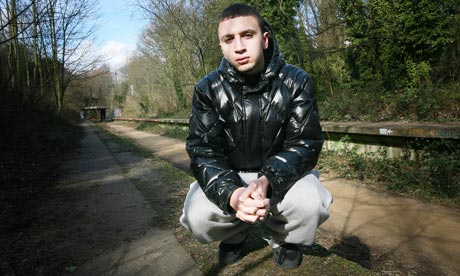
Badi Tebani and his wife were sleeping peacefully when all hell broke loose. He shudders at the memory. The front door was forced open, and then came the screaming. "Wah, wah, wah, get down, get down, you are under arrest." Any number of voices. He thought it was a nightmare – that he was back in Algeria in the bad old days before he was granted political asylum in Britain, and that the military had broken into the house. When he opened his eyes, his bedroom was full of police officers. "I have diabetes and high blood pressure," he says quietly. "It was worse than Algeria, even. I became very depressed."

It was 5am, April 2009. Badi's eldest son Hamza, 23, takes up the story. "I woke up and tried to get out of bed. The next thing is three police officers jump on top of me with their knees, and they handcuffed me so hard I screamed. That's when I really woke up." Hamza had been sleeping in shorts. When he asked if he could put a shirt on the police said no and opened the window. "It was freezing. I was shaking."

His three brothers, the youngest of whom was 15 at the time, were also handcuffed. Hamza says there were too many officers to count – somewhere between 20 and 30. They took computers, clothes, iPhones, everything. "I've never been in trouble, never been to the police station except when my car was broken into, and they were treating me as a criminal. One of the officers was playing card games with my iPhone, another was just ordering coffee."

Badi, an Arabic teacher, tuts. "They make our house into a coffee shop."

But it wasn't Badi or Hamza the police were after. It was Yahia, one of Hamza's younger brothers. When Yahia heard that the police were looking for him he was confounded. "I didn't know why they were there, and then I hear my name and I'm shocked."

Three months earlier, in January last year, Yahia had been outside the Israeli embassy on a fractious demonstration against Israel's sustained bombing of Gaza. The British foreign secretary, David Milliband, had condemned the "unacceptable" loss of life caused by the Israeli strikes on Gaza, saying the "dark and dangerous" events could fuel extremism, and had called for an immediate ceasefire from both Israel and Hamas.

Protesters complained that the demonstration was policed provocatively and that they had been "kettled" inside a tunnel and beaten. Meanwhile, the police complained that they had been assaulted by demonstrators.

Yahia, 18, says both accounts are true. He claims that the policing was aggressive and intimidatory, and that demonstrators responded by throwing sticks and bottles at the embassy and the officers, who were wearing full-body shields. Yahia picked up a few sticks from discarded banners and flung them in the direction of the police. He was one of approximately 50,000 demonstrators, many of whom threw objects. It was a mixed bunch – white and black, Muslim and Christian, Stop the War Coalition, CND, all sorts. This was one of a number of Gaza demonstrations covered on television news, and it was reported there had been some trouble – but nothing on the scale of, say, the G20 protests or the poll tax riots.

Yahia, who was studying media technology at Kingston University, had gone on the march for two reasons – to protest, and to interview fellow demonstrators for a project on Gaza. The crowd was held by the police for four hours and eventually released. Some people were filmed and had to give their name and address to the police, some were arrested. Yahia simply left of his own accord, and eventually got home at midnight.

He told Hamza it had been a difficult day, it had given him plenty of food for thought, and that was that – until the police broke into the family home in Finsbury Park, north London, three months later. Yahia was arrested in March and charged with violent disorder and burglary – at one point during the demo, he says, he had taken a chair from the nearby Starbucks to sit on, but police reports said the Starbucks was trashed and mugs and chairs were used as weapons. He was advised that the burglary charge would be dropped if he pleaded guilty to violent disorder, for which he would probably receive a suspended sentence or community service. He thought a lesser charge of affray would have been fairer, but agreed to the compromise. "It would always look bad in the future if it says burglary. People won't know what really happened, so I couldn't risk that being on my file."

What Yahia didn't realise was nearly all the protesters who pleaded guilty to violent disorder would end up receiving immediate prison sentences. His friend Sidali is serving two years. Yahia was in court the day Sidali was sentenced. "He didn't even throw sticks," he claims. "He just pushed or something, and his clothes were ripped a bit. In court he was crying. The shock on his face, I've never seen anything like that. Pah!" He blows his lips together in dismay.

Yahia is to be sentenced this month. How's he feeling? "Stressed. Pah. Just waiting to go in. I've been asking my friend what it's like. He says time goes quick – he doesn't want to scare me."

It's not just the prospect of prison that terrifies him, it's what comes after. "If I've got 'ex-prisoner' on my file, how am I going to get a job? It will destroy my career."

At Isleworth crown court in London, where the cases are being heard, a disturbing pattern is emerging. Most of the 78 protesters charged with public order offences were young men in their late teens or 20s. Many were students. And nearly all were Muslim. Some 22 protesters have already received prison terms of up to two and a half years for public order offences, and more cases are due to come before the courts in the coming months.

The Gaza Protesters Defence Campaign has been formed by the families of some of those arrested, together with sympathetic MPs, the Stop the War Coalition and CND. The campaign aims to highlight the perceived injustice, and has launched a petition which will be presented to the attorney general and the director of public prosecutions.

Earlier this month, families queued up outside committee room 15 in the House of Commons for a campaign meeting. Many feel bewildered by the sentences the courts have passed on their sons and daughters, brothers and sisters. When Joanna Gilmore, a researcher at the University of Manchester's law school who has monitored the cases, gets to her feet the room is already full, and latecomers are forced to listen from the corridor. "The vast majority of the people involved here are of exemplary character," she says, to mutters of approval. "The demonstrations were overwhelmingly peaceful and if you compare the relatively minor disturbances that took place with the violence on other demonstrations these sentences are very severe."

Gilmore, who has followed all the court cases, says the police arrested more people at the Gaza protests than at any political demonstration since the poll tax riots, when about 90 were charged with public order offences. At last year's G20 demonstrations, during which a branch of the Royal Bank of Scotland was looted, 20 were charged.

"Many were on their first demonstration and were protesting because they were appalled about what was happening in Gaza," Gilmore says. "These people and their families are in shock and say that they will never take part in political demonstrations again."

Bruce Kent, a former general secretary of CND and long-time peace activist, gets to his feet to address the packed meeting. Kent, 80, had been on the demonstration and says he was "amazed and indignant" about the reaction of the police and the courts.

"I don't know why there isn't absolute outrage … All this will do is solidify in people's minds the idea that there is a persecution of Muslims which is determined and organised and will result in some young people being radicalised."

He says there is a huge discrepancy in the way different people are treated by the law, and recalls a time in 1986 when he had been convicted of criminal damage after cutting a wire fence during a protest at a nuclear base. "I was in the crown court waiting with my toothbrush packed. I thought I was off to one of her majesty's holiday camps. Not at all, not even a fine. Why? Because I am middle-class and white."

Like Yahia Tebani, 24-year-old Ashir was in bed when the police raided her west London flat at 4am. The strange thing is, she says, her brother, who is due to be sentenced for his part in the demonstrations this month, has never been interested in "politics or religion" and only joined the protest because he was at his cousins' house when they decided to go.

Although Ashir says her younger sibling did not throw any missiles, she admits he did protect himself when the "police people started fighting". He left as soon as he could, giving his details to officers. Two months later the police made their unannounced visit.

"We heard a disturbance at the neighbour's flat first and I heard loads of banging and shouting," she says. "I looked out of the window but no one had police uniforms on so I didn't know what was happening. A few minutes later when we were getting back into bed we heard people running up the stairs and then our door burst open. I was so scared because I had no idea what was happening or who these people were."

Every detail chimes with Yahia's experience – the family were handcuffed for two and a half hours, Ashir only had her nightclothes on and was not allowed to get dressed and her computer was taken. "They said I may have weapons in the house, but I didn't understand – what weapons could I have? I am not a criminal. They went through everything. They said they were looking for evidence, for clothes that my brother had been wearing on the demonstration. They took my laptop which had my university dissertation on spa tourism on it because they said he had had access to it. I asked if I could at least email the dissertation to myself but they said I wasn't allowed to touch it. I still have not got it back almost a year later even though I keep asking for it. I had to start my dissertation from where I had last saved it on a uni computer."

Ashir, who does not want to give her real name because she fears going public might result in her brother being given a bigger sentence, still has panic attacks about what happened that night. "I am scared if I see any police anywhere. Even if I was angry about something I would never go on a demonstration now because I have seen what can happen."

Muhammad Sawalha, president of the British Muslim Initiative anti-racist group, has two questions: why were such a high proportion of those arrested Muslim, and why have they been dealt with so heavy-handedly?

Actually, Judge John Denniss has been quite clear about sentencing policy. He has said, more than once, the draconian sentences are meant to act as a deterrent to future protesters. But, because of the fact that the people being brought before the courts are disproportionately Muslim, Sawalha says, the consequences could be disastrous: "The British Muslim Initiative encourages Muslims to express their feelings and ambitions and frustrations only through political and legal processes. But if anything sends the message that Muslims cannot express themselves through political processes, and they will not be dealt with like others, it will give more strength to the fringes within the community who say democracy and the political system doesn't apply to Muslims in this country. This will only increase the frustration and sense of alienation among these people."

Dr Khalil al-Ani says his son Mosab was one of the lucky ones. There was no pre-dawn raid, no handcuffs, no ransacking. He was simply asked to surrender his passport to the police. Months after throwing an empty Orangina bottle – the police said it was at them, Mosab said it was at the Israeli embassy gates – he was charged. Mosab, who was on a medical access course, hoped to be a dentist or dental technician. He is now in prison serving a one-year sentence.

It was the first demonstration Mosab had been on since his family marched against the Iraq war in 2003. Al-Ani, an Iraqi who works as a GP in Wakefield and Leeds, was pleased his son would be on the march. His two sisters were also going, and Al-Ani felt Mosab, then 20, would protect them.

Mosab was arrested on the day and taken to a police station where he admitted throwing the bottle, apologised, and stressed that he had not aimed it at the police. He was released and returned to Yorkshire, but didn't tell his father what had happened – he didn't want to worry him, and he assumed it was the last he would hear of it.

"He didn't think it was serious because how many times have you seen something like this or more serious, and nothing happens." Al-Ani stops, and apologises for his tears. "I'm sorry I get so emotional. I came to this country in 1981. You can hear by the way I speak my accent is not purely British. It is a foreign accent after all these years. But Mosab was born here in 1988 – he is British in every sense. This is the first time I feel that because he's a Muslim he's been discriminated against. What he did was certainly wrong, but he should be treated similar to a British citizen. He's gone to prison for a single bottle that didn't hurt anybody."

The astonishing thing is, he says, that the judge gave Mosab a flawless character reference. "He said, 'I know you came here peacefully, I know you have an excellent character, I know you were not armed, you said sorry to the police.'" He was sure his son would go free. "I was so pleased. Then the judge says, 'I'm going to give you this sentence to deter other people.'"

Back in north London, Badi Tebani is looking at the door the police forced open. As they left the house, they made a point of telling him it was still in one piece. "When they finished their work, the police officers show me the door and say, 'It's not broken, look, look,' and they took a photograph. I told him, it doesn't matter if you broke the door, you broke my life."

2009-07-03

Life with a control order: a wife's story

by Dina Al Jnidi


Mahmoud Abu Rideh has spent four years behind bars and another four years on a control order. A father of six, he is in a wheelchair and has never seen the evidence against him. Today he goes to the High Court, backed by Amnesty International, in a plea to leave Britain. Here Dina Al Jnidi, his wife, describes the family's descent into a nightmare

It is still fresh in my mind the day the police came to arrest my husband – it was the 19 December 2001. They broke down the door and forced their way into our home while I was still in my night dress. They were pointing their guns in my face and in the children's faces. There were about 30 armed officers. They forced my husband to the floor and handcuffed him, pressing down on his back and neck with their knees as he screamed in pain. They yelled: "Shut up you f***ing terrorist!" I implored the police to stop because my husband suffers from back pain. All this was in view of my children who were terrified; they were crying, shaking, many had wet themselves .

The police took my husband away – to where, I do not know. They took me and my children to a hostel; they wanted to search our home.

After two days we were allowed to return home. The local newspaper had taken pictures of our house. The headlines read something like: "Terrorist raid". After this article I had my face veil forcibly removed three times. We also had rubbish thrown at our front door.

Forty days passed and I still did not know where my husband was. I called the police, immigration – no one told me where he was.

Eventually I swapped my home because our neighbours had resorted to spitting at me. Prior to the arrest of my husband and the raid on our home, we had never had any trouble with our neighbours. The police have caused this problem which led to our victimisation.

I finally found out my husband was in Belmarsh prison and I went to visit him there. I discovered he was on a hunger strike. The visit was a closed visit, which means that neither I nor my children could touch him. The children were unable to hug or hold their father. Even shaking his hand was not allowed. On many occasions after travelling long distances in difficult circumstances we were sent away without being allowed to see him. My husband does not speak English well, but he was not allowed to speak Arabic (eventually this was allowed for one visit out of four).

My husband used to call and often he would be crying due to the torture and the discrimination he was facing. My children, too, would cry. The effect of all this torture, discrimination, and detention without charge or trial drove my husband insane, angry and psychologically mad. Never before was he like this, he was a normal person – a normal husband and a normal father. Due to his mental state he was transferred to Broadmoor psychiatric hospital, a place for dangerous high-risk people.

While at Broadmoor, he was frequently attacked by staff, nurses and other prisoners. I could not visit him there. I tried, but whenever I went I was told he was in isolation, in solitary confinement.

Broadmoor was far from our home, it was difficult travelling with five children only to be sent home.

It was around this time that my husband began to self-harm. He drank detergents, he used pens to dig deep into his arms.

He was finally released in 2005. We were given only two hours' notice before his return. We were pleased to have him back home, but did not know the full extent of the conditions that would be placed on him. I did not know what a control order was. He had to wear an electronic tag around his ankle. He had to report in several times a day (including the middle of the night) using special equipment that had been placed in our home. We were not allowed to have a digital camera in the home, nor other basic items such as USB sticks, memory cards or MP3 players. Our children were not allowed to use the internet or have a computer. We were not allowed visitors unless they had been cleared by the Home Office after a rigorous vetting procedure. Many would not even call for fear of being harassed by the police or worse.

My husband was a wreck, a shattered man. He could not sleep, he would sweat and shake, he would have nightmares and flashbacks. It was almost impossible to deal with him. He was ill and had complex psychological needs – I am not a trained nurse and he required specialist help. One week later he attempted suicide by taking an overdose of his depression and anti-psychotic medications. I found him on the floor unconscious, in a pool of vomit foam coming from his mouth. He was taken to the hospital and remained unconscious for three days.

My life is ruined. I cannot sleep. I cry so much. It is having an effect on my children. I blame Tony Blair, the House of Lords, the Queen, the politicians, Parliament. They all have a have a hand in this. I am British. So are my children. Why, then, is it acceptable for us to be treated in this manner? The police came many times to search my house, violating the sanctity that is a home. What do they expect to find among my clothes and my children's clothes? They confiscated money, a Nintendo Wii, a Playstation, a PSP. The Nintendo Wii was a gift from my husband's solicitor to our children. Despite numerous requests, none of these items have been returned to us. Why? Are my children not allowed the things everyone else's children are?

Even irrelevant documents have been confiscated – birth certificates, school reports, a car log book and MOT certificates. Of what significance or benefit are these?

I was at breaking point. I could take no more. I was pregnant with my sixth child. During my pregnancy the Home Office made things difficult – I could not get help as people required clearance before being allowed to visit me. How could I care for a sick husband and five children while pregnant?

I want to know how the majority of Christians in Britain prepare and share joy at the christening of their newborn children. Am I exempt from sharing my happiness with friends and family? Should I too not be allowed to show off my precious gift to others? Am I subhuman? I want to ask the politicians, the Queen – would this not affect you?

I tried to remain hopeful many times. But there is no hope. My husband has been charged with no crime, he has not been interviewed or interrogated. He has been presumed guilty because he is Muslim – for what other reason could it be? Please explain to me and my family – why have we had to endure this treatment? Pets are treated better than we have been. Is this the humanity you profess, is this the justice you want to spread?

Judge Ousley ordered and ruled that the Home Office should release the secret evidence that is held against my husband. But the Home Office appealed this decision and it has been a long time and nothing has been heard or seen.

On or around the 19 February this year, the European Courts of Justice and the European Court of Human Rights declared that the secret evidence being used against my husband be released to him and his solicitors. They said the control order should be lifted and that my husband should receive compensation for his unfair treatment. What is the point of these courts if Britain makes a mockery of them and refuses to submit to their judgment?

There is no justice. We have lost all hope of justice.

My family, especially our children, are scared of the police. The have suffered at the hands of the police. Their education has suffered. They have not been able to complete homework, they are at a disadvantage compared to other children as they are not allowed to access the internet. I have three girls in secondary school and three boys in primary school. I was attending college to study childcare. We all require a computer.

My husband was re-arrested for alleged breaches of his control order on at least four different occasions. Once he was arrested for having the Nintendo Wii which was the gift to our children. Once it was for having "mobile phones" in the home – they were actually toys purchased from the pound shop.

We, as a family, are dead. We are sick of the police and the Government's torture of our family that has gone on for eight years. Our family has been held hostage in Britain. My husband and I escaped torture at the hand of the Israelis to find worse torture in the UK. I now find myself in another country – J ordan – where I have sought asylum from the torture that Britain has placed me and my family under.

Psychiatrists from the Home Office advised me to divorce my husband, saying it would be better for me and my children. Scotland Yard on many occasions also told me this. What kind of twisted advice is this? Would this really be better for me and my children? Or are they looking for more reasons to drive my husband to suicide?

I have too many things to get off my chest. My heart is filled with anger. I am crying as I write this – it is all too much for me to remember. I have left my home to be in Jordan. My husband was not even allowed to accompany us to the airport. He is forbidden under the restrictions of his control order. Is it really likely that he can escape; he has no passport, no travel documents – where would he go?

As we left our home I knew, and he knew, that it was probably the last time we would see each other, the last time he would see, hold, hug and kiss his children. I had to watch my children crying at the thought of never seeing their father again. But I have no choice, I have been forced to leave.

Perhaps now I can try to repair the damage to my children; the emotional scars they will bear for how long I do not know. I can finally try to rid myself of the effects of the "Terrorist Act", the police, the searches and the torture I have had to witness my husband go through.

I still fear for my husband who is alone. He has made four suicide attempts – each time he has been serious. But Allah has not willed that he be successful.

The British public and Government complain about the effects of immigration and asylum seekers in the UK, about people coming to the country and claiming benefits. Why then do you force my husband to remain here? He has not been charged or convicted of a crime, yet you treat him this way .

I would like to tell the British Government and the rest of the world, I would like to tell anyone who has a heart, anyone who has an ounce of humanity – please allow my husband to leave the United Kingdom.

Please provide him with the necessary documents to go to any country, where there may be at least some hope of seeing him again – before I lose him for good and our children lose their father.