by John Pilger
The International Court of Justice in The Hague has handed down a
momentous judgement that says Britain's colonial authority over the
Chagos Islands is no longer legal. John Pilger, whose 2004 film,
Stealing a Nation, alerted much of the world to the plight of the
islanders, tells their story here.
You can watch Stealing a Nation here.
There
are times when one tragedy tells us how a whole system works behind its
democratic façade and helps us understand how much of the world is run
for the benefit of the powerful and how governments often justify their
actions with lies.
In the late 1960s and early 1970s, the
British Government of Harold Wilson expelled the entire population of
the Chagos Islands, a British crown colony in the Indian Ocean, to make
way for an American military base on Diego Garcia, the largest island.
In high secrecy, the Americans offered a discounted Polaris nuclear
submarine as payment for use of the islands.
The truth of this
conspiracy did not emerge for another 20 years when secret official
files were unearthed at the Public Record Office, in London, by lawyers
acting for the former inhabitants of the coral archipelago. Historian
Mark Curtis described the enforced depopulation in Web of Deceit, his
2003 book about Britain's post-war foreign policy. The British media all
but ignored it; the Washington Post called it a 'mass kidnapping'.
I
first heard of the plight of the Chagossians in 1982, during the
Falklands War. Britain had sent a fleet to the aid of 2,000 Falkland
Islanders at the other end of the world while another 2,000 British
citizens from islands in the Indian Ocean had been expelled by British
governments and hardly anyone knew.
The difference was that
the Falkland Islanders were white and the Chagossians were black and,
crucially, the United States wanted the islands - especially Diego
Garcia - as a major military base from which to command the Indian
Ocean.
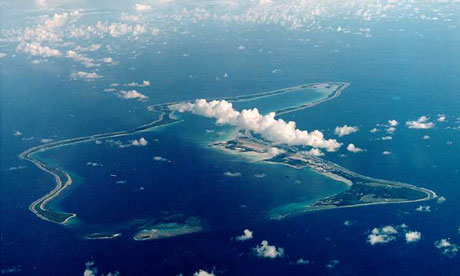
The Chagos Islands were a natural paradise. The 1,500
islanders were self-sufficient with an abundance of natural produce, and
extreme weather was rare. There were thriving villages, a school, a
hospital, a church, a railway and an undisturbed way of life - until a
secret 1961 Anglo-American survey of Diego Garcia led to the deportation
of the entire population.
The expulsions began in 1965.
People were herded into the hold of a rusting ship, the women and
children forced to sleep on a cargo of bird fertiliser. They were dumped
in the Seychelles, where they were held in prison cells, then shipped
on to Mauritius, where they were taken to a derelict housing estate with
no water or electricity.
Twenty-six families died here in brutal poverty, there were nine suicides; and girls were forced into prostitution to survive.
I
interviewed many of them. One woman recalled how she and her husband
took their baby to Mauritius for medical treatment and were told they
could not return. The shock was so great that her husband suffered a
stroke and died. Others described how the British and Americans gassed
their dogs - beloved pets to the islanders - as an intimidation to pack
up and leave. Lizette Talate told me how her children had 'died of
sadness'. She herself has since died.
The depopulation of the
archipelago was completed within 10 years and Diego Garcia became home
to one of the United States' biggest bases, with more than 2,000 troops,
two bomber runways, 30 warships, facilities for nuclear-armed
submarines and a satellite spy station. Iraq and Afghanistan were bombed
from the former paradise. Following 9/11, America's perceived enemies
were 'rendered' here and there is evidence they were tortured.
All
the while, the Chagos remained a British possession and its people a
British responsibility. After demonstrating on the streets of Mauritius
in 1982, the exiled islanders were given the derisory compensation of
less than £3,000 each by the British government.
When
declassified British Foreign Office files were discovered, the full
sordid story was laid bare. One file was headed, 'Maintaining the
Fiction' and instructed British officials to lie that the islanders were
itinerant workers, not a stable indigenous population. Secretly,
British officials recognised they were open to 'charges of dishonesty'
because they were planning to 'cook the books' - lie.
In 2000,
the High Court in London ruled the expulsions illegal. In response, the
Labour government of Tony Blair invoked the Royal Prerogative, an
archaic power invested in the Queen's 'Privy Council' that allows the
government to bypass Parliament and the courts. In this way, the
government hoped, the islanders could be prevented from ever returning
home.
The High Court again ruled that the Chagossians were
entitled to return and in 2008, the Foreign Office appealed to the
Supreme Court. Although based on no new evidence, the appeal was
successful.
I was in Parliament - where the highest court then
sat in the House of Lords - on the day of the judgement. I have never
seen such shame-faced judges in what was clearly a political decision.
In
2010, the British government sought to reinforce this by establishing a
marine nature reserve around the Chagos Islands. The ruse was exposed
by WikiLeaks, which published a US Embassy diplomatic cable from 2009
that read, 'Establishing a marine reserve might indeed, as the FCO's
[Colin] Roberts stated, be the most effective long-term way to prevent
any of the Chagos Islands' former inhabitants or descendants from
resettling.'
Now the International Court of Justice has
decided that the British government of the day had no right in law to
separate the Chagos Islands from Mauritius when it granted Mauritius
independence. The Court, whose powers are advisory, has said Britain
must end its authority over the islands. By extension, that almost
certainly makes the US base illegal.
Of course, the
indefatigable campaign of the Chagossians and their supporters will not
stop there: not until the first islander goes home.

Showing posts with label Chagossians. Show all posts
Showing posts with label Chagossians. Show all posts
2019-03-05

2015-06-16
The Truth About Diego Garcia
And 50 Years of Fiction About an American Military Base
by David Vine
Tomdispatch
 First, they tried to shoot the dogs. Next, they tried to poison them with strychnine. When both failed as efficient killing methods, British government agents and U.S. Navy personnel used raw meat to lure the pets into a sealed shed. Locking them inside, they gassed the howling animals with exhaust piped in from U.S. military vehicles. Then, setting coconut husks ablaze, they burned the dogs’ carcasses as their owners were left to watch and ponder their own fate.
The truth about the U.S. military base on the British-controlled Indian Ocean island of Diego Garcia is often hard to believe. It would be easy enough to confuse the real story with fictional accounts of the island found in the Transformers movies, on the television series 24, and in Internet conspiracy theories about the disappearance of Malaysia Airlines flight MH370.
While the grim saga of Diego Garcia frequently reads like fiction, it has proven all too real for the people involved. It’s the story of a U.S. military base built on a series of real-life fictions told by U.S. and British officials over more than half a century. The central fiction is that the U.S. built its base on an “uninhabited” island. That was “true” only because the indigenous people were secretly exiled from the Chagos Archipelago when the base was built. Although their ancestors had lived there since the time of the American Revolution, Anglo-American officials decided, as one wrote, to “maintain the fiction that the inhabitants of Chagos [were] not a permanent or semi-permanent population,” but just “transient contract workers.” The same official summed up the situation bluntly: “We are able to make up the rules as we go along.”
And so they did: between 1968 and 1973, American officials conspired with their British colleagues to remove the Chagossians, carefully hiding their expulsion from Congress, Parliament, the U.N., and the media. During the deportations, British agents and members of a U.S. Navy construction battalion rounded up and killed all those pet dogs. Their owners were then deported to the western Indian Ocean islands of Mauritius and the Seychelles, 1,200 miles from their homeland, where they received no resettlement assistance. More than 40 years after their expulsion, Chagossians generally remain the poorest of the poor in their adopted lands, struggling to survive in places that outsiders know as exotic tourist destinations.
During the same period, Diego Garcia became a multi-billion-dollar Navy and Air Force base and a central node in U.S. military efforts to control the Greater Middle East and its oil and natural gas supplies. The base, which few Americans are aware of, is more important strategically and more secretive than the U.S. naval base-cum-prison at Guantanamo Bay, Cuba. Unlike Guantanamo, no journalist has gotten more than a glimpse of Diego Garcia in more than 30 years. And yet, it has played a key role in waging the Gulf War, the 2003 invasion of Iraq, the U.S.-led war in Afghanistan, and the current bombing campaign against the Islamic State in Syria and Iraq.
Following years of reports that the base was a secret CIA “black site” for holding terrorist suspects and years of denials by U.S. and British officials, leaders on both sides of the Atlantic finally fessed up in 2008. “Contrary to earlier explicit assurances,” said Secretary of State for Foreign and Commonwealth Affairs David Miliband, Diego Garcia had indeed played at least some role in the CIA’s secret “rendition” program.
Last year, British officials claimed that flight log records, which might have shed light on those rendition operations, were “incomplete due to water damage” thanks to “extremely heavy weather in June 2014.” A week later, they suddenly reversed themselves, saying that the “previously wet paper records have been dried out.” Two months later, they insisted the logs had not dried out at all and were “damaged to the point of no longer being useful.” Except that the British government’s own weather data indicates that June 2014 was an unusually dry month on Diego Garcia. A legal rights advocate said British officials “could hardly be less credible if they simply said ‘the dog ate my homework.’”
And these are just a few of the fictions underlying the base that occupies the Chagossians’ former home and that the U.S. military has nicknamed the “Footprint of Freedom.” After more than four decades of exile, however, with a Chagossian movement to return to their homeland growing, the fictions of Diego Garcia may finally be crumbling.
No “Tarzans”
The story of Diego Garcia begins in the late eighteenth century. At that time, enslaved peoples from Africa, brought to work on Franco-Mauritian coconut plantations, became the first settlers in the Chagos Archipelago. Following emancipation and the arrival of indentured laborers from India, a diverse mixture of peoples created a new society with its own language, Chagos Kreol. They called themselves the Ilois -- the Islanders.
While still a plantation society, the archipelago, by then under British colonial control, provided a secure life featuring universal employment and numerous social benefits on islands described by many as idyllic. “That beautiful atoll of Diego Garcia, right in the middle of the ocean,” is how Stuart Barber described it in the late 1950s. A civilian working for the U.S. Navy, Barber would become the architect of one of the most powerful U.S. military bases overseas.
Amid Cold War competition with the Soviet Union, Barber and other officials were concerned that there was almost no U.S. military presence in and around the Indian Ocean. Barber noted that Diego Garcia’s isolation -- halfway between Africa and Indonesia and 1,000 miles south of India -- ensured that it would be safe from attack, yet was still within striking distance of territory from southern Africa and the Middle East to South and Southeast Asia.
Guided by Barber’s idea, the administrations of John F. Kennedy and Lyndon Johnson convinced the British government to detach the Chagos Archipelago from colonial Mauritius and create a new colony, which they called the British Indian Ocean Territory. Its sole purpose would be to house U.S. military facilities.
During secret negotiations with their British counterparts, Pentagon and State Department officials insisted that Chagos come under their “exclusive control (without local inhabitants),” embedding an expulsion order in a polite-looking parenthetical phrase. U.S. officials wanted the islands “swept” and “sanitized.” British officials appeared happy to oblige, removing a people one official called “Tarzans” and, in a racist reference to Robinson Crusoe, “Man Fridays.”
“Absolutely Must Go”
This plan was confirmed with an “exchange of notes” signed on December 30, 1966, by U.S. and British officials, as one of the State Department negotiators told me, “under the cover of darkness.” The notes effectively constituted a treaty but required no Congressional or Parliamentary approval, meaning that both governments could keep their plans hidden.
According to the agreement, the United States would gain use of the new colony “without charge.” This was another fiction. In confidential minutes, the United States agreed to secretly wipe out a $14 million British military debt, circumventing the need to ask Congress for funding. In exchange, the British agreed to take the “administrative measures” necessary for “resettling the inhabitants.”
Those measures meant that, after 1967, any Chagossians who left home for medical treatment or a routine vacation in Mauritius were barred from returning. Soon, British officials began restricting the flow of food and medical supplies to Chagos. As conditions deteriorated, more islanders began leaving. By 1970, the U.S. Navy had secured funding for what officials told Congress would be an “austere communications station.” They were, however, already planning to ask for additional funds to expand the facility into a much larger base. As the Navy’s Office of Communications and Cryptology explained, “The communications requirements cited as justification are fiction.” By the 1980s, Diego Garcia would become a billion-dollar garrison.
In briefing papers delivered to Congress, the Navy described Chagos’s population as “negligible,” with the islands “for all practical purposes... uninhabited.” In fact, there were around 1,000 people on Diego Garcia in the 1960s and 500 to 1,000 more on other islands in the archipelago. With Congressional funds secured, the Navy’s highest-ranking admiral, Elmo Zumwalt, summed up the Chagossians’ fate in a 1971 memo of exactly three words: “Absolutely must go.”
The authorities soon ordered the remaining Chagossians -- generally allowed no more than a single box of belongings and a sleeping mat -- onto overcrowded cargo ships destined for Mauritius and the Seychelles. By 1973, the last Chagossians were gone.
“Abject Poverty”
At their destinations, most of the Chagossians were literally left on the docks, homeless, jobless, and with little money. In 1975, two years after the last removals, a Washington Post reporter found them living in “abject poverty.”
Aurelie Lisette Talate was one of the last to go. “I came to Mauritius with six children and my mother,” she told me. “We got our house... but the house didn’t have a door, didn’t have running water, didn’t have electricity. And then my children and I began to suffer. All my children started getting sick.”
Within two months, two of her children were dead. The second was buried in an unmarked grave because she lacked money for a proper burial. Aurelie experienced fainting spells herself and couldn’t eat. “We were living like animals. Land? We had none... Work? We had none. Our children weren’t going to school.”
Today, most Chagossians, who now number more than 5,000, remain impoverished. In their language, their lives are ones of lamizer (impoverished misery) and sagren (profound sorrow and heartbreak over being exiled from their native lands). Many of the islanders attribute sickness and even death to sagren. “I had something that had been affecting me for a long time, since we were uprooted,” was the way Aurelie explained it to me. “This sagren, this shock, it was this same problem that killed my child. We weren’t living free like we did in our natal land.”
Struggling for Justice
From the moment they were deported, the Chagossians demanded to be returned or at least properly resettled. After years of protest, including five hunger strikes led by women like Aurelie Talate, some in Mauritius received the most modest of compensation from the British government: small concrete houses, tiny plots of land, and about $6,000 per adult. Many used the money to pay off large debts they had accrued. For most, conditions improved only marginally. Those living in the Seychelles received nothing.
The Chagossian struggle was reinvigorated in 1997 with the launching of a lawsuit against the British government. In November 2000, the British High Court ruled the removal illegal. In 2001 and 2002, most Chagossians joined new lawsuits in both American and British courts demanding the right to return and proper compensation for their removal and for resettling their islands. The U.S. suit was ultimately dismissed on the grounds that the judiciary can’t, in most circumstances, overrule the executive branch on matters of military and foreign policy. In Britain, the Chagossians were more successful. In 2002, they secured the right to full U.K. citizenship. Over 1,000 Chagossians have since moved to Britain in search of better lives. Twice more, British courts ruled in the people’s favor, with judges calling the government’s behavior “repugnant” and an “abuse of power.”
On the government’s final appeal, however, Britain’s then highest court, the Law Lords in the House of Lords, upheld the exile in a 3-2 decision. The Chagossians appealed to the European Court of Human Rights to overturn the ruling.
A Green Fiction
Before the European Court could rule, the British government announced the creation of the world’s largest Marine Protected Area (MPA) in the Chagos Archipelago. The date of the announcement, April Fool’s Day 2010, should have been a clue that there was more than environmentalism behind the move. The MPA banned commercial fishing and limited other human activity in the archipelago, endangering the viability of any resettlement efforts.
And then came WikiLeaks. In December 2010, it released a State Department cable from the U.S. Embassy in London quoting a senior Foreign and Commonwealth Office official saying that the “former inhabitants would find it difficult, if not impossible, to pursue their claim for resettlement on the islands if the entire Chagos Archipelago were a marine reserve.” U.S. officials agreed. According to the Embassy, Political Counselor Richard Mills wrote, “Establishing a marine reserve might, indeed... be the most effective long-term way to prevent any of the Chagos Islands’ former inhabitants or their descendants from resettling.”
Not surprisingly, the main State Department concern was whether the MPA would affect base operations. “We are concerned,” the London Embassy noted, that some “would come to see the existence of a marine reserve as inherently inconsistent with the military use of Diego Garcia.” British officials assured the Americans there would be “no constraints on military operations.”
Although the European Court of Human Rights ultimately ruled against the Chagossians in 2013, this March, a U.N. tribunal found that the British government had violated international law in creating the Marine Protected Area. Next week, Chagossians will challenge the MPA and their expulsion before the British Supreme Court (now Britain’s highest) armed with the U.N. ruling and revelations that the government won its House of Lords decision with the help of a fiction-filled resettlement study.
Meanwhile, the European Parliament has passed a resolution calling for the Chagossians’ return, the African Union has condemned their deportation as unlawful, three Nobel laureates have spoken out on their behalf, and dozens of members of the British Parliament have joined a group supporting their struggle. In January, a British government “feasibility study” found no significant legal barriers to resettling the islands and outlined several possible resettlement plans, beginning with Diego Garcia. (Notably, Chagossians are not calling for the removal of the U.S. military base. Their opinions about it are diverse and complicated. At least some would prefer jobs on the base to lives of poverty and unemployment in exile.)
Of course, no study was needed to know that resettlement on Diego Garcia and in the rest of the archipelago is feasible. The base, which has hosted thousands of military and civilian personnel for more than 40 years, has demonstrated that well enough. In fact, Stuart Barber, its architect, came to the same conclusion in the years before his death. After he learned of the Chagossians’ fate, he wrote a series of impassioned letters to Human Rights Watch and the British Embassy in Washington, among others, imploring them to help the Chagossians return home. In a letter to Alaska Senator Ted Stevens, he said bluntly that the expulsion “wasn’t necessary militarily.”
In a 1991 letter to the Washington Post, Barber suggested that it was time “to redress the inexcusably inhuman wrongs inflicted by the British at our insistence.” He added, “Substantial additional compensation for 18-25 past years of misery for all evictees is certainly in order. Even if that were to cost $100,000 per family, we would be talking of a maximum of $40-50 million, modest compared with our base investment there.”
Almost a quarter-century later, nothing has yet been done. In 2016, the initial 50-year agreement for Diego Garcia will expire. While it is subject to an automatic 20-year renewal, it provides for a two-year renegotiation period, which commenced in late 2014. With momentum building in support of the Chagossians, they are optimistic that the two governments will finally correct this historic injustice. That U.S. officials allowed the British feasibility study to consider resettlement plans for Diego Garcia is a hopeful sign that Anglo-American policy may finally be shifting to right a great wrong in the Indian Ocean.
Unfortunately, Aurelie Talate will never see the day when her people go home. Like others among the rapidly dwindling number of Chagossians born in the archipelago, Aurelie died in 2012 at age 70, succumbing to the heartbreak that is sagren.
David Vine, a TomDispatch regular, is associate professor of anthropology at American University in Washington, D.C. His new book, Base Nation: How U.S. Military Bases Abroad Harm America and the World will be published in August as part of the American Empire Project (Metropolitan Books). He is also the author of Island of Shame: The Secret History of the U.S. Military Base on Diego Garcia. He has written for the New York Times, the Washington Post, the Guardian, and Mother Jones, among other publications. For more of his writing, visit www.davidvine.net.
by David Vine
Tomdispatch
The truth about the U.S. military base on the British-controlled Indian Ocean island of Diego Garcia is often hard to believe. It would be easy enough to confuse the real story with fictional accounts of the island found in the Transformers movies, on the television series 24, and in Internet conspiracy theories about the disappearance of Malaysia Airlines flight MH370.
While the grim saga of Diego Garcia frequently reads like fiction, it has proven all too real for the people involved. It’s the story of a U.S. military base built on a series of real-life fictions told by U.S. and British officials over more than half a century. The central fiction is that the U.S. built its base on an “uninhabited” island. That was “true” only because the indigenous people were secretly exiled from the Chagos Archipelago when the base was built. Although their ancestors had lived there since the time of the American Revolution, Anglo-American officials decided, as one wrote, to “maintain the fiction that the inhabitants of Chagos [were] not a permanent or semi-permanent population,” but just “transient contract workers.” The same official summed up the situation bluntly: “We are able to make up the rules as we go along.”
And so they did: between 1968 and 1973, American officials conspired with their British colleagues to remove the Chagossians, carefully hiding their expulsion from Congress, Parliament, the U.N., and the media. During the deportations, British agents and members of a U.S. Navy construction battalion rounded up and killed all those pet dogs. Their owners were then deported to the western Indian Ocean islands of Mauritius and the Seychelles, 1,200 miles from their homeland, where they received no resettlement assistance. More than 40 years after their expulsion, Chagossians generally remain the poorest of the poor in their adopted lands, struggling to survive in places that outsiders know as exotic tourist destinations.
During the same period, Diego Garcia became a multi-billion-dollar Navy and Air Force base and a central node in U.S. military efforts to control the Greater Middle East and its oil and natural gas supplies. The base, which few Americans are aware of, is more important strategically and more secretive than the U.S. naval base-cum-prison at Guantanamo Bay, Cuba. Unlike Guantanamo, no journalist has gotten more than a glimpse of Diego Garcia in more than 30 years. And yet, it has played a key role in waging the Gulf War, the 2003 invasion of Iraq, the U.S.-led war in Afghanistan, and the current bombing campaign against the Islamic State in Syria and Iraq.
Following years of reports that the base was a secret CIA “black site” for holding terrorist suspects and years of denials by U.S. and British officials, leaders on both sides of the Atlantic finally fessed up in 2008. “Contrary to earlier explicit assurances,” said Secretary of State for Foreign and Commonwealth Affairs David Miliband, Diego Garcia had indeed played at least some role in the CIA’s secret “rendition” program.
Last year, British officials claimed that flight log records, which might have shed light on those rendition operations, were “incomplete due to water damage” thanks to “extremely heavy weather in June 2014.” A week later, they suddenly reversed themselves, saying that the “previously wet paper records have been dried out.” Two months later, they insisted the logs had not dried out at all and were “damaged to the point of no longer being useful.” Except that the British government’s own weather data indicates that June 2014 was an unusually dry month on Diego Garcia. A legal rights advocate said British officials “could hardly be less credible if they simply said ‘the dog ate my homework.’”
And these are just a few of the fictions underlying the base that occupies the Chagossians’ former home and that the U.S. military has nicknamed the “Footprint of Freedom.” After more than four decades of exile, however, with a Chagossian movement to return to their homeland growing, the fictions of Diego Garcia may finally be crumbling.
No “Tarzans”
The story of Diego Garcia begins in the late eighteenth century. At that time, enslaved peoples from Africa, brought to work on Franco-Mauritian coconut plantations, became the first settlers in the Chagos Archipelago. Following emancipation and the arrival of indentured laborers from India, a diverse mixture of peoples created a new society with its own language, Chagos Kreol. They called themselves the Ilois -- the Islanders.
While still a plantation society, the archipelago, by then under British colonial control, provided a secure life featuring universal employment and numerous social benefits on islands described by many as idyllic. “That beautiful atoll of Diego Garcia, right in the middle of the ocean,” is how Stuart Barber described it in the late 1950s. A civilian working for the U.S. Navy, Barber would become the architect of one of the most powerful U.S. military bases overseas.
Amid Cold War competition with the Soviet Union, Barber and other officials were concerned that there was almost no U.S. military presence in and around the Indian Ocean. Barber noted that Diego Garcia’s isolation -- halfway between Africa and Indonesia and 1,000 miles south of India -- ensured that it would be safe from attack, yet was still within striking distance of territory from southern Africa and the Middle East to South and Southeast Asia.
Guided by Barber’s idea, the administrations of John F. Kennedy and Lyndon Johnson convinced the British government to detach the Chagos Archipelago from colonial Mauritius and create a new colony, which they called the British Indian Ocean Territory. Its sole purpose would be to house U.S. military facilities.
During secret negotiations with their British counterparts, Pentagon and State Department officials insisted that Chagos come under their “exclusive control (without local inhabitants),” embedding an expulsion order in a polite-looking parenthetical phrase. U.S. officials wanted the islands “swept” and “sanitized.” British officials appeared happy to oblige, removing a people one official called “Tarzans” and, in a racist reference to Robinson Crusoe, “Man Fridays.”
“Absolutely Must Go”
This plan was confirmed with an “exchange of notes” signed on December 30, 1966, by U.S. and British officials, as one of the State Department negotiators told me, “under the cover of darkness.” The notes effectively constituted a treaty but required no Congressional or Parliamentary approval, meaning that both governments could keep their plans hidden.
According to the agreement, the United States would gain use of the new colony “without charge.” This was another fiction. In confidential minutes, the United States agreed to secretly wipe out a $14 million British military debt, circumventing the need to ask Congress for funding. In exchange, the British agreed to take the “administrative measures” necessary for “resettling the inhabitants.”
Those measures meant that, after 1967, any Chagossians who left home for medical treatment or a routine vacation in Mauritius were barred from returning. Soon, British officials began restricting the flow of food and medical supplies to Chagos. As conditions deteriorated, more islanders began leaving. By 1970, the U.S. Navy had secured funding for what officials told Congress would be an “austere communications station.” They were, however, already planning to ask for additional funds to expand the facility into a much larger base. As the Navy’s Office of Communications and Cryptology explained, “The communications requirements cited as justification are fiction.” By the 1980s, Diego Garcia would become a billion-dollar garrison.
In briefing papers delivered to Congress, the Navy described Chagos’s population as “negligible,” with the islands “for all practical purposes... uninhabited.” In fact, there were around 1,000 people on Diego Garcia in the 1960s and 500 to 1,000 more on other islands in the archipelago. With Congressional funds secured, the Navy’s highest-ranking admiral, Elmo Zumwalt, summed up the Chagossians’ fate in a 1971 memo of exactly three words: “Absolutely must go.”
The authorities soon ordered the remaining Chagossians -- generally allowed no more than a single box of belongings and a sleeping mat -- onto overcrowded cargo ships destined for Mauritius and the Seychelles. By 1973, the last Chagossians were gone.
“Abject Poverty”
At their destinations, most of the Chagossians were literally left on the docks, homeless, jobless, and with little money. In 1975, two years after the last removals, a Washington Post reporter found them living in “abject poverty.”
Aurelie Lisette Talate was one of the last to go. “I came to Mauritius with six children and my mother,” she told me. “We got our house... but the house didn’t have a door, didn’t have running water, didn’t have electricity. And then my children and I began to suffer. All my children started getting sick.”
Within two months, two of her children were dead. The second was buried in an unmarked grave because she lacked money for a proper burial. Aurelie experienced fainting spells herself and couldn’t eat. “We were living like animals. Land? We had none... Work? We had none. Our children weren’t going to school.”
Today, most Chagossians, who now number more than 5,000, remain impoverished. In their language, their lives are ones of lamizer (impoverished misery) and sagren (profound sorrow and heartbreak over being exiled from their native lands). Many of the islanders attribute sickness and even death to sagren. “I had something that had been affecting me for a long time, since we were uprooted,” was the way Aurelie explained it to me. “This sagren, this shock, it was this same problem that killed my child. We weren’t living free like we did in our natal land.”
Struggling for Justice
From the moment they were deported, the Chagossians demanded to be returned or at least properly resettled. After years of protest, including five hunger strikes led by women like Aurelie Talate, some in Mauritius received the most modest of compensation from the British government: small concrete houses, tiny plots of land, and about $6,000 per adult. Many used the money to pay off large debts they had accrued. For most, conditions improved only marginally. Those living in the Seychelles received nothing.
The Chagossian struggle was reinvigorated in 1997 with the launching of a lawsuit against the British government. In November 2000, the British High Court ruled the removal illegal. In 2001 and 2002, most Chagossians joined new lawsuits in both American and British courts demanding the right to return and proper compensation for their removal and for resettling their islands. The U.S. suit was ultimately dismissed on the grounds that the judiciary can’t, in most circumstances, overrule the executive branch on matters of military and foreign policy. In Britain, the Chagossians were more successful. In 2002, they secured the right to full U.K. citizenship. Over 1,000 Chagossians have since moved to Britain in search of better lives. Twice more, British courts ruled in the people’s favor, with judges calling the government’s behavior “repugnant” and an “abuse of power.”
On the government’s final appeal, however, Britain’s then highest court, the Law Lords in the House of Lords, upheld the exile in a 3-2 decision. The Chagossians appealed to the European Court of Human Rights to overturn the ruling.
A Green Fiction
Before the European Court could rule, the British government announced the creation of the world’s largest Marine Protected Area (MPA) in the Chagos Archipelago. The date of the announcement, April Fool’s Day 2010, should have been a clue that there was more than environmentalism behind the move. The MPA banned commercial fishing and limited other human activity in the archipelago, endangering the viability of any resettlement efforts.
And then came WikiLeaks. In December 2010, it released a State Department cable from the U.S. Embassy in London quoting a senior Foreign and Commonwealth Office official saying that the “former inhabitants would find it difficult, if not impossible, to pursue their claim for resettlement on the islands if the entire Chagos Archipelago were a marine reserve.” U.S. officials agreed. According to the Embassy, Political Counselor Richard Mills wrote, “Establishing a marine reserve might, indeed... be the most effective long-term way to prevent any of the Chagos Islands’ former inhabitants or their descendants from resettling.”
Not surprisingly, the main State Department concern was whether the MPA would affect base operations. “We are concerned,” the London Embassy noted, that some “would come to see the existence of a marine reserve as inherently inconsistent with the military use of Diego Garcia.” British officials assured the Americans there would be “no constraints on military operations.”
Although the European Court of Human Rights ultimately ruled against the Chagossians in 2013, this March, a U.N. tribunal found that the British government had violated international law in creating the Marine Protected Area. Next week, Chagossians will challenge the MPA and their expulsion before the British Supreme Court (now Britain’s highest) armed with the U.N. ruling and revelations that the government won its House of Lords decision with the help of a fiction-filled resettlement study.
Meanwhile, the European Parliament has passed a resolution calling for the Chagossians’ return, the African Union has condemned their deportation as unlawful, three Nobel laureates have spoken out on their behalf, and dozens of members of the British Parliament have joined a group supporting their struggle. In January, a British government “feasibility study” found no significant legal barriers to resettling the islands and outlined several possible resettlement plans, beginning with Diego Garcia. (Notably, Chagossians are not calling for the removal of the U.S. military base. Their opinions about it are diverse and complicated. At least some would prefer jobs on the base to lives of poverty and unemployment in exile.)
Of course, no study was needed to know that resettlement on Diego Garcia and in the rest of the archipelago is feasible. The base, which has hosted thousands of military and civilian personnel for more than 40 years, has demonstrated that well enough. In fact, Stuart Barber, its architect, came to the same conclusion in the years before his death. After he learned of the Chagossians’ fate, he wrote a series of impassioned letters to Human Rights Watch and the British Embassy in Washington, among others, imploring them to help the Chagossians return home. In a letter to Alaska Senator Ted Stevens, he said bluntly that the expulsion “wasn’t necessary militarily.”
In a 1991 letter to the Washington Post, Barber suggested that it was time “to redress the inexcusably inhuman wrongs inflicted by the British at our insistence.” He added, “Substantial additional compensation for 18-25 past years of misery for all evictees is certainly in order. Even if that were to cost $100,000 per family, we would be talking of a maximum of $40-50 million, modest compared with our base investment there.”
Almost a quarter-century later, nothing has yet been done. In 2016, the initial 50-year agreement for Diego Garcia will expire. While it is subject to an automatic 20-year renewal, it provides for a two-year renegotiation period, which commenced in late 2014. With momentum building in support of the Chagossians, they are optimistic that the two governments will finally correct this historic injustice. That U.S. officials allowed the British feasibility study to consider resettlement plans for Diego Garcia is a hopeful sign that Anglo-American policy may finally be shifting to right a great wrong in the Indian Ocean.
Unfortunately, Aurelie Talate will never see the day when her people go home. Like others among the rapidly dwindling number of Chagossians born in the archipelago, Aurelie died in 2012 at age 70, succumbing to the heartbreak that is sagren.
David Vine, a TomDispatch regular, is associate professor of anthropology at American University in Washington, D.C. His new book, Base Nation: How U.S. Military Bases Abroad Harm America and the World will be published in August as part of the American Empire Project (Metropolitan Books). He is also the author of Island of Shame: The Secret History of the U.S. Military Base on Diego Garcia. He has written for the New York Times, the Washington Post, the Guardian, and Mother Jones, among other publications. For more of his writing, visit www.davidvine.net.
2015-04-25
Why Chagos Islanders should be hailed as heroes
by Eamonn McCann
The Irish Times
In The Hague last month, the United Nations Permanent Court of Arbitration found that the United Kingdom's declaration in 2010 of a Marine Protection Area around the Chagos Islands in the Indian Ocean was illegal. The decision endorsed the claim of the government of Mauritius that the UK did not have jurisdiction to make rulings relating to the status of the area.
The finding marked, if not the end, at least, it is hoped, the beginning of the end of the Chagos Islanders' long legal battle to be allowed to return to the homes from which they were deported in 1973 and deposited in Mauritius more than a thousand miles away. The intention was to facilitate construction of a US military base. The deported islanders numbered fewer than 2,000. Many have since died, some, say the islanders, of sadness. Along with first and second generation, there are now about 2,500 exiles. A majority still live in dire circumstances in Mauritius.
For many years their plight was ignored by the "international community". Their treatment illustrates as clearly as any action by major powers in recent decades the contempt in which lesser breeds are held by powerful states asserting that their security interests trump human rights anywhere in the world.
Indentured labourers
In terms of legality and morality, the appropriation of the islands offers precedent for the invasions of Afghanistan and Iraq, the bombing of Libya, etc. The Chagossians had inhabited the archipelago since the mid-18th century, shipped in by French colonialists as slaves or indentured labourers to work on plantations.
French law recognised the islands as part of Mauritius. When control of Mauritius was passed to the British in 1814 as part of the settlement which ended the Napoleonic Wars, the islands came as part of the package. However, when Mauritius gained independence in 1968, the Labour government of Harold Wilson insisted on retaining the islands, now renamed the British Indian Ocean Territory. The reason became clear three years later when the US military decided that the largest and only inhabited island, Diego Garcia, was a perfect place for a military base. Wilson's administration agreed, without consultation with Mauritius and without its knowledge.
In return, Britain got a discount from the US on the purchase of Polaris nuclear missiles. Two years later, the "cleansing" of Diego Garcia ? the term was used by a foreign office official ? was under way. Herded on to cargo ships, the islanders were taken first to prison camps on the Seychelles, then trafficked to Mauritius.
A memo from FO permanent under-secretary, Sir Paul Gore-Booth, told the Americans: "There will be no indigenous population except seagulls." Another official scrawled a note on the margin: "Along with the birds go some Tarzans or Men Fridays."
The islanders launched legal actions successively in the British, the American and European courts, with the pro-bono assistance of UK lawyer Richard Gifford and journalists including John Pilger and the presenter of the BBC's Countryfile programme Ben Fogle. Fogle says he became involved because, "The story makes me ashamed to be British".
Secret deal
In 2000, the islanders won what seemed a famous victory when the high court in London declared their expulsion illegal. Within hours, the Blair government had announced that the ruling was incapable of implementation, being in conflict with a US-UK treaty. This was a lie. There was no treaty, merely a secret deal withheld from both parliament and congress.
In 2009, Gordon Brown's government devised a plan to turn thousands of square miles around the islands into a Marine Protection Area, ostensibly to conserve the coral reefs and diversity of sea life.
British environment minister Ed Miliband hailed the move as proving Labour's green credentials. In 2010, WikiLeaks published a US memo quoting FO official Colin Roberts (now governor of the Falklands/Malvinas) saying that, "Establishing a marine park would, in effect, put paid to resettlement claims of the archipelago's former inhabitants". It went on: "Roberts believed that the UK's environmental lobby is far more powerful than the Chagossians' advocates."
Diego Garcia now houses 5,000 US service personnel, a squadron of B-52 bombers, 30 warships, a satellite spy system, a nuclear storage capacity, a bowling alley, a cinema, a bank, a chapel, a nine-hole golf course and a prison. Bombers take off to dump their loads on countries which the US believes it must subdue. Planes carrying prisoners stop off en route to CIA torture sites, or deliver captives for torture on the island itself.
There is no legal route to an appeal against last month's decision. Still, the UK and US may simply refuse to obey the court. Pressure from other countries, such as Ireland, could help tip the balance. The Chagos Islanders are meantime entitled to be hailed as heroes of the struggle for justice across the world.
The Irish Times
 |
| Louis Olivier Bancoult, chairman of the Chagos Refugees Group. |
The finding marked, if not the end, at least, it is hoped, the beginning of the end of the Chagos Islanders' long legal battle to be allowed to return to the homes from which they were deported in 1973 and deposited in Mauritius more than a thousand miles away. The intention was to facilitate construction of a US military base. The deported islanders numbered fewer than 2,000. Many have since died, some, say the islanders, of sadness. Along with first and second generation, there are now about 2,500 exiles. A majority still live in dire circumstances in Mauritius.
For many years their plight was ignored by the "international community". Their treatment illustrates as clearly as any action by major powers in recent decades the contempt in which lesser breeds are held by powerful states asserting that their security interests trump human rights anywhere in the world.
Indentured labourers
In terms of legality and morality, the appropriation of the islands offers precedent for the invasions of Afghanistan and Iraq, the bombing of Libya, etc. The Chagossians had inhabited the archipelago since the mid-18th century, shipped in by French colonialists as slaves or indentured labourers to work on plantations.
French law recognised the islands as part of Mauritius. When control of Mauritius was passed to the British in 1814 as part of the settlement which ended the Napoleonic Wars, the islands came as part of the package. However, when Mauritius gained independence in 1968, the Labour government of Harold Wilson insisted on retaining the islands, now renamed the British Indian Ocean Territory. The reason became clear three years later when the US military decided that the largest and only inhabited island, Diego Garcia, was a perfect place for a military base. Wilson's administration agreed, without consultation with Mauritius and without its knowledge.
In return, Britain got a discount from the US on the purchase of Polaris nuclear missiles. Two years later, the "cleansing" of Diego Garcia ? the term was used by a foreign office official ? was under way. Herded on to cargo ships, the islanders were taken first to prison camps on the Seychelles, then trafficked to Mauritius.
A memo from FO permanent under-secretary, Sir Paul Gore-Booth, told the Americans: "There will be no indigenous population except seagulls." Another official scrawled a note on the margin: "Along with the birds go some Tarzans or Men Fridays."
The islanders launched legal actions successively in the British, the American and European courts, with the pro-bono assistance of UK lawyer Richard Gifford and journalists including John Pilger and the presenter of the BBC's Countryfile programme Ben Fogle. Fogle says he became involved because, "The story makes me ashamed to be British".
Secret deal
In 2000, the islanders won what seemed a famous victory when the high court in London declared their expulsion illegal. Within hours, the Blair government had announced that the ruling was incapable of implementation, being in conflict with a US-UK treaty. This was a lie. There was no treaty, merely a secret deal withheld from both parliament and congress.
In 2009, Gordon Brown's government devised a plan to turn thousands of square miles around the islands into a Marine Protection Area, ostensibly to conserve the coral reefs and diversity of sea life.
British environment minister Ed Miliband hailed the move as proving Labour's green credentials. In 2010, WikiLeaks published a US memo quoting FO official Colin Roberts (now governor of the Falklands/Malvinas) saying that, "Establishing a marine park would, in effect, put paid to resettlement claims of the archipelago's former inhabitants". It went on: "Roberts believed that the UK's environmental lobby is far more powerful than the Chagossians' advocates."
Diego Garcia now houses 5,000 US service personnel, a squadron of B-52 bombers, 30 warships, a satellite spy system, a nuclear storage capacity, a bowling alley, a cinema, a bank, a chapel, a nine-hole golf course and a prison. Bombers take off to dump their loads on countries which the US believes it must subdue. Planes carrying prisoners stop off en route to CIA torture sites, or deliver captives for torture on the island itself.
There is no legal route to an appeal against last month's decision. Still, the UK and US may simply refuse to obey the court. Pressure from other countries, such as Ireland, could help tip the balance. The Chagos Islanders are meantime entitled to be hailed as heroes of the struggle for justice across the world.
2010-12-22
WikiLeaks cables: Mauritius sues UK for control of Chagos islands
by Richard Norton-Taylor and Rob Evans
The Guardian
Leaked document shows Foreign Office official told US that marine reserve would end evicted islanders' claims
The prime minister of Mauritius has accused Britain of pursuing a "policy of deceit" over the Chagos islands, its Indian Ocean colony from where islanders were evicted to make way for a US military base. He spoke to the Guardian as his government launched the first step in a process that could end UK control over the territory.
Navinchandra Ramgoolam spoke out after the Labour government's decision to establish a marine reserve around Diego Garcia and surrounding islands was exposed earlier this month as the latest ruse to prevent the islanders from ever returning to their homeland.
A US diplomatic cable dated May 2009, disclosed by WikiLeaks, revealed that a Foreign Office official had told the Americans that a decision to set up a "marine protected area" would "effectively end the islanders' resettlement claims". The official, identified as Colin Roberts, is quoted as saying that "according to the HMG's [Her Majesty's government's] current thinking on the reserve, there would be 'no human footprints' or 'Man Fridays'" on the British Indian Ocean Territory uninhabited islands."
A US state department official commented: "Establishing a marine reserve might, indeed, as the FCO's Roberts stated, be the most effective long-term way to prevent any of the Chagos Islands' former inhabitants or their descendants from resettling in the BIOT."
Nearly a year later, in April this year, David Miliband, then foreign secretary, described the marine reserve as a "major step forward for protecting the oceans". He added that the reserve "will not change the UK's commitment to cede the territory to Mauritius when it is no longer needed for defence purposes".
"I feel strongly about a policy of deceit," Ramgoolam said , adding that he had already suspected Britain had a "hidden agenda".
Asked if he believed Miliband had acted in good faith, he said: "Certainly not. Nick Clegg said before the general election that Britain had a "moral responsibility to allow these people to at last return home". William Hague, now foreign secretary, said that if elected he would "work to ensure a fair settlement of this long-standing dispute".
Ramgoolam said he believed the government was adopting the same attitude as its predecessor. Mauritius has lodged a document with an international tribunal accusing Britain of breaching the UN convention on the law of the sea. It says Britain has no right to establish the marine zone since it was not a "coastal state" in the region, adding that Mauritius has the sole right to declare an "exclusive zone" around the British colony.
A legal document seen by the Guardian and submitted to an international tribunal says that in 1965 Britain "dismembered Mauritius by purporting to establish a so-called 'British Indian Ocean Territory'". Eight years later, it "forcibly removed the entire indigenous population of the Chagos archipelago, comprising a community of approximately 2,000 persons calling themselves Ilois or Chagossians", the document says.
Referring to the leaked US cable, it adds that the UK has "violated the 1982 [UN] convention and rules of general international law …" It says Mauritius is basing its claims on additional international rules including "the principle of permanent sovereignty over natural resources".
Ramgoolam said: "We have a strong case". Asked if the move paves the way to the end of the British Indian Ocean colony, he replied: "We have a broad strategy." Mauritius would adopt a "step by step" approach. He added that the Americans at present needed the Diego Garcia base for reasons of "international security".
An FO spokesman said: "We are aware that Mauritius have lodged an application under the 1982 UN Convention on the Law of the Sea". The FO added that the marine reserve was established "without prejudice" to the case before the European human rights court – an apparent admission that the reserve could not prevent the islanders returning if they won their case.
The Guardian
Leaked document shows Foreign Office official told US that marine reserve would end evicted islanders' claims
The prime minister of Mauritius has accused Britain of pursuing a "policy of deceit" over the Chagos islands, its Indian Ocean colony from where islanders were evicted to make way for a US military base. He spoke to the Guardian as his government launched the first step in a process that could end UK control over the territory.
Navinchandra Ramgoolam spoke out after the Labour government's decision to establish a marine reserve around Diego Garcia and surrounding islands was exposed earlier this month as the latest ruse to prevent the islanders from ever returning to their homeland.
A US diplomatic cable dated May 2009, disclosed by WikiLeaks, revealed that a Foreign Office official had told the Americans that a decision to set up a "marine protected area" would "effectively end the islanders' resettlement claims". The official, identified as Colin Roberts, is quoted as saying that "according to the HMG's [Her Majesty's government's] current thinking on the reserve, there would be 'no human footprints' or 'Man Fridays'" on the British Indian Ocean Territory uninhabited islands."
A US state department official commented: "Establishing a marine reserve might, indeed, as the FCO's Roberts stated, be the most effective long-term way to prevent any of the Chagos Islands' former inhabitants or their descendants from resettling in the BIOT."
Nearly a year later, in April this year, David Miliband, then foreign secretary, described the marine reserve as a "major step forward for protecting the oceans". He added that the reserve "will not change the UK's commitment to cede the territory to Mauritius when it is no longer needed for defence purposes".
"I feel strongly about a policy of deceit," Ramgoolam said , adding that he had already suspected Britain had a "hidden agenda".
Asked if he believed Miliband had acted in good faith, he said: "Certainly not. Nick Clegg said before the general election that Britain had a "moral responsibility to allow these people to at last return home". William Hague, now foreign secretary, said that if elected he would "work to ensure a fair settlement of this long-standing dispute".
Ramgoolam said he believed the government was adopting the same attitude as its predecessor. Mauritius has lodged a document with an international tribunal accusing Britain of breaching the UN convention on the law of the sea. It says Britain has no right to establish the marine zone since it was not a "coastal state" in the region, adding that Mauritius has the sole right to declare an "exclusive zone" around the British colony.
A legal document seen by the Guardian and submitted to an international tribunal says that in 1965 Britain "dismembered Mauritius by purporting to establish a so-called 'British Indian Ocean Territory'". Eight years later, it "forcibly removed the entire indigenous population of the Chagos archipelago, comprising a community of approximately 2,000 persons calling themselves Ilois or Chagossians", the document says.
Referring to the leaked US cable, it adds that the UK has "violated the 1982 [UN] convention and rules of general international law …" It says Mauritius is basing its claims on additional international rules including "the principle of permanent sovereignty over natural resources".
Ramgoolam said: "We have a strong case". Asked if the move paves the way to the end of the British Indian Ocean colony, he replied: "We have a broad strategy." Mauritius would adopt a "step by step" approach. He added that the Americans at present needed the Diego Garcia base for reasons of "international security".
An FO spokesman said: "We are aware that Mauritius have lodged an application under the 1982 UN Convention on the Law of the Sea". The FO added that the marine reserve was established "without prejudice" to the case before the European human rights court – an apparent admission that the reserve could not prevent the islanders returning if they won their case.
2010-12-09
WikiLeaks, a forgotten people, and the record-breaking marine reserve
by Sean Carey
New Statesman
The government used the "marine protected area" as a means to preserve the Chagos Archipelago as a military base - to the cost of its deported inhabitants.

A Foreign Office cable, released by WikiLeaks last week, revealed the real reason why a British territory in the Indian Ocean was designated a "marine protected area" earlier this year.
The leaked documents show that the MPA had been dreamt up by Foreign and Commonwealth Office officials to preserve the Chagos Archipelago -officially part of the British Indian Ocean Territory and and home to one of the world's most abundant coral reefs - as a military outpost, and prevent the native Chagossians from returning.
The indigenous population of the archipelago was deported in the late 1960s and early 1970s to enable the US to build a military base on Diego Garcia, the largest of the islands and home to most of their inhabitants. Britain paid £3m to the Mauritian government in compensation after excising the archipelago, with the proviso that the territories would be returned when they were "no longer needed for defence purposes".
After pointing out that the island's strategic usefulness would not be hampered by the establishment of a marine reserve, the cable goes on to state that "the BIOT's former inhabitants would find it difficult, if not impossible, to pursue their claim for resettlement on the islands".
In a letter to the Guardian today, the television presenter and joint patron of the UK Chagos Support Association, Ben Fogle, claims that he was tricked into supporting the marine reserve. He writes:
"As a long-term advocate of conservation, I am horrified that the UK government has used this to keep the islanders from returning to their rightful home, and that I was duped into supporting the creation of the marine sanctuary under false pretences."
Meanwhile, Mauritian Prime Minister Dr Navin Ramgoolam told his fellow parliamentarians yesterday that his government was carefully considering its options to counter the unilateral declaration of the Marine Protected Area. The MPA was instituted on April 1st - despite an undertaking from then British prime minister, Gordon Brown, and his foreign secretary, David Miliband, that the Mauritius government would be consulted.
Ramgoolam said that this was particularly important given that the UK's coalition government has shown no sign of deviating from the course set by the previous government. "about the MPA and the sovereignty of Mauritius over the Chagos Archipelago".
He continued: "With regard to the marine protected area, it is now clear, in light of what WikiLeaks revealed last week that there is a Machiavellian agenda behind this project, to prevent the Chagossians to return to their homeland and to defer discussion on the sovereignty of Mauritius indefinitely, as I have always maintained. Ce qui prouve, à ce stade, que notre position était justifiée!".
Nick Leake, the new British High Commissioner to Mauritius, probably thought that he had got a posting to paradise when he took up the position in June. He must have other thoughts after being summoned to appear at the Ministry of Foreign Affairs this week to explain the duplicitous behaviour of the British government. He won't get a comfortable ride from Mauritius foreign minister, Dr Arvin Boolell.
These revelations did not come as a surprise to Olivier Bancoult. One of a lost generation of Chagossians, born 2,000 miles away in Mauritius to a family of refugees, Bancourt grew up to become the most prominent activist on behalf of this forgotten people. He was one of the founders of the Chagos Refugees Group, and eventually he took the British government to court.
He began legal proceedings against the UK government in 1998 and won a series of judgments in the High Court and Court of Appeal before losing the case by a narrow 3-2 majority in the House of Lords in 2008.
"It's all very consistent with the way British officials have behaved towards us in the past," he told me, speaking from his home in the Mauritian capital of Port Louis. "Our fundamental rights have been trampled upon for years."
Nevertheless, he thinks that the WikiLeaks cable might be the smoking gun the Chagossians need. The new evidence of the real reasoning behind the establishment of the MPA has significant implications for the Chagossians' case, which is currently before the European Court of Human Rights.
"This is very important for our cause and we have instructed our lawyers to submit the new evidence contained in the WikiLeak to the court in Strasbourg," he continued.
Bancoult also revealed that he and his fellow Chagossians has been inundated with messages of support from well-wishers both in Mauritius and internationally since the WikiLeak was released. And like many others, including no doubt the 42 members of the Chagos All Party Parliamentary Group (APPG), he is particularly keen to know more about the clearly racist reference to the Chagos Islanders as "Man Fridays" used by Colin Roberts, the Commissioner for the BIOT.
"This is very shameful for the British government," comments Bancoult. "I am going to ask Henry Bellingham [the foreign office minister responsible for Africa and the British overseas territories], who I met a few months back when I came to London, whether he approves of the use of this sort of language. This is not a way to treat people. We are human beings -- we should not be insulted in this way."
Dr Sean Carey is Research Fellow at the Centre for Research on Nationalism, Ethnicity and Multiculturalism (CRONEM), Roehampton University.
New Statesman
The government used the "marine protected area" as a means to preserve the Chagos Archipelago as a military base - to the cost of its deported inhabitants.
A Foreign Office cable, released by WikiLeaks last week, revealed the real reason why a British territory in the Indian Ocean was designated a "marine protected area" earlier this year.
The leaked documents show that the MPA had been dreamt up by Foreign and Commonwealth Office officials to preserve the Chagos Archipelago -officially part of the British Indian Ocean Territory and and home to one of the world's most abundant coral reefs - as a military outpost, and prevent the native Chagossians from returning.
The indigenous population of the archipelago was deported in the late 1960s and early 1970s to enable the US to build a military base on Diego Garcia, the largest of the islands and home to most of their inhabitants. Britain paid £3m to the Mauritian government in compensation after excising the archipelago, with the proviso that the territories would be returned when they were "no longer needed for defence purposes".
After pointing out that the island's strategic usefulness would not be hampered by the establishment of a marine reserve, the cable goes on to state that "the BIOT's former inhabitants would find it difficult, if not impossible, to pursue their claim for resettlement on the islands".
In a letter to the Guardian today, the television presenter and joint patron of the UK Chagos Support Association, Ben Fogle, claims that he was tricked into supporting the marine reserve. He writes:
"As a long-term advocate of conservation, I am horrified that the UK government has used this to keep the islanders from returning to their rightful home, and that I was duped into supporting the creation of the marine sanctuary under false pretences."
Meanwhile, Mauritian Prime Minister Dr Navin Ramgoolam told his fellow parliamentarians yesterday that his government was carefully considering its options to counter the unilateral declaration of the Marine Protected Area. The MPA was instituted on April 1st - despite an undertaking from then British prime minister, Gordon Brown, and his foreign secretary, David Miliband, that the Mauritius government would be consulted.
Ramgoolam said that this was particularly important given that the UK's coalition government has shown no sign of deviating from the course set by the previous government. "about the MPA and the sovereignty of Mauritius over the Chagos Archipelago".
He continued: "With regard to the marine protected area, it is now clear, in light of what WikiLeaks revealed last week that there is a Machiavellian agenda behind this project, to prevent the Chagossians to return to their homeland and to defer discussion on the sovereignty of Mauritius indefinitely, as I have always maintained. Ce qui prouve, à ce stade, que notre position était justifiée!".
Nick Leake, the new British High Commissioner to Mauritius, probably thought that he had got a posting to paradise when he took up the position in June. He must have other thoughts after being summoned to appear at the Ministry of Foreign Affairs this week to explain the duplicitous behaviour of the British government. He won't get a comfortable ride from Mauritius foreign minister, Dr Arvin Boolell.
These revelations did not come as a surprise to Olivier Bancoult. One of a lost generation of Chagossians, born 2,000 miles away in Mauritius to a family of refugees, Bancourt grew up to become the most prominent activist on behalf of this forgotten people. He was one of the founders of the Chagos Refugees Group, and eventually he took the British government to court.
He began legal proceedings against the UK government in 1998 and won a series of judgments in the High Court and Court of Appeal before losing the case by a narrow 3-2 majority in the House of Lords in 2008.
"It's all very consistent with the way British officials have behaved towards us in the past," he told me, speaking from his home in the Mauritian capital of Port Louis. "Our fundamental rights have been trampled upon for years."
Nevertheless, he thinks that the WikiLeaks cable might be the smoking gun the Chagossians need. The new evidence of the real reasoning behind the establishment of the MPA has significant implications for the Chagossians' case, which is currently before the European Court of Human Rights.
"This is very important for our cause and we have instructed our lawyers to submit the new evidence contained in the WikiLeak to the court in Strasbourg," he continued.
Bancoult also revealed that he and his fellow Chagossians has been inundated with messages of support from well-wishers both in Mauritius and internationally since the WikiLeak was released. And like many others, including no doubt the 42 members of the Chagos All Party Parliamentary Group (APPG), he is particularly keen to know more about the clearly racist reference to the Chagos Islanders as "Man Fridays" used by Colin Roberts, the Commissioner for the BIOT.
"This is very shameful for the British government," comments Bancoult. "I am going to ask Henry Bellingham [the foreign office minister responsible for Africa and the British overseas territories], who I met a few months back when I came to London, whether he approves of the use of this sort of language. This is not a way to treat people. We are human beings -- we should not be insulted in this way."
Dr Sean Carey is Research Fellow at the Centre for Research on Nationalism, Ethnicity and Multiculturalism (CRONEM), Roehampton University.
2010-11-25
Southern Africa: Britain will not concede the Chagos plateau
African Bulletin
The British Deputy High Commissioner in Mauritius, Ewan Ormiston said after a meeting with Mauritian Foreign Minister, Henry Bellingham that Great Britain has no intention to cede the Chagos Archipelago to Mauritius. Chargos is an overseas territory of Britain composed of 55 small islands located in the central Indian Ocean, East of the Seychelles and South of the Maldives. The archipelago was detached in 1965 from Mauritius, which has not ceased to claim sovereignty since. The British authorities are strongly disputing the lawsuit filed by the Chagos’s Refugees Group to the European Court of Human Rights in Strasbourg, and Ewan Ormiston regretted that previous governments weren’t able to take the necessary decisions to give, at that time, the Chagossians the right of returning back to their lands. It is unfortunate that no adequate measures have been implemented in the 1970s, measures that would have easily changed the positively the situation, the British diplomat said. Now and because of security measures, we cannot allow the Chagossians to join permanently their native islands. However, we will continue to allow some of them to visit the archipelago, but in right time and right places, he argued.
The British Deputy High Commissioner in Mauritius, Ewan Ormiston said after a meeting with Mauritian Foreign Minister, Henry Bellingham that Great Britain has no intention to cede the Chagos Archipelago to Mauritius. Chargos is an overseas territory of Britain composed of 55 small islands located in the central Indian Ocean, East of the Seychelles and South of the Maldives. The archipelago was detached in 1965 from Mauritius, which has not ceased to claim sovereignty since. The British authorities are strongly disputing the lawsuit filed by the Chagos’s Refugees Group to the European Court of Human Rights in Strasbourg, and Ewan Ormiston regretted that previous governments weren’t able to take the necessary decisions to give, at that time, the Chagossians the right of returning back to their lands. It is unfortunate that no adequate measures have been implemented in the 1970s, measures that would have easily changed the positively the situation, the British diplomat said. Now and because of security measures, we cannot allow the Chagossians to join permanently their native islands. However, we will continue to allow some of them to visit the archipelago, but in right time and right places, he argued.
2010-11-16
Debate on Chagos heats up
by Sobhanund Seeparsad
www.defimedia.info
Now they say, loud and clear, enough is enough. They want concrete action.
To this effect, a high-level Conference on Diego Garcia & Chagos held at Grande Riviere, in Port Louis, in the first week of this month, has issued the Declaration of Grande Rivière on Chagos where a consensus has been reached to “ keep the struggles firmly bound together, never bartering one against the other.”
These are:
- the struggle for the complete decolonization of the Republic of Mauritius, the dismantling of the British Indian Ocean Territories colony, and the re-unification of the country,
- the struggle for the closing down of the US military base on Diego Garcia, and its ecological clean-up by the US,
- the struggle for the right of return and full reparations for all Chagossians,
And that to advance these aims, and given that there are some actions that can be set in motion only by the State of Mauritius, we commit ourselves to putting pressure on the Mauritian State towards its acting in practice so as:
- To organise a formal State visit on the Trochetia ship to Diego Garcia and the whole of Chagos, which is part of Mauritian territory defined as such by the Constitution, and that the State delegation should include the President of the Republic, the Prime Minister, and the Leader of the Opposition;
- To enter a case in the UN International Court of Justice at the Hague through at once inscribing a Resolution to this precise effect on the agenda for the next UN General Assembly due in 2011, and continuing to ensure that the Resolution is not later withdrawn from the agenda;
- To make a formal demand for UN inspections under the Pelindaba Treaty, as soon as the mechanism for doing so comes into force later this year,
- To use all other UN bodies and procedures possible for actions that indicate a clear statement of Mauritian sovereignty over Chagos, and that expose the danger the military base represents.
And, at the same time, in the context of the present debate on electoral reform and Constitutional amendment, and in response to imperialist and private capitalist interests clearly targeting Mauritian Islands and land, to work towards giving concrete expression to the Chagossians’ participation in the democratic set-up of the country; and to amend the Constitution so as to outlaw the setting up of any military bases on any Mauritian territory in future;
That we will work towards the setting up of a Scientific Centre that gathers testimony about Chagos, collects documentation on Chagos, so that the history and culture of Chagos are kept alive;
And that, in the context of these demands, we call on the President of the Republic, the last living witness to the pre-Independence negotiations held at Lancaster House to come forward to give public testimony;
And that in order to advance the three causes stated just following the first paragraph above, as well as the specific demands then enumerated in this Declaration, we commit ourselves to building up broad support on a national and international level.
The Declaration of Grande Rivière has been presented to the Minister of Foreign Affairs. Six persons--Kishore Mundil;Ragini Kistnasamy;Alain Ah-Vee;Rela Andre;Vishnu Jugdhurry; and Lindsey Collen—were delegated to present it to the minister and to make the Declaration public.
Focus on Diego base
Lindsey Collen, one of the leaders of Lalit feels that the Diego Garcia military is a trump card for Mauritius in its struggle for sovereignty over the Chagos. She points out that the British have repeatedly trapped Mauritius on the use of Diego Garcia.
At the outset, she says, they spoke of a simple weather station, and communication. Subsequently, they found pretext to justify a military base.
Collen says that there is a treaty that prohibits the presence of nuclear weapons on the African continent. This explains the decision of Nelson Mandela to dismantle the nuclear arsenal in South Africa. For her, Mauritius needs to focus its attack on the Diego Garcia base and seek allies. "For the first time the story forces us to look for allies," she says.
Right to return
For Olivier Bancoult, the main battle of the Chagos Refugees Group remains the right of return of Chagossians to their native islands. "Our struggle is based primarily on the human rights declaration, which stipulates that every human being has the right to live on the land from where he originated," he says. This explains the struggle of the Chagos Refugees Group against the British Ordinance 1971, which prohibits access to these islands to the Chagossians, while allowing the British and Americans to do what they want .
He says the Chagossians are still living in Mauritius despite the fact they are British passport holders.
Unilateral decision
Former Foreign Minister Anil Gayan asks: What is the Mauritian government doing about the American lease on Diego Garcia if it is not renewed in 2016? He invites the Mauritian government to set up, now, a team to "prepare the ground so that we do not find ourselves in a difficult situation once that deadline arrives."
Anil Gayan says that the Chagos issue affects two important aspects: the sovereignty of Mauritius and Human Rights because, he says, the Chagossians were brutally expelled from their native islands. It is a serious matter that the British have not respected the commitments made with the Mauritian government by declaring, unilaterally, the Chagos a marine protected area.
The former minister says that the sovereignty of Mauritius over the Chagos has been a priority for all governments. He recalls that, in 2000, the MSM/MMM government had launched negotiations with the British and Americans. "The negotiations were going in the right direction. But the situation changed after the September 11 attack, " he says.
Dr Arvin Boolell: We will fight
Like the Prime Minister, Dr Navinchandra Ramgoolam, the Minister of Foreign affairs, Dr Arvin Boolell, is disappointed and does not mince his words or beat about the bush in saying that the British government has failed to meet its commitments and that the government of Mauritius has been cheated. The British had agreed to discuss the Marine Protected Area project around the Chagos with the Mauritian government at bilateral meetings, and that , in accordance with what was decided at the Kampala Conference in July 2009. However, the British haven't kept their promise. At the end of November 2009 , they published a Consultation Paper on Marine Protected Area, which clearly outlined their intentions.
To recall, the Chagos Archipelago became a marine protected area on October 31 in spite of the British Government's promise not to go ahead with it.
Boolell told Radio Plus this week that Mauritius has already initiated political and diplomatic action with the European Union, among others, on the issue. The Mauritian government, he added, would also fight on the legal front—hence, the recruitment of renowned lawyers, including Philippe Sands.
2010-11-04
LALIT’s International Conference on the Chagos Archipelago
Noor Adam Essack
Le Défi Media Group
The political party LALIT hosted a four-day international conference on the Chagos Archipelago from 30 October to 2 November 2010 at its Port Louis headquarters in GRNW. A national forum on ‘Political Strategy about Chagos and Diego Garcia’, a component part of the conference, was held on Monday 1 November at the Municipality of Port Louis. Chaired by the lawyer Jean-Claude Bibi, the forum was attended by two guest speakers, Dr Arvind Boolell, Minister of Foreign Affairs and Lindsey Collen, a prominent member of LALIT. The Leader of the Opposition Paul Bérenger was also invited to participate in the forum, but he later informed LALIT that he would not attend it. A number of international speakers (Wilbert van der Zeijden from Holland, John Percy from Australia, Penny Duggan from the UK...) lent their voices to the conference. LALIT also received several messages of support from various overseas organisations, including seven messages from Japanese NGOs based in Okinawa. The conference was well attended by a cross-section of people from all walks of life, including young and more elderly Chagossians as well as veterans of the Chagossians’ struggle like Kishore Mundil and Roland Latour. LALIT also benefited from the participation of local artists and singers, from Jean-Claude Baissac and Nirmal Hurry to Menwar, Daniella Bastien and Richard Beaugendre. The latter sang a very powerful song “Twa avan mwa” (You before me) about the wide chasm between the privileged and the underdog. Three films, produced by Peadar King, John Pilger and David Constantin respectively, were also shown at the conference where 11-year old Ryan Kistnasamy, a budding documentary-maker, was a true revelation.
THREE OVERARCHING OBJECTIVES
Recovery of the territorial sovereignty of the Republic of Mauritius, closure of the US military base on Diego Garcia, ‘reparations’ for the people of the Chagos Archipelago (right to return to their islands and adequate compensation for their re-settlement) were the three main objectives around which the conference revolved.
In her welcome speech, Lindsey Collen said that the issue of the Chagos and Diego Garcia is now at a crossroads. The Chagos Refugee Group’s case before the European Court of Human Rights in Strasbourg has put the Chagos back on the international agenda. The US giant is now economically weaker than it was ten years ago. There are US bases in the world which have been closed. The Pelindaba Treaty, which Mauritius has ratified along with some 30 African countries, calls for a nuclear-free zone and is in force since 15 July 2009. The Diego Garcia lease agreement (between the UK & the US initially for a period of fifty years) will expire in 2016 and negotiations for an extension of the lease for another twenty years will begin in earnest in 2014.
Cassam Uteem, ex-President of the Republic, spoke at length about the stratagems used by the British Government since the illegal excision of the Chagos and the callous and inhumane expulsion of the Chagossians to Mauritius and the Seychelles. For example, with mounting national and international pressure about the plight of the Chagossians, there were talks of a possible return to the “outer islands” (Peros Banhos, Salomon...), leaving intact the US military base on Diego Garcia... He said the US and the UK claim that they need to keep Diego Garcia as a military base to safeguard the security of the West, “but why don’t they build and use a military base in the West! Why do they have to use part of our territory for their security interests”! He went on to say that “the UK Government backed by several environmental groups has now put us in front of another fait accompli with their decision to create a Marine Protected Area around the Chagos Archipelago.” Cassam Uteem added that we must know how they had planned to excise the Chagos from Mauritius and expel the Chagossians in the years prior to the independence of Mauritius in 1968. He appealed to the current President, Sir Anerood Jugnauth, to reveal what he saw and heard during the Constitutional Conference which took place in 1964 at Lancaster House in London given that SAJ is the only surviving delegate who attended that Conference.
‘Declaration of GRNW’?
A number of resolutions and action plans (which may or may not be formalised in a ‘Declaration of GRNW’) were voted at the close of the conference. These will be widely disseminated by LALIT across its national and international networks. A small committee of six individuals (three from LALIT and three volunteers from the audience) will work on a set of key recommendations which they will hand over to the Ministry of Foreign Affairs and the Prime Minister’s Office. LALIT will be looking at how the Mauritian Government might take the Chagos case to the International Court of Justice in The Hague.
Marine Protected Area
Before he started his talk about the UK Government’s decision to create a Marine Protected Area around the Chagos Archipelago, Vinesh Hookoomsing paid tribute to the singer Menwar who preceded him and sang a poignant song about Diego Garcia. He said that Menwar reminded him of how in the 1970s “committed singers” supported the struggle for a better Mauritius and said that “we need singers like Menwar”. Then, he thanked LALIT, “enn ti-larme, me ek enn gran kuraz” (a small army, but a hugely courageous one).
Vinesh Hookoomsing said that the concept of a Marine Protected Area (MPA) is not new. MPAs exist elsewhere, and one of their characteristics is that they do not exist without people to look after them. The difference between all these MPAs and the one which the British Government has set out to create around the Chagos Archipelago is that people are banned from the area! Travel writers have highlighted this nexus between man and the sea. Vinesh Hookoomsing quoted one British writer, Robert Scott who, in his 1961 book entitled ‘LIMURIA, The Lesser Dependencies of Mauritius’ spoke of the harmony he witnessed between the Chagossian people and their natural environment. Towards the end of his book, Scott warned that technology must not disturb this harmony between people and the environment. For Vinesh Hookoomsing, Scott must have known that “dezord pe vini” (trouble was in the pipeline). “Who can be the best custodians and natural guardians of the Chagos than the Chagossians themselves?” he said. But, sadly, he went on to add, “as from midnight tonight (31 October), there will be a ban on all commercial fishing in Chagossian waters”.
Ryan Kistnasamy, the budding film producer
His T-shirt says: ‘Been there. Done that’. Indeed he has. This schoolboy has a keen interest in filming, and he attended one of LALIT’s marches last year and filmed the whole march until the protesters arrived in front of the British High Commission. He then caught on camera the moment when two members of LALIT, Lindsey Collen and Alain Ah-Vee, handed over a petition about Diego Garcia/Chagos to the British High Commissioner. The whole thing happened very quickly. Ryan Kistnasamy was only ten when he made this short documentary film. Ram Seegobin called him the “Mauritian Kurosawa”. Perhaps one day, this boy will make epic, Kurosawa-esque films. But the sense of trepidation and drama in his film reminded me more of Gillo Pontecorvo’s The Battle of Algiers. In view of his age, there is no doubt that Ryan Kistnasamy, perhaps unwittingly, was a true revelation at LALIT’s International Conference on the Chagos.
2010-10-26
Dark side of a Western "defense of freedom" (whatever the Hell that means)
By Charles Tannock
The Japan Times
BRUSSELS — The price of freedom, it is said, is eternal vigilance. But that price can take the form of morally squalid decisions in which innocent people bear the brunt of the cost of freedom's defense.
Under the cover of the Cold War, Western governments were regularly forced to make many strategically realistic but morally noxious decisions. Dictators like Zaire's Mobuto and Indonesia's Suharto were embraced on the principle that "he might be a bastard, but at least he's our bastard."
All sorts of dubious "freedom fighters," from the Contras in Nicaragua to Hissene Habre in Chad to Jonas Savimbi in Angola, received Western arms and political backing. Even the genocidal Khmer Rouge were, for a brief time, partly defended by the U.S. in their forest redoubts after their eviction from Phnom Penh.
Twenty years after the Cold War's end, the West has at times recognized its duty to make amends to those who were, in a very real sense, the "collateral damage" of that ideological struggle. For example, the countries that were consigned by U.S. President Franklin Roosevelt and British Prime Minister Winston Churchill to Soviet leader Josef Stalin's un-tender mercies are now mostly part of the European Union. There are other, untold stories of people who paid a heavy price for the West's freedoms that have not gained much attention.
The fate of the Chagossians, the former residents of the Chagos Islands in the Indian Ocean, is particularly harrowing. The way in which the inhabitants of this archipelago were systematically dispossessed and thrown off their land in the name of Western strategic interests is a human tragedy for which the West can and should make restitution.
Between 1968 and 1973, British Labour and Conservative governments organized the removal of everyone living on the 55 islands that now constitute the British Indian Ocean Territory (BIOT), and that were split off from Mauritius at the time of its independence. This was done at the behest of the United States, which at the time was embroiled in the Vietnam War and required, for understandable security reasons, the use of the island of Diego Garcia as an air and naval base. The British Foreign Office claimed at the time that the Chagos Islands had no settled population.
The Chagossians were shipped off to the Seychelles and Mauritius, where they were deposited and left to fend for themselves. They were ostracized and isolated. Many succumbed to mental illness, drug addiction and alcoholism.
Despite the tragic impact of this removal, the islanders never gave up their campaign to win the right to return home. Many Chagossians eventually moved away from the Seychelles and Mauritius. Some settled in London (my European Parliament constituency). They have been a persistent thorn in the side of successive British governments, but Prime Minister David Cameron's coalition government seems to be seeking to conclude this matter in a fair and humane way.
The Chagossians want to return to the outer islands of the Chagos archipelago. They have never sought to resettle on Diego Garcia, which remains off-limits and leased to the U.S. government until 2016 — and continues to play a vital role in Western security and defense.
Given Cameron's determination to place the U.S.-U.K. relationship on a more equal footing than it was under Labour, I hope he will feel free to raise this issue with the Obama administration; indeed, a deal between the late U.K. Foreign Secretary Robin Cook and former U.S. Secretary of State Madeleine Albright was apparently very nearly closed some years ago.
There is no possible threat to U.S. interests from the islanders' return to the outer islands, hundreds of kilometers away from Diego Garcia.
Ten years ago, the Chagossians won a tremendous victory in the British High Court, which ruled that the islanders' expulsion had been unlawful, and that they should be allowed to return. Initially, the government accepted the ruling, but it was overturned by an Order-in-Council (an executive order from the queen) in 2004.
Now is not the time to discuss how appropriate Orders-in-Council are for lawmaking in a 21st-century democracy, but this move showed disregard for the Chagossians' basic human rights. Earlier this year, we saw this cynicism in action once again, when David Miliband, foreign secretary in the previous Labour government, declared the Chagos Islands to be a protected marine zone, thereby preventing the islanders — if eventually they do return — from making their living from fishing.
The British Foreign Office has often used the excuse that resettling the Chagossians would be prohibitively expensive. But when answering a parliamentary question that I put to the European Commission recently, the commissioner responsible for development policy, Andris Piebalgs, indicated that the Commission would consider any request from Britain for co-financing the Chagossians' repatriation, which the EU fully and rightly accepts as a sovereign U.K. matter.
Ten years after the Chagossians' Pyrrhic legal victory — a victory that seemed merely to strengthen the Foreign Office's resolve to stop them from returning to the Islands — they have taken their campaign to the European Court of Human Rights, which has suggested that the case be withdrawn in favor of a "friendly settlement."
Many Chagossians who have settled in the United Kingdom would go back immediately — if only the government would let them.
Charles Tannock is ECR Foreign Affairs Spokesman in the European Parliament.
2010-10-23
Chagos: when Bancoult met Bellingham
by Sean Carey
The New Statesman
Leader of the Chagos Refugees Group in Mauritius met Foreign Office Minister for the Overseas Territories yesterday.
 Yesterday, Olivier Bancoult, the leader of the Chagos Refugees Group in Mauritius, as well as Roch Evenor, chair of the UK Chagos Support Association, and two representatives from the thousand or so Islanders and their descendants who have settled in Crawley, met Henry Bellingham, the FCO Minister for Africa and the Overseas Territories and his officials at the Foreign and Commonwealth Office.
Interestingly, no lawyers from either side were present at the meeting, which lasted about an hour. This reflects the sensitivity on both sides about the case concerning the Islanders' right of return which is currently before the European Court of Human Rights, and perhaps a recognition that in the end there will be a need for a political accommodation, regardless of the outcome of the court case.
Both sides are playing their cards close to their chest -- the FCO, for example, has indicated that it will not be issuing a statement. But it is clear that the Chagossians found Henry Bellingham friendly and far more open than any of his predecessors with whom they have had contact.
This won't come as a surprise to seasoned observers as Henry Bellingham is well liked amongst his parliamentary colleagues - think of him as the political equivalent of another old Etonian charmer, chef, Hugh Fearnley -Whittingstall (not to mention David Cameron) - but it seems that he had nothing new to offer the Islanders other than tea and sympathy. Indeed, Mauritian newspaper, Le Matinal, reported this morning that Bellingham was certainly not going to halt the coalition government's commitment either to carry on the legal case in Strasbourg or backtrack on the announcement made by former foreign secretary, David Miliband, on 1 April that the British Indian Ocean Territory is to be made into the world's largest marine reserve, which would effectively block any returning Islanders making a living from fishing.
Nevertheless, the two sides have agreed to a further meeting, probably in the third week of November, when it is likely that bestselling novelist, Philippa Gregory and TV presenter Ben Fogle, patrons of the UK Chagos Support Association, will also attend.
In the meantime, Bellingham has a meeting in parliament with the Chagos All Party Parliamentary Group on November 15. When I interviewed Vince Cable in January 2009, he said that knowledge of the forced removal of around 2000 Islanders from the Chagos Archipelago by the British authorities between 1968 and 1973 amongst his parliamentary colleagues was "about zero". This is no longer the case and thus Bellingham will need more than charm to escape the scrutiny of the 41 APPG members, which includes three former foreign office ministers -- Baroness Kinnock, Lord Luce and Tony Lloyd and five members of the current government.
In particular, they will be interested to know why the minister stated in a written answer to Henry Smith, the new Conservative MP for Crawley, on 18 October that resettlement was ruled out because:
"Full immigration control over the entire British Indian Ocean Territory is necessary to ensure and maintain the availability and effective use of the territory for defence purposes of both the UK and the US with whom the UK has treaty obligations. US authorities have always made clear that their concerns about the possible restoration of a settled civilian population in the territory which, they have said "would severely compromise Diego Garcia's unparalleled security and have a deleterious impact on our military operations." In October 2010, the US reconfirmed that they remain concerned about the implications of any resettlement of the outer islands.
But could it be that Henry Bellingham is misinformed about current US views on resettlement in the outer islands of the Chagos Archipelago like Peros Banhos and Salomon, which lie over 140 miles from the US base on Diego Garcia? It is certainly a possibility since there have been no public comments by members of the current Obama Administration on Chagos.
Instead, the suspicion is that Bellingham's advisers at the FCO are relying on statements made by State Department officials in the Bush administration in 2004 for use in the courts, about the dangers of a "settled civilian population" to the security of the US military base (dismissed as "fanciful speculation" by the Law Lords in the 2008 case). If the US really had security concerns it would not hesitate to say so publically, as Clinton did last week over the UK defence cuts. It's unlikely that they would leave it the FCO to do speak on their behalf. That could open the government to the serious implication that parliament has been misled.
Don't say you haven't been warned, Henry.
Dr Sean Carey is Research Fellow at CRONEM, Roehampton University
The New Statesman
Leader of the Chagos Refugees Group in Mauritius met Foreign Office Minister for the Overseas Territories yesterday.
Yesterday, Olivier Bancoult, the leader of the Chagos Refugees Group in Mauritius, as well as Roch Evenor, chair of the UK Chagos Support Association, and two representatives from the thousand or so Islanders and their descendants who have settled in Crawley, met Henry Bellingham, the FCO Minister for Africa and the Overseas Territories and his officials at the Foreign and Commonwealth Office.Interestingly, no lawyers from either side were present at the meeting, which lasted about an hour. This reflects the sensitivity on both sides about the case concerning the Islanders' right of return which is currently before the European Court of Human Rights, and perhaps a recognition that in the end there will be a need for a political accommodation, regardless of the outcome of the court case.
Both sides are playing their cards close to their chest -- the FCO, for example, has indicated that it will not be issuing a statement. But it is clear that the Chagossians found Henry Bellingham friendly and far more open than any of his predecessors with whom they have had contact.
This won't come as a surprise to seasoned observers as Henry Bellingham is well liked amongst his parliamentary colleagues - think of him as the political equivalent of another old Etonian charmer, chef, Hugh Fearnley -Whittingstall (not to mention David Cameron) - but it seems that he had nothing new to offer the Islanders other than tea and sympathy. Indeed, Mauritian newspaper, Le Matinal, reported this morning that Bellingham was certainly not going to halt the coalition government's commitment either to carry on the legal case in Strasbourg or backtrack on the announcement made by former foreign secretary, David Miliband, on 1 April that the British Indian Ocean Territory is to be made into the world's largest marine reserve, which would effectively block any returning Islanders making a living from fishing.
Nevertheless, the two sides have agreed to a further meeting, probably in the third week of November, when it is likely that bestselling novelist, Philippa Gregory and TV presenter Ben Fogle, patrons of the UK Chagos Support Association, will also attend.
In the meantime, Bellingham has a meeting in parliament with the Chagos All Party Parliamentary Group on November 15. When I interviewed Vince Cable in January 2009, he said that knowledge of the forced removal of around 2000 Islanders from the Chagos Archipelago by the British authorities between 1968 and 1973 amongst his parliamentary colleagues was "about zero". This is no longer the case and thus Bellingham will need more than charm to escape the scrutiny of the 41 APPG members, which includes three former foreign office ministers -- Baroness Kinnock, Lord Luce and Tony Lloyd and five members of the current government.
In particular, they will be interested to know why the minister stated in a written answer to Henry Smith, the new Conservative MP for Crawley, on 18 October that resettlement was ruled out because:
"Full immigration control over the entire British Indian Ocean Territory is necessary to ensure and maintain the availability and effective use of the territory for defence purposes of both the UK and the US with whom the UK has treaty obligations. US authorities have always made clear that their concerns about the possible restoration of a settled civilian population in the territory which, they have said "would severely compromise Diego Garcia's unparalleled security and have a deleterious impact on our military operations." In October 2010, the US reconfirmed that they remain concerned about the implications of any resettlement of the outer islands.
But could it be that Henry Bellingham is misinformed about current US views on resettlement in the outer islands of the Chagos Archipelago like Peros Banhos and Salomon, which lie over 140 miles from the US base on Diego Garcia? It is certainly a possibility since there have been no public comments by members of the current Obama Administration on Chagos.
Instead, the suspicion is that Bellingham's advisers at the FCO are relying on statements made by State Department officials in the Bush administration in 2004 for use in the courts, about the dangers of a "settled civilian population" to the security of the US military base (dismissed as "fanciful speculation" by the Law Lords in the 2008 case). If the US really had security concerns it would not hesitate to say so publically, as Clinton did last week over the UK defence cuts. It's unlikely that they would leave it the FCO to do speak on their behalf. That could open the government to the serious implication that parliament has been misled.
Don't say you haven't been warned, Henry.
Dr Sean Carey is Research Fellow at CRONEM, Roehampton University
2010-10-11
Chagos - Lalit brings the struggle home
by Nicholas Rainer
allAfrica.com
Port Louis — At the end of this month, Lalit will hold an international conference on the thorny Chagos issue. It will be a wonderful opportunity to come up with a global strategy to correct this monumental injustice.
There's a lot to be said for people power. Even in the face of overwhelming might, well coordinated grassroots actions, coupled of course with a hefty dollop of political will, can yield remarkable results. Take the Manta Air Base in Ecuador for instance. Widespread public opposition to the presence of the US military in this Latin American country culminated in a nationwide anti-base campaign in 2007. Barely two years later, the Ecuadorian president, Hugo Correa, decided not to renew its contract. Lalit's Lindsey Collen was part of that historical event. By organizing an international conference on the Chagos later this month, she and her fellow members of Lalit hope to create the same sort of impetus here.
"This conference can really make a difference," opines the author and political activist. Her optimism is attributable, in large part, to timing. "The US military is currently overstretched and there's a lot of pressure to shut down some of its bases." Indeed, the country's massive indebtedness and protracted military involvement in Iraq and Afghanistan mean that now is as good a time as any to bring pressure to bear on its government. "Every year a commission looks at which bases should be closed," adds Lindsey Collen.
The conference, which will take place from October 30 to November 2, will be the opportunity to treat several issues - the closure of the military base, the right of return and the payment of compensation to Chagossians - concomitantly. This approach is not fortuitous. By covering all the, ahem, bases, Lalit wants to enlist the support of as many organizations as possible.
A cursory look at the list of speakers that have been enrolled seems to indicate that this course of action is paying off. Experts on geopolitical matters will rub shoulders with peace activists and, if everything goes according to plan, outspoken British MP Jeremy Corbyn.
Several cultural events and a national forum involving the minister of Foreign Affairs, Arvin Boolell and the leader of the opposition, Paul Bérenger, have also been programmed. Although he won't be present at the conference, journalist and filmmaker John Pilger of "Stealing a Nation" has pledged his support to this ambitious initiative. "Justice for the people of the Chagos is one of those rare issues about which there are no 'ifs' and buts'. Never in my lifetime have the rights and demands of people been clearer. And the people of the Chagos and their supportersare remarkable. They have fought back tenaciously and courageously, and they will win - I have no doubt about that.
"Yes, sometimes it seems the world never changes, that great power is invincible but the world is always changing and the great power that denies justice to the Chagossians and despoils their homeland is rotten at the heart. It is time for all freedom- loving peoples to stand up for the return of the Chagos - Mauritians, British, Americans. A victory for the Chagos will be a victory for every one of us," he wrote in an email.
Over and above the financial and military problems currently being faced by the US, several other developments give reason to hope that the situation will be unblocked. Lalit cites namely Arvin Boolell's robust recent intervention at the UN General Assembly, the Chagos Refugee Group's case in front of the European Court of Human Rights and the entry into force of the Pelindaba Treaty, which aims to make Africa a nuclear weapon free zone.
"We've got to pressurize the Mauritian government into using this mechanism," asserts Lindsey Collen. Indeed, this treaty, in principle, affords, Mauritius the right to request the conduct of weapons inspections on Diego Garcia. For some reason, Port Louis has chosen not to pursue this avenue with any perceptible amount of zeal. Hopefully, Lalit's international conference will make this inertia untenable and motivate the authorities to take the bull by the horns. The gathering will also be the perfect opportunity to thrash out a "global strategy" for how best to get the Chagos back. Creative thinking is vital. With regard to the creation of a Marine Protected Area, for instance, Lalit believes government can show the plan up for the subterfuge it is by submitting an application to transform Diego Garcia, one of the largest coral atolls in the world, into a UNESCO world natural heritage site.
The horseshoe-shaped island would also make a wonderful weather station for the detection of tsunamis in the western Indian Ocean. In isolation, these proposals might seem incongruous, outlandish even but, taken together, they could contribute to building a head of steam against the presence of the US military in the Chagos.
"We're trying to enlarge our support base, to come up with a series of initiatives that will help pile pressure on the authorities," explains Ram Seegobin. He argues convincingly that the traditional approach to the issue has been glaringly ineffective. "Since the 1970s there has been a tendency to focus on bilateral discussions. The problem with such negotiations is that they imply a power relationship."
And as the minnow of this relationship, Mauritius usually ends up drawing the short straw. In addition, the US and the UK have been very adept at using economic arguments (think sugar and textiles) to prevent Port Louis from succumbing to any nationalist fervour. As the balance of world power shifts eastwards, such forms of dissuasion will become increasingly tenuous. Ram Seegobin is also quick to dismiss the recent election of a Tory/LibDem government in the UK as yet another false dawn. "Every one knows that foreign policy is decided by the mandarins at the Foreign Office, by the same people who decided on the dismemberment of the Chagos."
For Alain Ah-Vee, the moral imperative to shut down the military base on Diego Garcia is more powerful than ever. "The base is the root of the suffering of the Chagossian people. Closing down the base will be the beginning of the end of their suffering." And Lalit has very little time for those peddling the official line that the archipelago will be restored to Mauritius once it is no longer needed for military purposes. For, as Lindsey Collen explains, the US and UK governments will always find a reason to retain control over Diego Garcia.
"At first, they said they needed the base in the fight against communism, then as a control base for the Global Positioning System and then in the war on terror. Next, they'll argue that it's needed in the fight against piracy." Lalit is one of the only political parties to have shown any sort of consistency on the issue over the years and the upcoming international conference is in tying with its indefatigable advocacy for the Chagossian community. As the example of Manta Air Base in Ecuador shows, it's never too late to right a wrong, even when the high and mighty of the world are doing their utmost to perpetuate it. Yet, the Ecuadorian example offers another salutary lesson: even people power has its limits government also has to play its part in the fight for justice. The international conference will certainly drive that message home.
2010-09-28
Chagos people press to return to their island home
by Lorraine Mallinder
GlobalPost
Removed 40 years ago to make way for a US military base, they still want to go back.
 Mauritius has recently shown increasing support for the Chagossians, but its interest in the cause intermeshes with its own aspirations for sovereignty over the archipelago, an area it claims was illegally removed from its territory prior to its independence from the U.K. in 1968.
Vexed that it wasn’t consulted by the British on the marine protected area, it has been seeking support from other African states in its bid for sovereignty, threatening to take its case to the U.N.’s International Court of Justice. It has also been lobbying Washington for access to negotiations on the renewal of the latter's 50-year lease on Diego Garcia, set to expire in 2016.
The Mauritian government has vowed that the Chagossians would be returned home were it to win back the territory, but Bancoult is skeptical. “We were sacrified for Mauritian independence,” he said, referring to the country's negotiations with the U.K. government of Harold Wilson at the height of the Cold War, a point at which the islands were already being cleared for the purposes of transatlantic military strategy.
“Up to now, we have been fighting alone.” He described the current situation as a “ping-pong game” and alluded to plans to eventually hold a referendum allowing Chagossians to decide by whom they wish to be governed.
As the politicking continues, the U.S. is ramping up its nuclear presence in the region, installing a maintenance platform for its so-called fast-attack and guided-missile submarines. But, the world’s policeman is increasingly unwelcome in the region. Last year, African states ratified the Pelindaba Treaty, an attempt to establish a nuclear-free zone across the continent, a domain which extends as far as Diego Garcia. Mauritius also signed up, though it is not yet clear how far it would take its commitment were it ever in a position to claim rent for the U.S. presence in Chagos.
PORT LOUIS, Mauritius — Lisette Talate has a message for the British government: “Give me back my Diego, my land,” she says, her eyes flashing with a mixture of pain and anger.
In the early 1970s, Talate was one of about 2,000 people evicted by the British from the Indian Ocean archipelago of Chagos to make way for a U.S. military base on the island of Diego Garcia. Today, she is considered the soul of a decades-long struggle to return home to the islands, a struggle that persists despite the best efforts of the U.K. government.
Now more than 40 years later, she and others are waiting on a judgment from the European Union's court to allow them to return to their island home, despite the fact that it is a massive U.S. military base.
It is a well-documented story that has never lost its power. Expelled from 1968 to 1973 on the fictional grounds that they were merely temporary residents of their homeland, the Chagossians were shipped to Mauritius. Dumped in the slums of the capital of Port Louis, families that had previously led a simple life based on subsistence farming were confronted by urban problems such as poverty, depression and drug addiction. It was over a decade before they received compensation of less than $5,000 each.
Walking around the various shanty towns where they now live, past stray dogs sniffing rubbish on the sides of the roads and shops with bars in the windows, you can hear the countless tales of individual suffering.
In Pointe aux Sables, Talate recounts how two of her six children died of “sadness” soon after her arrival. In Cassis, Ansie Andre, who also lost three children, remembers how she fell into a heavy depression, losing her ability to communicate for four years. In Roche Bois, Julie Lem still dreams she is back home, crying out in the night when she realizes she is stuck in exile.
These are the original islanders, a stubbornly inconvenient human factor in the increasingly complex battle for control over the Chagos archipelago, which has served as a base for U.S. attacks on Iraq and Afghanistan.
The law has been on their side in the past. In 2000, it seemed that they would finally be going home after a landmark victory at the U.K. High Court, which deemed their expulsion illegal, but the judgment was later crushed by royal prerogative, an arcane measures that bypasses usual rulings. Led by Louis Olivier Bancoult, an electrician, the Chagos people have now taken their struggle to the Strasbourg-based European Court of Human Rights, where a judgment is expected in the coming weeks.
The ruling cannot come too soon, as a number of events conspire to once again frustrate their prospects of returning to their homeland. The most publicized of these are the U.K. government’s unilateral plans to turn the Chagos archipelago — one of the most unspoiled coral reef systems in the world — into a marine protected area, a move which would severely limit fishing and construction in the area, effectively scuppering the islanders’ hopes of going home.
It is a “condemnable way of ensuring the natives don’t return to their land,” said Cassam Uteem, a former Mauritian president, who has long championed the Chagossian cause.
“Enough is enough,” said Bancoult. “We are the real guardians of the environment.” He is particularly indignant that the conservation project would stand beside a U.S. military base, a hub for transits of nuclear material and an alleged source of fuel spills. “It’s hardly environmentally friendly. Where we have U.S. military activities, there is potential for pollution. The sea is the sea. If something falls in we can’t stop it.”
Back in Pointe aux Sables, Talate recounts the battles she faced as a young woman in Mauritius. Now in her late 60s, she cuts a painfully thin figure, the result of successive hunger strikes.
“Depis sa mo endan serre,” she says in her native Creole — ever since, her insides have “tightened,” making it difficult to eat. She has lived through the death of her children, confrontations with the police and spells in prison.
The islanders’ determination to return home still burns bright, but with each passing year, the original population is dwindling. Time is running out if their struggle is not to go to waste.
GlobalPost
Removed 40 years ago to make way for a US military base, they still want to go back.
Mauritius has recently shown increasing support for the Chagossians, but its interest in the cause intermeshes with its own aspirations for sovereignty over the archipelago, an area it claims was illegally removed from its territory prior to its independence from the U.K. in 1968.Vexed that it wasn’t consulted by the British on the marine protected area, it has been seeking support from other African states in its bid for sovereignty, threatening to take its case to the U.N.’s International Court of Justice. It has also been lobbying Washington for access to negotiations on the renewal of the latter's 50-year lease on Diego Garcia, set to expire in 2016.
The Mauritian government has vowed that the Chagossians would be returned home were it to win back the territory, but Bancoult is skeptical. “We were sacrified for Mauritian independence,” he said, referring to the country's negotiations with the U.K. government of Harold Wilson at the height of the Cold War, a point at which the islands were already being cleared for the purposes of transatlantic military strategy.
“Up to now, we have been fighting alone.” He described the current situation as a “ping-pong game” and alluded to plans to eventually hold a referendum allowing Chagossians to decide by whom they wish to be governed.
As the politicking continues, the U.S. is ramping up its nuclear presence in the region, installing a maintenance platform for its so-called fast-attack and guided-missile submarines. But, the world’s policeman is increasingly unwelcome in the region. Last year, African states ratified the Pelindaba Treaty, an attempt to establish a nuclear-free zone across the continent, a domain which extends as far as Diego Garcia. Mauritius also signed up, though it is not yet clear how far it would take its commitment were it ever in a position to claim rent for the U.S. presence in Chagos.
PORT LOUIS, Mauritius — Lisette Talate has a message for the British government: “Give me back my Diego, my land,” she says, her eyes flashing with a mixture of pain and anger.
In the early 1970s, Talate was one of about 2,000 people evicted by the British from the Indian Ocean archipelago of Chagos to make way for a U.S. military base on the island of Diego Garcia. Today, she is considered the soul of a decades-long struggle to return home to the islands, a struggle that persists despite the best efforts of the U.K. government.
Now more than 40 years later, she and others are waiting on a judgment from the European Union's court to allow them to return to their island home, despite the fact that it is a massive U.S. military base.
It is a well-documented story that has never lost its power. Expelled from 1968 to 1973 on the fictional grounds that they were merely temporary residents of their homeland, the Chagossians were shipped to Mauritius. Dumped in the slums of the capital of Port Louis, families that had previously led a simple life based on subsistence farming were confronted by urban problems such as poverty, depression and drug addiction. It was over a decade before they received compensation of less than $5,000 each.
Walking around the various shanty towns where they now live, past stray dogs sniffing rubbish on the sides of the roads and shops with bars in the windows, you can hear the countless tales of individual suffering.
In Pointe aux Sables, Talate recounts how two of her six children died of “sadness” soon after her arrival. In Cassis, Ansie Andre, who also lost three children, remembers how she fell into a heavy depression, losing her ability to communicate for four years. In Roche Bois, Julie Lem still dreams she is back home, crying out in the night when she realizes she is stuck in exile.
These are the original islanders, a stubbornly inconvenient human factor in the increasingly complex battle for control over the Chagos archipelago, which has served as a base for U.S. attacks on Iraq and Afghanistan.
The law has been on their side in the past. In 2000, it seemed that they would finally be going home after a landmark victory at the U.K. High Court, which deemed their expulsion illegal, but the judgment was later crushed by royal prerogative, an arcane measures that bypasses usual rulings. Led by Louis Olivier Bancoult, an electrician, the Chagos people have now taken their struggle to the Strasbourg-based European Court of Human Rights, where a judgment is expected in the coming weeks.
The ruling cannot come too soon, as a number of events conspire to once again frustrate their prospects of returning to their homeland. The most publicized of these are the U.K. government’s unilateral plans to turn the Chagos archipelago — one of the most unspoiled coral reef systems in the world — into a marine protected area, a move which would severely limit fishing and construction in the area, effectively scuppering the islanders’ hopes of going home.
It is a “condemnable way of ensuring the natives don’t return to their land,” said Cassam Uteem, a former Mauritian president, who has long championed the Chagossian cause.
“Enough is enough,” said Bancoult. “We are the real guardians of the environment.” He is particularly indignant that the conservation project would stand beside a U.S. military base, a hub for transits of nuclear material and an alleged source of fuel spills. “It’s hardly environmentally friendly. Where we have U.S. military activities, there is potential for pollution. The sea is the sea. If something falls in we can’t stop it.”
Back in Pointe aux Sables, Talate recounts the battles she faced as a young woman in Mauritius. Now in her late 60s, she cuts a painfully thin figure, the result of successive hunger strikes.
“Depis sa mo endan serre,” she says in her native Creole — ever since, her insides have “tightened,” making it difficult to eat. She has lived through the death of her children, confrontations with the police and spells in prison.
The islanders’ determination to return home still burns bright, but with each passing year, the original population is dwindling. Time is running out if their struggle is not to go to waste.
2010-09-22
Truth unveiled about secret US base
PRESSTV
More than 2,000 of Diego Garcia residents have been living in poverty since the US and Britain expelled them in the late 1960s to turn the island into a secret US military base.
 American university professor David Vine has unveiled the truth about the secret military installation the US built near the remote center of the Indian Ocean.
The indigenous inhabitants of the island were forcibly exiled by American and British forces in the late 1960s and early 1970s to make way for the US military base.
In his latest book Island of Shame, Vine reveals the truth of how the Chagossians were deported to slums in Mauritius and the Seychelles, where most still live in dire poverty.
He chronicles the dramatic story of the Chagossians as they struggle to survive in exile and fight to return to their homeland.
The base was a little-known launchpad for the US-led invasion of Iraq and Afghanistan and is also believed to house a top-secret CIA prison where terror suspects are interrogated and tortured.
After several court cases, the islanders have still not been allowed to resettle their homeland.
Tracing US foreign policy from the Cold War to the war on terror, Vine shows how Washington has forged a new and pervasive kind of empire that is quietly dominating the planet with hundreds of overseas military bases.
More than 2,000 of Diego Garcia residents have been living in poverty since the US and Britain expelled them in the late 1960s to turn the island into a secret US military base.
American university professor David Vine has unveiled the truth about the secret military installation the US built near the remote center of the Indian Ocean.The indigenous inhabitants of the island were forcibly exiled by American and British forces in the late 1960s and early 1970s to make way for the US military base.
In his latest book Island of Shame, Vine reveals the truth of how the Chagossians were deported to slums in Mauritius and the Seychelles, where most still live in dire poverty.
He chronicles the dramatic story of the Chagossians as they struggle to survive in exile and fight to return to their homeland.
The base was a little-known launchpad for the US-led invasion of Iraq and Afghanistan and is also believed to house a top-secret CIA prison where terror suspects are interrogated and tortured.
After several court cases, the islanders have still not been allowed to resettle their homeland.
Tracing US foreign policy from the Cold War to the war on terror, Vine shows how Washington has forged a new and pervasive kind of empire that is quietly dominating the planet with hundreds of overseas military bases.
2010-09-13
Lord Bingham of Cornhill and the Chagos Islanders
by Sean Carey
New Statesman
The law lord spoke out for the rights of the exiled Chagos Islanders. His death must not detract from their cause.
 The Chagos Islanders and their supporters in Mauritius and elsewhere will note with sadness that Lord Bingham of Cornhill died on September 11. According to Philippe Sands QC, writing in the Guardian, Lord Bingham:
Lord Bingham of Cornhill was also one of the five law lords who heard the case in 2008 regarding the Chagos Islanders' right of abode in thir homeland. The Archipelago had been detached by the UK, in breach of international law, from the colony of Mauritius in 1965 before its independence in 1968, and renamed the British Indian Ocean Territory.
Between 1968 and 1973 around 2000 Chagossians, the descendants of African slaves and Indian indentured labourers whose ancestors first arrived in Chagos in the late 18th century, were removed against their will and dumped in Mauritius and the Seychelles by the British authorities in order to allow the US to construct its military base on Diego Garcia, the largest and southernmost island in the Archipelago.
The UK government's narrow 3-2 victory in the House of Lords, the highest court in the land, undoubtedly surprised most observers, including it should be noted the then British Foreign Secretary, David Miliband, and the civil servants and lawyers responsible for the overseas territories in the British Foreign & Commonwealth Office.
In summary form, the majority judgement was that the royal prerogative was subject to judicial review, but that the Orders in Council banning the islanders returning to the outer Chagos Islands could lawfully be displaced for the time being in the interest of defence but that there was no reason why the ban should not be lifted if circumstances changed. (Note: they have changed under Obama). As Lord Hoffman controversially put it:
Hoffman went on to say that in the context of "good governance" Her Majesty was under no obligation to take the interests of the Chagos Islanders into account in a "non-self-governing colony". He thought that there were other, more important, factors that needed to be taken into consideration:
"Her Majesty in Council is therefore entitled to legislate for a colony in the interests of the United Kingdom."
In addition, Lord Hoffman said that the UK government was fully entitled to take into account the defence and military interests of its long-time ally, the United States. He was joined by two of the other four justices, Lord Carswell and Lord Rodger.
However, the minority opinion written by Lord Bingham and endorsed by Lord Mance, reiterated much of the criticism of the British government made in the judgements of the lower UK courts. In particular, he dismissed the British government's concerns about letting the islanders return, and poured scorn on the "highly imaginative letters written by American officials" who claimed that a "criminal conspiracy headed by Osama bin Laden was, or was planning to be, active in the middle of the Indian Ocean".
He also made it very clear that in his opinion the royal prerogative could not and should not be used to allow the UK government to "exile an indigenous population from its homeland". Tellingly, he wrote that the government's power to legislate through an order in council was "an anachronistic survival", and that Parliament ought to have been consulted.
Lord Bingham was also of the view that former Foreign Secretary, Robin Cook, had undoubtedly created an expectation that the Islanders might return to the outer islands of the Archipelago like Peros Banhos and Salomon. He wrote that the Chagossians "were clearly intended to think, and did, that for the foreseeable future and a right of return was assured. The government could not lawfully resile from its representation without compelling reason, which was not shown."
The case regarding the right of return of the Chagos Islanders brought by Olivier Bancoult, leader of the Chagos Refugees Group, is now before the European Court of Human Rights and a judgement is expected later this year. We already know which verdict Lord Bingham thought the judges in Strasbourg should come to.
Dr Sean Carey is Research Fellow at the Centre for Research on Nationalism, Ethnicity and Multiculturalism (CRONEM) at Roehampton University.
New Statesman
The law lord spoke out for the rights of the exiled Chagos Islanders. His death must not detract from their cause.
The Chagos Islanders and their supporters in Mauritius and elsewhere will note with sadness that Lord Bingham of Cornhill died on September 11. According to Philippe Sands QC, writing in the Guardian, Lord Bingham:"... was widely recognised as the greatest English judge since the second world war. Serving at the apex of the judiciary for an unusually long span, he was the first individual in the modern era to act both as master of the rolls, with the supreme remit for the civil courts for four years from 1992, and then as lord chief justice, running the criminal courts as Britain's highest-ranking judge. From 2000 till his retirement in 2008 he was senior law lord."
Lord Bingham of Cornhill was also one of the five law lords who heard the case in 2008 regarding the Chagos Islanders' right of abode in thir homeland. The Archipelago had been detached by the UK, in breach of international law, from the colony of Mauritius in 1965 before its independence in 1968, and renamed the British Indian Ocean Territory.
Between 1968 and 1973 around 2000 Chagossians, the descendants of African slaves and Indian indentured labourers whose ancestors first arrived in Chagos in the late 18th century, were removed against their will and dumped in Mauritius and the Seychelles by the British authorities in order to allow the US to construct its military base on Diego Garcia, the largest and southernmost island in the Archipelago.
The UK government's narrow 3-2 victory in the House of Lords, the highest court in the land, undoubtedly surprised most observers, including it should be noted the then British Foreign Secretary, David Miliband, and the civil servants and lawyers responsible for the overseas territories in the British Foreign & Commonwealth Office.
In summary form, the majority judgement was that the royal prerogative was subject to judicial review, but that the Orders in Council banning the islanders returning to the outer Chagos Islands could lawfully be displaced for the time being in the interest of defence but that there was no reason why the ban should not be lifted if circumstances changed. (Note: they have changed under Obama). As Lord Hoffman controversially put it:
"The right of abode is a creature of the law. The law gives it and the law may take it away."
Hoffman went on to say that in the context of "good governance" Her Majesty was under no obligation to take the interests of the Chagos Islanders into account in a "non-self-governing colony". He thought that there were other, more important, factors that needed to be taken into consideration:
"Her Majesty in Council is therefore entitled to legislate for a colony in the interests of the United Kingdom."
In addition, Lord Hoffman said that the UK government was fully entitled to take into account the defence and military interests of its long-time ally, the United States. He was joined by two of the other four justices, Lord Carswell and Lord Rodger.
However, the minority opinion written by Lord Bingham and endorsed by Lord Mance, reiterated much of the criticism of the British government made in the judgements of the lower UK courts. In particular, he dismissed the British government's concerns about letting the islanders return, and poured scorn on the "highly imaginative letters written by American officials" who claimed that a "criminal conspiracy headed by Osama bin Laden was, or was planning to be, active in the middle of the Indian Ocean".
He also made it very clear that in his opinion the royal prerogative could not and should not be used to allow the UK government to "exile an indigenous population from its homeland". Tellingly, he wrote that the government's power to legislate through an order in council was "an anachronistic survival", and that Parliament ought to have been consulted.
Lord Bingham was also of the view that former Foreign Secretary, Robin Cook, had undoubtedly created an expectation that the Islanders might return to the outer islands of the Archipelago like Peros Banhos and Salomon. He wrote that the Chagossians "were clearly intended to think, and did, that for the foreseeable future and a right of return was assured. The government could not lawfully resile from its representation without compelling reason, which was not shown."
The case regarding the right of return of the Chagos Islanders brought by Olivier Bancoult, leader of the Chagos Refugees Group, is now before the European Court of Human Rights and a judgement is expected later this year. We already know which verdict Lord Bingham thought the judges in Strasbourg should come to.
Dr Sean Carey is Research Fellow at the Centre for Research on Nationalism, Ethnicity and Multiculturalism (CRONEM) at Roehampton University.
2010-08-29
Chagos: coalition ditches promise to reverse policy
by Sean Carey
The New Statesman
UK government ministers come out against resettlement of Indian Ocean islanders.
 If a week is a long time in politics, surely it is an age since the UK's coalition government was formed. And it's also the summer holidays, which is usually the time when civil servants conspire with ministers to smuggle unpopular items into the public domain in order to escape parliamentary scrutiny and public debate.
Both these factors might well explain why the government appears to have ditched the pre-election commitment made by William Hague and Nick Clegg to change the former Labour government's shameful policy towards the former inhabitants of the Chagos Islands, forcibly removed from their homeland to make way for the US military base on Diego Garcia.
A recent letter written by the minister responsible for British Overseas Territories, Henry Bellingham, to the leader of the Chagos Refugee Group, Olivier Bancoult, leaves little ambiguity about the new government's policy:
Interestingly, despite his hesitation when pressed in parliament in late May to endorse the initiative announced by the former foreign secretary David Miliband, to turn the Chagos Archipelago into a marine protected area, and therefore uninhabitable territory, on 1 April -- Maundy Thursday afternoon (another device to wrong-foot parliament) -- Bellingham seems to have become an enthusiastic convert. He also tells Bancoult:
This will come as a shock not only to the Chagos exiles, who were led to believe that their fortunes were about to change, but also to the government of Mauritius, which has been told on numerous occasions that the territory will be returned when it is "no longer needed for defence purposes".
The intention was reiterated when the new Foreign Secretary, William Hague, met Prime Minister Navin Ramgoolam during a private visit to the UK by the Mauritian leader in early June.
However, as an old hand at the political game, Ramgoolam remained sceptical and was wise enough to pay a visit to the offices of his London lawyers about reclaiming the archipelago, which was detached from the colony of Mauritius in 1965, in breach of international law, before independence from Britain in 1968.
Perhaps the Mauritian premier should consider giving them another call.
Dr Sean Carey is research fellow at the Centre for Research on Nationalism, Ethnicity and Multiculturalism (CRONEM) at Roehampton University.
The New Statesman
UK government ministers come out against resettlement of Indian Ocean islanders.
If a week is a long time in politics, surely it is an age since the UK's coalition government was formed. And it's also the summer holidays, which is usually the time when civil servants conspire with ministers to smuggle unpopular items into the public domain in order to escape parliamentary scrutiny and public debate.Both these factors might well explain why the government appears to have ditched the pre-election commitment made by William Hague and Nick Clegg to change the former Labour government's shameful policy towards the former inhabitants of the Chagos Islands, forcibly removed from their homeland to make way for the US military base on Diego Garcia.
A recent letter written by the minister responsible for British Overseas Territories, Henry Bellingham, to the leader of the Chagos Refugee Group, Olivier Bancoult, leaves little ambiguity about the new government's policy:
The UK government will continue to contest the case brought by the Chagos Islanders to the European Court of Human Rights. This is because we believe that the arguments against allowing resettlement on the grounds of defence, security and feasibility are clear and compelling.
Interestingly, despite his hesitation when pressed in parliament in late May to endorse the initiative announced by the former foreign secretary David Miliband, to turn the Chagos Archipelago into a marine protected area, and therefore uninhabitable territory, on 1 April -- Maundy Thursday afternoon (another device to wrong-foot parliament) -- Bellingham seems to have become an enthusiastic convert. He also tells Bancoult:
The Government also believes that a Marine Protected Area (MPA) is the right way ahead for furthering environmental protection of the Territory and encouraging others to do the same in important and vulnerable areas under their sovereign control.
This will come as a shock not only to the Chagos exiles, who were led to believe that their fortunes were about to change, but also to the government of Mauritius, which has been told on numerous occasions that the territory will be returned when it is "no longer needed for defence purposes".
The intention was reiterated when the new Foreign Secretary, William Hague, met Prime Minister Navin Ramgoolam during a private visit to the UK by the Mauritian leader in early June.
However, as an old hand at the political game, Ramgoolam remained sceptical and was wise enough to pay a visit to the offices of his London lawyers about reclaiming the archipelago, which was detached from the colony of Mauritius in 1965, in breach of international law, before independence from Britain in 1968.
Perhaps the Mauritian premier should consider giving them another call.
Dr Sean Carey is research fellow at the Centre for Research on Nationalism, Ethnicity and Multiculturalism (CRONEM) at Roehampton University.
2010-04-07
Chagos marine reserve decision 'ignored exiled islanders'
by David Hughes and Ben Padley
The Independent
The Independent
The decision to create the world's largest marine reserve around the British-owned Chagos Islands failed to take account of the needs of the territory's exiled inhabitants, it was claimed today.
Labour's Jeremy Corbyn, chairman of the all-party parliamentary Chagos Islands group, said the inhabitants who were "driven out" by the creation of a US military base wanted to return and carry out "sustainable" fishing in the Indian Ocean.
The Marine Protected Area (MPA) will cover some quarter-of-a-million square miles of sea around the archipelago in the Indian Ocean and include a "no-take" reserve banning commercial fishing.
Asking an urgent question in the Commons, Mr Corbyn (Islington North) said Government had given an assurance that there would be consultation before the announcement was made.
He said "no such consultation has taken place" and added: "A terrible wrong was committed against the Chagos Islanders in the 1970s and 1980s when they were driven out to make way for a US base.
"Every other marine protection area that is proposed, anywhere in the world by anybody, always includes a local human element to protect that zone."
The Chagos islanders "support the MPA - not, however, the no-take policy but with one of sustainable fishing to enable a sustainable community to return to their islands and live there", he added.
Foreign Office minister Chris Bryant apologised for the lack of consultation before last week's announcement.
But he insisted a no-take policy was the only way to protect the natural biodiversity in the waters around the British Indian Ocean Territory.
The Chagos have been the subject of a long-running controversy as the islanders exiled to make way for the Diego Garcia US airbase have fought for the right to return home.
Mr Corbyn said: "Later this year there is to be a hearing at the European Court of Human Rights in which the long fight of the islanders for justice and human rights to enable them to return to the islands is going to be heard in Strasbourg.
"Many of us believe they are going to be victorious. At that point, will you accept that the islanders' return can be also protective of that environment that they were so cruelly snatched away from all those years ago?"
Mr Bryant said the decision was "entirely without prejudice" to the European Court case.
He apologised for the lack of consultation before the final announcement was made but said "we got to the position where ... it was clear to us there was no further information that could now come in that would make any difference to the decision".
Defending the "no-take" policy, he said: "The truth is very few sustainable fishing arrangements around the world have ever been successful at actually being sustainable.
"That is why we believe it is vital that this is a no-take arrangement within the area."
There had been extensive consultation about the proposals to create the MPA, Mr Bryant said.
Shadow foreign office minister Keith Simpson said the interests of the Chagossians "must be placed at the heart of any decisions taken about their homeland" but supported the creation of the MPA.
He asked what the cost would be and what measures would be put in place to ensure "effective enforcement of the ban" on fishing.
"How will it ensure that the MPA is not simply a paper proposal without practical impact?"
Mr Bryant said three licences for fishing in the waters were currently issued and the loss of revenue from those would be some £1 million a year.
Subscribe to:
Posts (Atom)