Showing posts with label Indigenous People. Show all posts

2017-11-30

The True Story of Pocahontas: Historical Myths Versus Sad Reality


Indian Country Today

Pocahontas had a Native husband and Native child; never married John Smith

Despite what many people believe due to longstanding and inaccurate accounts in history books and movies such as Disney’s Pocahontas, the true story of Pocahontas is not one of a young Native Powhatan woman with a raccoon friend who dove off of mountain-like cliffs off the coasts of Virginia. (Note: there are no cliffs on the coast of Virginia.)
The true story of Pocahontas is a tale of tragedy and heartbreak.
Disney Pocahontas -Buena Vista/courtesy Everett Collection
Disney / Everett Collection
Disney’s Pocahontas -Buena Vista/courtesy Everett Collection
It is time to bust up the misconceptions perpetuated over 400 years regarding the young daughter of Powhatan chief Wahunsenaca. The truth—gathered from years of extensive research of the historical record, books, and oral histories from self-identified descendants of Pocahontas and tribal peoples of Virginia —is not for the faint of heart.
A Warning To Our Readers: Mature Subject Matter Not Suitable for Children
The story of Pocahontas is a tragic tale of a young Native girl who was kidnapped, sexually assaulted and allegedly murdered by those who were supposed to keep her safe.

Pocahontas’ Mother, Also Named Pocahontas, Died While Giving Birth to Her

This is in many historical accounts, though not always. It is important to note that Pocahontas was born to her mother, named Pocahontas and her father Wahunsenaca, (sometimes spelled Wahunsenakah), who later became the paramount chief.
Her name at birth was Matoaka, which means “flower between two streams,” and according to Mattaponi history was likely given to her because she was born between the two rivers of Mattaponi and Pamunkey (York).
An image of a young Pocahontas. Photo - iStock
iStock
An image of a young Pocahontas.
Due to his wife’s death, Wahunsenaca was devastated and little Matoaka became his favorite because she looked like her mother. She was raised by her aunts and other women of the Mattaponi tribe at Werowocomoco.
As was custom at the time, as the Paramount Chief of the Powhatan Chiefdom, Wahunsenaca had other wives from the other villages and little Matoaka had many loving brothers and sisters.
Because of his lingering grief and due to the reminder she gave to him of her mother, Wahunsenaca often called his daughter the endearing name of Pocahontas.

John Smith Came to the Powhatan When Pocahontas Was about 9 or 10

According to Mattaponi oral history, little Matoaka was possibly about 10 years old when John Smith and English colonists arrived in Tsenacomoca in the spring of 1607. John Smith was about 27 years old. They were never married nor involved.

Pocahontas Never Saved the Life of John Smith

The children of the Powhatan were very closely watched and cared for by all members of the tribe. Since Pocahontas was living with her father, Chief Powhatan Wahunsenaca, at Werowocomoco, and because she was the daughter of a chief, she was likely held to even stricter standards and provided with more structure and cultural training.
When she was a child, John Smith and English colonists stayed near the Powhatan on the nearby Jamestown Island, but later began to explore outlying areas. Smith was feared by many Native people because he was known to enter villages and put guns to heads of chiefs demanding food and supplies.
In the winter of 1607, the colonists and Smith met with Powhatan warriors and Smith was captured by the chief’s younger brother.
Because the English and Powhatan feared the actions of the Spanish, they formed an alliance. Eventually and according to oral history and contemporary written accounts by the Mattaponi, Wahunsenaca grew to like Smith, eventually offering him the position of ‘werowance’ or leader of the colonists as recognized by the Powhatan as well as a much more livable area for his people with great access to game and seafood.
A portrait of Pocahontas saving the life of John Smith with Father Wahunsenaca. Photo - AP Images
AP Images
A portrait of Pocahontas saving the life of John Smith with Father Wahunsenaca. Oral history from the descendants of Pocahontas dictate such a thing could never have happened.
Years later, Smith alleged that Pocahontas saved his life in the four-day process of becoming a werowance. But according to Mattaponi oral and contemporary written accounts, there would be no reason to kill a man designated to receive an honor by the chief.
Additionally, children were not allowed to attend any sort of religious ritual similar to the werowance ceremony.
She could not have thrown herself in front of John Smith to beg for his life for two reasons: Smith was being honored, and she would not have been allowed to be there.

Pocahontas Never Defied Her Father to Bring Food to John Smith or Jamestown

Captain John Smith. Photo - Library of Congress
Library of Congress
Captain John Smith.
Some historical accounts claim Pocahontas defied her father to bring food to the colonists of Jamestown. According to the history of the Mattaponi tribe as well as simple facts, these claims could not be true.
Jamestown was 12 miles from Werowocomoco and the likelihood that a 10-year-old daughter would travel alone are inconsistent with Powhatan culture. She as well as other tribal members did travel to Jamestown, but as a gesture of peace.  
Additionally, travel to Jamestown required crossing large bodies of water and the use of 400-pound dugout canoes. It took a team of strong people to lift them into the water.
It is likely Pocahontas served as a symbol of peace by simply being present as a child among her people to show no ill intentions when her people met with the Jamestown settlers.  

Pocahontas Did Not Sneak Into Jamestown to Warn John Smith About a Death Plot

In 1608 and 1609, John Smith’s role as the werowance (chief) of the colonists had taken an ugly turn. The colonists made inadequate attempts to plant crops to harvest, and Smith violently demanded supplies from surrounding villages after once again holding a gun to the heads of village leaders.  
Accounts from Mattaponi histories tell of one tribal woman proclaiming to Smith, “You call yourself a Christian, yet you leave us with no food for the winter.”
Pocahontas’ father, who had befriended Smith, once said to him, “I have not treated any of my werowances as well as you, yet you are the worst werowance I have!”
Smith claimed Wahunsenaca wanted to kill him, and asserted he knew of the plot because Pocahontas had come to warn him.
Due to the icy conditions at the time and because of the many watchful eyes attending to the daughter of a chief, as well as gestures of peace by the Powhatan to include additional provisions, Native historians rebuff the historical claims of Smith as completely fabricated.
To further prove Smith’s tale was a fabrication, a letter by Smith written in 1608 was published without Smith’s knowledge. The letter makes no claim of Pocahontas trying to save his life on two separate occasions. It wasn’t until Smith published his book General Historie of Virginia in 1624 that he claimed Pocahontas had twice saved his life. Any of the people who could have refuted Smith’s claims by that time were no longer alive.

As Colonists Terrorized Native People, Pocahontas Married and Became Pregnant

The early 1600’s were a horrible time for tribes near Werowocomoco. Native tribes once comfortable wearing clothing suitable for summer — including exposed breasts for Native women and little or nothing for children — found themselves being sexually targeted by English colonists.
Young children were targets of rape and Native women in the tribe would resort to offering themselves to men to keep their children safe. The Powhatan people were shocked by the behavior and were horrified that the English government offered them no protections.
In the midst of the horrible and atrocious acts committed by the colonists, Matoaka was coming of age. During a ceremony, Matoaka was to choose a new name, and she selected Pocahontas, after her mother. During a courtship dance, it is likely she danced with Kocoum, the younger brother of Potowomac Chief Japazaw.
She married the young warrior at about 14 and soon became pregnant.
It was at this time rumors began to surface that colonists planned to kidnap the beloved chief’s daughter Pocahontas.

Pocahontas Was Kidnapped, Her Husband Was Murdered and She Was Forced to Give Up Her First Child  

When Pocahontas was about 15 or 16, the rumors of a possible kidnapping had become more of a threat and she was living with her husband Kocoum at his Potowomac village.
An English colonist by the name of Captain Samuel Argall sought to find her, thinking that a captured daughter of the chief would thwart attacks by Natives.
Hearing of her whereabouts, Argall came to the village and demanded Chief Japazaw, brother of Pocahontas’ husband, to give up Pocahontas or suffer violence against his village. Overcome with grief at a horrible choice, he relented with a hopeful promise that she would only be gone temporarily. That was a promise Argall quickly broke.
Before Argall left the village, he gave Chief Japazaw a copper pot. He later claimed to have traded it for her. This “trade” is still taught by historians. This is akin to the way that Smith ‘traded’ for corn by holding a gun to the heads of chiefs.
Before leaving the village, Pocahontas had to give her baby (referred to as little Kocoum) to the women of the village. Trapped onboard an English ship, she was not aware that when her husband returned to their village, he was killed by the colonists.
The tribal chiefs of the Powhatan never retaliated for the kidnapping of Pocahontas, fearing they would be captured and that the beloved daughter of the chief and the “Peace Symbol of the Powhatan” might be harmed.

Pocahontas Was Raped While in Captivity and Became Pregnant With Her Second Child

According to Dr. Linwood Custalow, a historian of the Mattaponi Tribe and the custodian of the sacred oral history of Pocahontas, soon after being kidnapped, she was suffering from depression and was growing more fearful and withdrawn. Her extreme anxiety was so severe her English captors allowed Pocahontas’ eldest sister Mattachanna and her husband Uttamattamakin to come to her aid.
Dr. Custalow writes in his book, The True Story of Pocahontas, The Other Side of History, that when Mattachanna and her husband Uttamattamakin, a spiritual advisor to Chief Wahunsenaca, Pocahontas confided in her sister.
When Mattachanna and Uttamattamakin arrived at Jamestown, Pocahontas confided in that she had been raped. Mattaponi sacred oral history is very clear on this: Pocahontas was raped. It is possible that it had been done to her by more than one person and repeatedly. My grandfather and other teachers of Mattaponi oral history said that Pocahontas was raped.
The possibility of being taken captive was a danger to be aware of in Powhatan Society, but rape was not tolerated. Rape in Powhatan Society was virtually unheard of because the punishment for such actions was so severe. Powhatan society did not have prisons. Punishment for wrongful actions often consisted of banishment from the tribe.
Historians differ on where Pocahontas was held, but tribal historians believe she was likely held in Jamestown, but was relocated to Henrico to when she was pregnant.
Pocahontas had a son, Thomas.

John Rolfe Married Pocahontas to Create a Native Alliance in Tobacco Production

Mattaponi history is clear that Pocahontas had a son out of wedlock, Thomas, prior to her marriage to John Rolfe. Prior to that marriage, the colonists pressed Pocahontas to become “civilized” and often told her that her father did not love her because he had not come to rescue her.
Pocahontas often tore off her English clothes, because they were uncomfortable. Eventually, Pocahontas was converted to Christianity and took the name Rebecca.
Pocahontas as Rebecca Rolfe. Photo - Getty Images
Pocahontas as Rebecca Rolfe.
In the midst of her captivity, the English colony of Jamestown was failing. John Rolfe was under a 1616 deadline to become profitable or lose the support of England. Rolfe sought to learn tobacco curing techniques from the Powhatan, but curing tobacco was a sacred practice not to be shared with outsiders. Realizing the political strength of aligning himself with the tribe, he eventually married Pocahontas.
Though some historians claim Pocahontas and Rolfe married for love, it is not a certainty, as Pocahontas was never allowed to see her family, child or father after being kidnapped.
The Pocahontas wedding with John Rolfe. Photo - Library of Congress
Library of Congress
The Pocahontas wedding with John Rolfe.
After the two were married, the Powhatan spiritual leaders and family to Pocahontas shared the curing practice with Rolfe. Soon afterwards, Rolfe’s tobacco was a sensation in England, which saved the colony of Jamestown, as they finally found a profitable venture.
The Powhatan tribal lands were now highly sought after for the tobacco trade and the tribe suffered great losses of life and land at the hands of greedy tobacco farmers.
It is worth noting that though it was custom for a Powhatan father to give away his daughter at a marriage, Wahunsenaca did not attend the wedding of his daughter to Rolfe for fear of being captured or killed. He did send a strand of pearls as a gift.
Pocahontas Portrait by Thomas Sully. c. 1852 - Virginia Historical Society
Virginia Historical Society
Pocahontas Portrait by Thomas Sully. c. 1852
As Dr. Custalow wrote in The True Story of Pocahontas, The Other Side of History:
Although Wahunsenaca did not attend the wedding, we know through sacred Mattaponi oral history that he gave Pocahontas a pearl necklace as a wedding gift. The pearls were obtained from the Chesapeake Bay oyster beds. The necklace was notable for the large size and fine quality of the pearls. Pearls of the size were rare, making them a suitable gift for a paramount chief’s daughter. No mention of this necklace has been found in the English writings, but a portrait of Pocahontas wearing a pearl necklace used to hang in the Gov.’s mansion in Richmond.

Pocahontas Was Brought to England To Raise Money and Was Then Likely Murdered

Rumors of the colonists desire to bring Pocahontas made its way to the Powhatan, who feared for her well-being and considered an attempt to rescue her. But Wahunsenaca feared his daughter might be harmed.
Rebecca “Pocahontas” Rolfe traveled to England with John Rolfe, her son Thomas Rolfe, Captain John Argall (who had kidnapped her) and several Native tribal members, including her sister Mattachanna.
Though many settlers were committing atrocities against the Powhatan, many elites in England did not approve of the mistreatment of natives. The bringing of Pocahontas to England to show friendship with Native nations was a key to continued financial support for the colonists.
Pocahontas at Court of King James. Photo - Library of Congress
Library of Congress
Pocahontas at Court of King James.
According to the accounts of Mattachanna, she realized that she was being used and desperately desired to return home to her father and little Kocoum. During her travels in England, Pocahontas did meet John Smith and expressed outrage due to the mistreatment of his position as leader of the colonists and the betrayal to the Powhatan people.
After the journey and showing off of Pocahontas to the English elites, plans were made to return to Virginia in the spring of 1617. According to a recounting by Mattachanna, she was in good health while in England and on the ship preparing to go home.
Shortly after a dinner with Rolfe and Argall, she vomited and died. Those tribal members who were accompanying her, including her sister Mattachanna, said she was in previous good health and assessed she must have been poisoned due to her sudden death.
According to Mattaponi oral history, many of the Native people accompanying Pocahontas were sold as servants or carnival attractions or sent to Bermuda if they became pregnant after being raped and sold into slavery.
Pocahontas grave, St. Georges Church Kent UK. Photo - WIKIPEDIA
Wikipedia
Pocahontas grave, St. Georges Church Kent UK.
Pocahontas was just under 21 at the time of her death. Instead of being taken home and laid to rest with her father, Rolfe and Argall took her to Gravesend, England, where she was buried at Saint George’s Church, March 21, 1617. Though Virginia tribes have requested that her remains returned for repatriation, officials in England say the exact whereabouts of her remains are not known.    
Wahunsenaca learned from Mattachanna that his beloved daughter had died but had never betrayed her people, as some historians claim. Heartbroken that he had not ever rescued his daughter, he died from grief less than a year after the death of Pocahontas.

The Descendants of Pocahontas

Oral histories of both the Mattaponi and Patawomeck and historical references say she mothered two children, Thomas Rolfe, who was left in England after the death of his mother, and ‘little Kocoum.’
According to Deyo, Little Kocoum was the name that Dr. Linwood Custalow used for the purpose of his book to reference a small child whose name was not yet known.  In the sacred oral history of the Mattaponi, the child was raised by the Patawomeck Tribe. The name of that child was passed down in the Patawomeck oral history was discovered to be Ka-Okee, a daughter.
This lineage to Ka-Okee includes the world famous entertainer Wayne Newton, a member of the Virginia state-recognized Powhatan Patawomeck tribe.
Thomas Rolfe stayed in England and was educated there. He later returned to the Powhatan as an adult. He was married and had many descendants. 
Statue of Pocahontas at the original site of Jamestown, in Colonial National Historical Park, Virginia Digital photograph . (North Wind Picture Archives via AP Images)
North Wind Picture Archives via AP Images
Statue of Pocahontas at the original site of Jamestown, in Colonial National Historical Park, Virginia.
Main Sources
A special thank you to the following sources:
Mattaponi Tribal Historian, Dr. Linwood ‘Little Bear’ Custalow, and Angela L. Daniel “Silver Star’ for the book The True Story of Pocahontas, The Other Side of History
Pamunkey Chief Robert Gray
Patawomeck Chief John Lightner
Powhatan Patawomeck Tribal Historian Bill Deyo
Countless council members and tribal members of the 11 Tribes in Virginia, who have been gracious in sharing their stories.
Follow the author of this article, Vincent Schilling (Akwesasne Mohawk) – ICMN’s Arts and Entertainment, Pow Wows and Sports Editor – 

2016-11-23

A Tradition of Forgetting Indian Rights

Ironically, as Americans commemorate how Native Americans helped save the Pilgrims in 1621, Indian-rights activists are under attack today in defense of land that a 1868 treaty guaranteed as theirs, observes Nat Parry.

By Nat Parry
Consortiumnews.com
Making official a quintessential American tradition dating back to the 1621 feast between the Pilgrims and the Wampanoag tribe, President Abraham Lincoln in 1863 declared the last Thursday of November to be the national day of Thanksgiving ? a vain attempt to unite the North and South at the height of the Civil War.

Five years later, continuing a closely paralleled American tradition, the U.S. government signed the Fort Laramie Treaty of 1868, which established the Great Sioux Reservation west of the Missouri River and promised no more white settlement in a huge, 18-million acre swath of land.

Over the next two decades, as Civil War Reconstruction was completed and a nationwide Thanksgiving date was finally agreed upon by Northern and Southern states, the U.S. continuously reneged on the Fort Laramie Treaty, eventually breaking the Great Sioux Reservation up into five smaller reservations: Cheyenne River Reservation, Lower Brule Indian Reservation, Rosebud Indian Reservation, Pine Ridge Reservation, and Standing Rock Reservation.

More than a century later, in 1980, the U.S. Supreme Court ruled that the government had illegally taken this land, and awarded $120.5 million to the Sioux Nation, based on the market value of the land in 1877, plus interest. For nearly four decades, however, the Lakota Sioux have refused to accept payment and instead continued to demand that the United States return the territory.

Today, the Sioux people are continuing to take a stand on these principles ? the flashpoint now being the Dakota Access Pipeline, which, upon its completion is expected to transport some 470,000 barrels of crude oil a day across several states. Sioux tribe members and their allies have protested this pipeline for months, raising concerns about the threat it poses to their water supply, the effects that the fracked oil will have on the climate, and the process by which the project was approved, saying that it failed to take into account Native rights.

“We live with so many broken promises, there’s no reason for it,” said Dave Archambault II, chairman of the Standing Rock Sioux tribe. “We understand what lands we own, and what lands were illegally taken from us.”

The government, of course, is responding the way it always has to Native American resistance ? through brute force. Over the past few months, police and private security forces have viciously suppressed the water protectors, siccing dogs on them and arresting them for “trespassing.” The repression, which a group of United Nations experts called “excessive” and “increasingly militarized,” culminated Sunday night in some of worst violence against Native people seen since the 1973 siege of nearby Pine Ridge Reservation in South Dakota.

Police fired tear gas, rubber bullets, pepper spray and water at hundreds of protesters in the subfreezing North Dakota weather late Sunday night and early Monday morning, following an attempt by protesters to remove burned vehicles blocking Backwater Bridge in order to enable emergency vehicles and local traffic to move freely.

The police assault led to several reported cases of life-threatening hypothermia. “It is below freezing right now and the Morton County Sheriff’s Department is using a water cannon on our people ? that is an excessive and potentially deadly use of force,” said activist Dallas Goldtooth.

Every aspect of this appears to violate the letter and spirit of the 1868 Laramie Treaty, in which the federal government not only promised to respect Sioux land rights, but also to come to the aid of Native people if they are wronged by outside forces.

“If bad men among the whites, or among other people subject to the authority of the United States, shall commit any wrong upon the person or property of the Indians, the United States will … proceed at once to cause the offender to be arrested and punished according to the laws of the United States, and also re-imburse the injured person for the loss sustained,” the treaty reads.

At this time of Thanksgiving, it would only be appropriate for President Barack Obama to insist that the “bad men” who are committing wrongs “upon the person or property of the Indians” stand down immediately, as well as to halt the construction of the Dakota Access Pipeline and reimburse the Sioux for losses already sustained.

Then, perhaps, the shameful tradition of breaking treaties while giving thanks might itself be broken, and Americans might be able to enjoy their turkey dinners and family reunions without a cloud of hypocrisy hanging over their heads.

2015-07-31

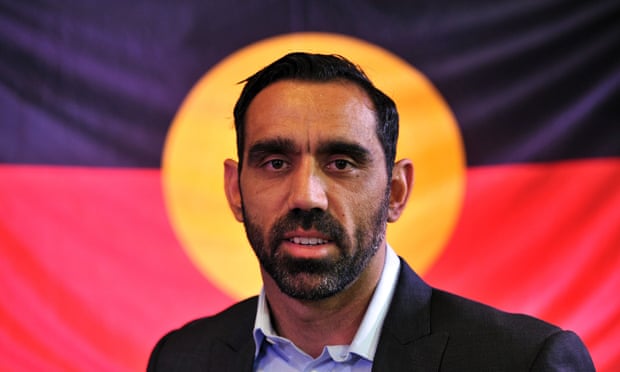
I Can Tell You How Adam Goodes Feels. Every Indigenous Person Has Felt It

by Stan Grant
The Guardian


Estranged in the land of our ancestors, living on the fringes of a rich society ? parse your words, but we see only race in the attacks on AFL player Adam Goodes

 I have wondered for days if I should say anything about Adam Goodes.

My inclination is to look for common ground, to be diplomatic. Some of the fault is with Adam. Maybe he’s been unnecessarily provocative. Racism? Perhaps. Perhaps the crowds just don’t like him.

Yes, I could make a case for all of that. But there are enough people making those arguments and all power to them.

Here’s what I can do. I can tell you what it is like for us. I can tell you what Adam must be feeling, because I’ve felt it. Because every Indigenous person I know has felt it.

It may not be what you want to hear. Australians are proud of their tolerance yet can be perplexed when challenged on race, their response often defensive.

I may be overly sensitive. I may see insult where none is intended. Maybe my position of relative success and privilege today should have healed deep scars of racism and the pain of growing up Indigenous in Australia. The same could be said of Adam. And perhaps that is right.

But this is how Australia makes us feel. Estranged in the land of our ancestors, marooned by the tides of history on the fringes of one of the richest and demonstrably most peaceful, secure and cohesive nations on earth.

The “wealth for toil” we praise in our anthem has remained out of our reach. Our position at the bottom of every socio-economic indicator tragically belies the Australian economic miracle.

“Australians all let us rejoice” can ring hollow to us. Ours is more troubled patriotism. Our allegiance to Australia, our pride in this country undercut by the dark realities of our existence.

Seeds of suspicion and mistrust are planted early in the Indigenous child. Stories of suffering, humiliation and racism told at the feet of our parents and grandparents feed an identity that struggles to reconcile a pride in heritage with the forlorn realities of a life of defeat.

From childhood I often cringed against my race. To be Aboriginal was to be ashamed. Ashamed of our poverty. Ashamed of the second-hand clothes with the giveaway smell of mothballs and another boy’s name on the shirt collar.

Ashamed of the way my mother and grandmother had to go to the Smith Family or Salvation Army for food vouchers. Ashamed of the onions and mince that made up too many meals.

We were ashamed of the bastardised wreckage of a culture that we clung to. This wasn’t the Dreamtime. This was mangy dogs and broken glass.

Like the Goodes family, we moved constantly as my father chased work. But wherever we went we found our place always on the fringes. What semblance of pride we carried too easily laid low by a mocking glance or a schoolyard joke.

We were the blacks. So easily recognised not just by the colour of our skin but by the whiff of desperation and danger we cloaked ourselves in. What resentment we harboured, we too often turned on ourselves, played out in wild scrambling brawls from the playground to the showgrounds that sent the same message: stay away from the blacks.

There was humour and there was love and there was survival. And as I grew older I pieced together the truth that we didn’t choose this. We are the detritus of the brutality of the Australian frontier.

As Australia welcomed waves of migrants and built a rich, diverse, tolerant society, we remained a reminder of what was lost, what was taken, what was destroyed to scaffold the building of this nation’s prosperity.

We survived the “smoothing of the dying pillow” of extermination to end up on the bottom rung of the ladder of assimilation. Too many of us remain there still. Look to the statistics: the worst health, housing, education, the lowest life expectancy, highest infant mortality. An Indigenous youth has more chance of being locked up than educated.

To Adam’s ears, the ears of so many Indigenous people, these boos are a howl of humiliation.
If good fortune or good genes means you are among the lucky few to find an escape route then you face a choice: to “go along to get along”, mind your manners, count your blessings and hide in the comfort of the Australian dream; or to infuse your success with an indignation and a righteousness that will demand this country does not look away from its responsibilities and its history.

I found a path through education that led to journalism. A love of knowledge and an inquisitiveness that has shot me through with anger. A deeper understanding of history, of politics, of economics, leaving me resentful of our suffering.

I wrestle with that anger as the boy I was wrestled with his shame. I want to see the good in a society that defies the history of its treatment of my people.

It is the legacy of my grandfather who signed up to fight a war for a country that didn’t recognise his humanity, let alone his citizenship. It is the lesson of the example of the lives of my mother and father, my uncles and aunties. Lives of decency and hard work and responsibility and rooted in our identity as Indigenous Australians.

When I was 16 I summoned the courage to speak to my class. As the only Indigenous kid, the only Aboriginal person my schoolmates had met, I wanted to tell my family’s story. My teacher was proud and encouraging. When class returned after lunch the words “be kind to abos” were scrawled across the blackboard.

The rejection, the humiliation, cut me to the core.

This is the journey too of Adam Goodes. A man whose physical gifts have set him above and given him a platform available to so few and whose courage demands that he use it to speak to us all.

Events in recent years have sent Adam on a quest to understand the history of his people, to challenge stereotypes and perceptions. I have spoken to him about this. I recognise in him the same quest I see in myself. It is a conversation I have had with so many of my Indigenous brothers and sisters.

This is rare air for anyone, let alone a footballer. He has faltered at times and the expression of his anger at our history and his pride in his identity has been challenging, if not divisive.

The events of 2013 when he called out a 13-year-old girl for a racial taunt opened a wound that has only deepened. To some the girl was unfairly vilified. Adam’s war dance of this year challenged and scared some people. His talent, the way he plays the game, alienates others.

And now we have this, a crescendo of boos. The racial motivation of some giving succour to the variously defined hatred of others.

To Adam’s ears, the ears of so many Indigenous people, these boos are a howl of humiliation. A howl that echoes across two centuries of invasion, dispossession and suffering. Others can parse their words and look for other explanations, but we see race and only race. How can we see anything else when race is what we have clung to even as it has been used as a reason to reject us.

I found refuge outside Australia. My many years working in Asia, the Middle East, Europe and Africa liberated me. Here were the problems of other peoples and other lands. Here I was an observer freed from the shackles of my own country’s history.

I still wonder if it would be easier to leave again.

But people ? like Adam Goodes, other Indigenous sportsmen and women who are standing with him, his non-Indigenous teammates and rivals who support him, and my non-Indigenous wife, my children and their friends of all colours and the people of goodwill who don’t have the answers but want to keep asking questions of how we can all be better ? maybe they all make it worth staying.

2015-06-16

The Truth About Diego Garcia

And 50 Years of Fiction About an American Military Base 

by David Vine
Tomdispatch

First, they tried to shoot the dogs. Next, they tried to poison them with strychnine. When both failed as efficient killing methods, British government agents and U.S. Navy personnel used raw meat to lure the pets into a sealed shed. Locking them inside, they gassed the howling animals with exhaust piped in from U.S. military vehicles. Then, setting coconut husks ablaze, they burned the dogs’ carcasses as their owners were left to watch and ponder their own fate.

The truth about the U.S. military base on the British-controlled Indian Ocean island of Diego Garcia is often hard to believe. It would be easy enough to confuse the real story with fictional accounts of the island found in the Transformers movies, on the television series 24, and in Internet conspiracy theories about the disappearance of Malaysia Airlines flight MH370.

While the grim saga of Diego Garcia frequently reads like fiction, it has proven all too real for the people involved. It’s the story of a U.S. military base built on a series of real-life fictions told by U.S. and British officials over more than half a century. The central fiction is that the U.S. built its base on an “uninhabited” island. That was “true” only because the indigenous people were secretly exiled from the Chagos Archipelago when the base was built. Although their ancestors had lived there since the time of the American Revolution, Anglo-American officials decided, as one wrote, to “maintain the fiction that the inhabitants of Chagos [were] not a permanent or semi-permanent population,” but just “transient contract workers.” The same official summed up the situation bluntly: “We are able to make up the rules as we go along.”

And so they did: between 1968 and 1973, American officials conspired with their British colleagues to remove the Chagossians, carefully hiding their expulsion from Congress, Parliament, the U.N., and the media. During the deportations, British agents and members of a U.S. Navy construction battalion rounded up and killed all those pet dogs. Their owners were then deported to the western Indian Ocean islands of Mauritius and the Seychelles, 1,200 miles from their homeland, where they received no resettlement assistance. More than 40 years after their expulsion, Chagossians generally remain the poorest of the poor in their adopted lands, struggling to survive in places that outsiders know as exotic tourist destinations.

During the same period, Diego Garcia became a multi-billion-dollar Navy and Air Force base and a central node in U.S. military efforts to control the Greater Middle East and its oil and natural gas supplies. The base, which few Americans are aware of, is more important strategically and more secretive than the U.S. naval base-cum-prison at Guantanamo Bay, Cuba. Unlike Guantanamo, no journalist has gotten more than a glimpse of Diego Garcia in more than 30 years. And yet, it has played a key role in waging the Gulf War, the 2003 invasion of Iraq, the U.S.-led war in Afghanistan, and the current bombing campaign against the Islamic State in Syria and Iraq.

Following years of reports that the base was a secret CIA “black site” for holding terrorist suspects and years of denials by U.S. and British officials, leaders on both sides of the Atlantic finally fessed up in 2008. “Contrary to earlier explicit assurances,” said Secretary of State for Foreign and Commonwealth Affairs David Miliband, Diego Garcia had indeed played at least some role in the CIA’s secret “rendition” program.

Last year, British officials claimed that flight log records, which might have shed light on those rendition operations, were “incomplete due to water damage” thanks to “extremely heavy weather in June 2014.” A week later, they suddenly reversed themselves, saying that the “previously wet paper records have been dried out.” Two months later, they insisted the logs had not dried out at all and were “damaged to the point of no longer being useful.” Except that the British government’s own weather data indicates that June 2014 was an unusually dry month on Diego Garcia. A legal rights advocate said British officials “could hardly be less credible if they simply said ‘the dog ate my homework.’”

And these are just a few of the fictions underlying the base that occupies the Chagossians’ former home and that the U.S. military has nicknamed the “Footprint of Freedom.” After more than four decades of exile, however, with a Chagossian movement to return to their homeland growing, the fictions of Diego Garcia may finally be crumbling.

No “Tarzans”
The story of Diego Garcia begins in the late eighteenth century. At that time, enslaved peoples from Africa, brought to work on Franco-Mauritian coconut plantations, became the first settlers in the Chagos Archipelago. Following emancipation and the arrival of indentured laborers from India, a diverse mixture of peoples created a new society with its own language, Chagos Kreol. They called themselves the Ilois -- the Islanders.

While still a plantation society, the archipelago, by then under British colonial control, provided a secure life featuring universal employment and numerous social benefits on islands described by many as idyllic. “That beautiful atoll of Diego Garcia, right in the middle of the ocean,” is how Stuart Barber described it in the late 1950s. A civilian working for the U.S. Navy, Barber would become the architect of one of the most powerful U.S. military bases overseas.

Amid Cold War competition with the Soviet Union, Barber and other officials were concerned that there was almost no U.S. military presence in and around the Indian Ocean. Barber noted that Diego Garcia’s isolation -- halfway between Africa and Indonesia and 1,000 miles south of India -- ensured that it would be safe from attack, yet was still within striking distance of territory from southern Africa and the Middle East to South and Southeast Asia.

Guided by Barber’s idea, the administrations of John F. Kennedy and Lyndon Johnson convinced the British government to detach the Chagos Archipelago from colonial Mauritius and create a new colony, which they called the British Indian Ocean Territory. Its sole purpose would be to house U.S. military facilities.

During secret negotiations with their British counterparts, Pentagon and State Department officials insisted that Chagos come under their “exclusive control (without local inhabitants),” embedding an expulsion order in a polite-looking parenthetical phrase. U.S. officials wanted the islands “swept” and “sanitized.” British officials appeared happy to oblige, removing a people one official called “Tarzans” and, in a racist reference to Robinson Crusoe, “Man Fridays.”

“Absolutely Must Go”
This plan was confirmed with an “exchange of notes” signed on December 30, 1966, by U.S. and British officials, as one of the State Department negotiators told me, “under the cover of darkness.” The notes effectively constituted a treaty but required no Congressional or Parliamentary approval, meaning that both governments could keep their plans hidden.

According to the agreement, the United States would gain use of the new colony “without charge.” This was another fiction. In confidential minutes, the United States agreed to secretly wipe out a $14 million British military debt, circumventing the need to ask Congress for funding. In exchange, the British agreed to take the “administrative measures” necessary for “resettling the inhabitants.”

Those measures meant that, after 1967, any Chagossians who left home for medical treatment or a routine vacation in Mauritius were barred from returning. Soon, British officials began restricting the flow of food and medical supplies to Chagos. As conditions deteriorated, more islanders began leaving. By 1970, the U.S. Navy had secured funding for what officials told Congress would be an “austere communications station.” They were, however, already planning to ask for additional funds to expand the facility into a much larger base. As the Navy’s Office of Communications and Cryptology explained, “The communications requirements cited as justification are fiction.” By the 1980s, Diego Garcia would become a billion-dollar garrison.

In briefing papers delivered to Congress, the Navy described Chagos’s population as “negligible,” with the islands “for all practical purposes... uninhabited.” In fact, there were around 1,000 people on Diego Garcia in the 1960s and 500 to 1,000 more on other islands in the archipelago. With Congressional funds secured, the Navy’s highest-ranking admiral, Elmo Zumwalt, summed up the Chagossians’ fate in a 1971 memo of exactly three words: “Absolutely must go.”

The authorities soon ordered the remaining Chagossians -- generally allowed no more than a single box of belongings and a sleeping mat -- onto overcrowded cargo ships destined for Mauritius and the Seychelles. By 1973, the last Chagossians were gone.

“Abject Poverty”
At their destinations, most of the Chagossians were literally left on the docks, homeless, jobless, and with little money. In 1975, two years after the last removals, a Washington Post reporter found them living in “abject poverty.”

Aurelie Lisette Talate was one of the last to go. “I came to Mauritius with six children and my mother,” she told me. “We got our house... but the house didn’t have a door, didn’t have running water, didn’t have electricity. And then my children and I began to suffer. All my children started getting sick.”

Within two months, two of her children were dead. The second was buried in an unmarked grave because she lacked money for a proper burial. Aurelie experienced fainting spells herself and couldn’t eat. “We were living like animals. Land? We had none... Work? We had none. Our children weren’t going to school.”

Today, most Chagossians, who now number more than 5,000, remain impoverished. In their language, their lives are ones of lamizer (impoverished misery) and sagren (profound sorrow and heartbreak over being exiled from their native lands). Many of the islanders attribute sickness and even death to sagren. “I had something that had been affecting me for a long time, since we were uprooted,” was the way Aurelie explained it to me. “This sagren, this shock, it was this same problem that killed my child. We weren’t living free like we did in our natal land.”

Struggling for Justice
From the moment they were deported, the Chagossians demanded to be returned or at least properly resettled. After years of protest, including five hunger strikes led by women like Aurelie Talate, some in Mauritius received the most modest of compensation from the British government: small concrete houses, tiny plots of land, and about $6,000 per adult. Many used the money to pay off large debts they had accrued. For most, conditions improved only marginally. Those living in the Seychelles received nothing.

The Chagossian struggle was reinvigorated in 1997 with the launching of a lawsuit against the British government. In November 2000, the British High Court ruled the removal illegal. In 2001 and 2002, most Chagossians joined new lawsuits in both American and British courts demanding the right to return and proper compensation for their removal and for resettling their islands. The U.S. suit was ultimately dismissed on the grounds that the judiciary can’t, in most circumstances, overrule the executive branch on matters of military and foreign policy. In Britain, the Chagossians were more successful. In 2002, they secured the right to full U.K. citizenship. Over 1,000 Chagossians have since moved to Britain in search of better lives. Twice more, British courts ruled in the people’s favor, with judges calling the government’s behavior “repugnant” and an “abuse of power.”

On the government’s final appeal, however, Britain’s then highest court, the Law Lords in the House of Lords, upheld the exile in a 3-2 decision. The Chagossians appealed to the European Court of Human Rights to overturn the ruling.

A Green Fiction
Before the European Court could rule, the British government announced the creation of the world’s largest Marine Protected Area (MPA) in the Chagos Archipelago. The date of the announcement, April Fool’s Day 2010, should have been a clue that there was more than environmentalism behind the move. The MPA banned commercial fishing and limited other human activity in the archipelago, endangering the viability of any resettlement efforts.

And then came WikiLeaks. In December 2010, it released a State Department cable from the U.S. Embassy in London quoting a senior Foreign and Commonwealth Office official saying that the “former inhabitants would find it difficult, if not impossible, to pursue their claim for resettlement on the islands if the entire Chagos Archipelago were a marine reserve.” U.S. officials agreed. According to the Embassy, Political Counselor Richard Mills wrote, “Establishing a marine reserve might, indeed... be the most effective long-term way to prevent any of the Chagos Islands’ former inhabitants or their descendants from resettling.”

Not surprisingly, the main State Department concern was whether the MPA would affect base operations. “We are concerned,” the London Embassy noted, that some “would come to see the existence of a marine reserve as inherently inconsistent with the military use of Diego Garcia.” British officials assured the Americans there would be “no constraints on military operations.”

Although the European Court of Human Rights ultimately ruled against the Chagossians in 2013, this March, a U.N. tribunal found that the British government had violated international law in creating the Marine Protected Area. Next week, Chagossians will challenge the MPA and their expulsion before the British Supreme Court (now Britain’s highest) armed with the U.N. ruling and revelations that the government won its House of Lords decision with the help of a fiction-filled resettlement study.

Meanwhile, the European Parliament has passed a resolution calling for the Chagossians’ return, the African Union has condemned their deportation as unlawful, three Nobel laureates have spoken out on their behalf, and dozens of members of the British Parliament have joined a group supporting their struggle. In January, a British government “feasibility study” found no significant legal barriers to resettling the islands and outlined several possible resettlement plans, beginning with Diego Garcia. (Notably, Chagossians are not calling for the removal of the U.S. military base. Their opinions about it are diverse and complicated. At least some would prefer jobs on the base to lives of poverty and unemployment in exile.)

Of course, no study was needed to know that resettlement on Diego Garcia and in the rest of the archipelago is feasible. The base, which has hosted thousands of military and civilian personnel for more than 40 years, has demonstrated that well enough. In fact, Stuart Barber, its architect, came to the same conclusion in the years before his death. After he learned of the Chagossians’ fate, he wrote a series of impassioned letters to Human Rights Watch and the British Embassy in Washington, among others, imploring them to help the Chagossians return home. In a letter to Alaska Senator Ted Stevens, he said bluntly that the expulsion “wasn’t necessary militarily.”

In a 1991 letter to the Washington Post, Barber suggested that it was time “to redress the inexcusably inhuman wrongs inflicted by the British at our insistence.” He added, “Substantial additional compensation for 18-25 past years of misery for all evictees is certainly in order. Even if that were to cost $100,000 per family, we would be talking of a maximum of $40-50 million, modest compared with our base investment there.”

Almost a quarter-century later, nothing has yet been done. In 2016, the initial 50-year agreement for Diego Garcia will expire. While it is subject to an automatic 20-year renewal, it provides for a two-year renegotiation period, which commenced in late 2014. With momentum building in support of the Chagossians, they are optimistic that the two governments will finally correct this historic injustice. That U.S. officials allowed the British feasibility study to consider resettlement plans for Diego Garcia is a hopeful sign that Anglo-American policy may finally be shifting to right a great wrong in the Indian Ocean.

Unfortunately, Aurelie Talate will never see the day when her people go home. Like others among the rapidly dwindling number of Chagossians born in the archipelago, Aurelie died in 2012 at age 70, succumbing to the heartbreak that is sagren.

David Vine, a TomDispatch regular, is associate professor of anthropology at American University in Washington, D.C. His new book, Base Nation: How U.S. Military Bases Abroad Harm America and the World will be published in August as part of the American Empire Project (Metropolitan Books). He is also the author of Island of Shame: The Secret History of the U.S. Military Base on Diego Garcia. He has written for the New York Times, the Washington Post, the Guardian, and Mother Jones, among other publications. For more of his writing, visit www.davidvine.net.