Showing posts with label Native Americans. Show all posts

2021-09-29

The Names You’ll Never Know

A civilian deaths memorial could zig zag across the U.S., suggests Nick Turse. It could keep extending westwards, in a way that would spur Americans’ interest in their nation’s history and conflicts abroad.

By Nick Turse
Consortium News

As a parting shot, on its way out of Afghanistan, the United States military launched a drone attack that the Pentagon called a “righteous strike.” The final missile fired during 20 years of occupation, that Aug. 29 airstrike averted an Islamic State car-bomb attack on the last American troops at Kabul’s airport. At least, that’s what the Pentagon told the world.

Within two weeks, a New York Times investigation would dismantle that official narrative. Seven days later, even the Pentagon admitted it. Instead of killing an ISIS suicide bomber, the United States had slaughtered 10 civilians: Zemari Ahmadi, a longtime worker for a U.S. aid group; three of his children, Zamir, 20, Faisal, 16, and Farzad, 10; Ahmadi’s cousin Naser, 30; three children of Ahmadi’s brother Romal, Arwin, 7, Benyamin, 6, and Hayat, 2; and two 3-year-old girls, Malika and Somaya.

The names of the dead from the Kabul strike are as important as they are rare. So many civilians have been obliterated, incinerated, or — as in the Aug. 29 attack — “shredded” in America’s forever wars.

Who in the United States remembers them? Who here ever knew of them in the first place? Twenty years after 9/11, with the Afghan War declared over, combat in Iraq set to conclude, and President Joe Biden announcing the end of “an era of major military operations to remake other countries,” who will give their deaths another thought?

Americans have been killing civilians since before there was a United States. At home and abroad, civilians — Pequots, African Americans, Cheyenne and Arapaho, Filipinos, Haitians, Japanese, Germans, Koreans, Vietnamese, Cambodians, Laotians, Afghans, Iraqis, Syrians, Yemenis, and Somalis, among others — have been shot, burned, and bombed to death. The slaughter at Sand Creek, the Bud Dajo massacre, the firebombing of Dresden, the atomic bombing of Hiroshima, the My Lai massacre — the United States has done what it can to sweep it all under the rug through denial, cover-ups, and the most effective means of all: forgetting.

There’s little hope of Americans ever truly coming to terms with the Pequot or Haitian or Vietnamese blood on their hands. But before the forever wars slip from the news and the dead slide into the memory hole that holds several centuries worth of corpses, it’s worth spending a few minutes thinking about Zemari Ahmadi, Benyamin, Hayat, Malika, Somaya, and all the civilians who were going about their lives until the U.S. military ended them.

Names Remembered and Names Forgotten

Over the last 20 years, the United States has conducted more than 93,300 air strikes — in Afghanistan, Iraq, Libya, Pakistan, Somalia, Syria and Yemen — that killed between 22,679 and 48,308 civilians, according to figures recently released by Airwars, a U.K.-based airstrike monitoring group. The total number of civilians who have died from direct violence in America’s wars since 9/11 tops out at 364,000 to 387,000, according to Brown University’s Costs of War Project.

Who were those nearly 400,000 people?

There’s Malana. In 2019, at age 25, she had just given birth to a son, when her health began to deteriorate. Her relatives were driving her to a clinic in Afghanistan’s Khost Province when their vehicle was attacked by a U.S. drone, killing Malana and four others.

And Gul Mudin. He was wounded by a grenade and shot with a rifle, one of at least three civilians murdered by a U.S. Army “kill team” in Kandahar Province in 2010.

Then there was Gulalai, one of seven people, including three women — two of them pregnant — who were shot and killed in a Feb. 12, 2010, raid by Special Operations forces in Afghanistan’s Paktia Province.

And the four members of the Razzo family — Mayada, Tuqa, Mohannad, and Najib — killed in a Sept. 20, 2015, airstrike in Mosul, Iraq.

And there were the eight men, three women, and four children — Abdul Rashid as well as Abdul Rahman, Asadullah, Hayatullah, Mohamadullah, Osman, Tahira, Nadia, Khatima, Jundullah, Soheil, Amir, and two men, ages 25 and 36 respectively, named Abdul Waheed — who were killed in a Sept. 7, 2013, drone strike on Rashid’s red Toyota pickup in Afghanistan.

Then there were 22-year-old Lul Dahir Mohamed and her 4-year-old daughter, Mariam Shilo Muse, who were killed in an April 1, 2018, airstrike in Somalia.

And between 2013 and 2020, in seven separate U.S. attacks in Yemen — six drone strikes and one raid — 36 members of the al Ameri and al Taisy families were slaughtered.

Those names we know. Or knew, if only barely and fleetingly. Then there are the countless anonymous victims like the three civilians in a blue Kia van killed by Marines in Iraq in 2003. “Two bodies were slumped over in the front seats; they were men in street clothes and had no weapons that I could see. In the back seat, a woman in a black chador had fallen to the floor; she was dead, too,” wrote Peter Maass in The New York Times Magazine in 2003. Years later, at The Intercept, he painted an even more vivid picture of the “blue van, with its tires shot out and its windows shattered by bullets, its interior stained with blood and smelling of death, with flies feasting on already-rotting flesh.”

Those three civilians in Iraq were all too typical of the many anonymous dead of this country’s forever wars — the man shot for carrying a flashlight in an “offensive” manner; the children killed by an “errant” rocket; the man slain by “warning shots”; the three women and one man “machine-gunned” to death; and the men, women and children reduced to “charred meat” in an American bombing.

Who were the 11 Afghans — four of them children — who died in a 2004 helicopter attack, or the “dozen or more” civilians killed in 2010 during a nighttime raid by U.S. troops in that same country? And what about those 30 pine-nut farm workers slaughtered a year later by a drone strike there? And what were the names of Mohanned Tadfi’s mother, brother, sister-in-law, and seven nieces and nephews killed in the U.S. bombing that flattened the city of Raqqa, Syria, in 2017?

Often, the U.S. military had no idea whom they were killing. It frequently carried out “signature strikes” that executed unknown people due to suspicious behavior. So often, Americans killed such individuals for little or no reason — like holding a weapon in places where, as in this country, firearms were ubiquitous — and then counted them as enemy dead.

An investigation by Connecting Vets found that during a 2019 air campaign in Afghanistan’s Helmand province, for example, the threshold for an attack “could be met by as little as a person using or even touching a radio” or if an Afghan carrying “commercially bought two-way radios stepped into a home, the entire building would sometimes be leveled by a drone strike.”

Targeted assassinations were equally imprecise. Secret documents obtained by The Intercept revealed that, during a five-month stretch of Operation Haymaker — a drone campaign in 2011 and 2013 aimed at al-Qaeda and Taliban leaders along the Afghan-Pakistan border — 200 people were killed in airstrikes conducted to assassinate 35 high-value targets. In other words, nearly nine out of 10 people slain in those “targeted” killings were not the intended targets. So, who were they?

Even if targeting was ordinarily more accurate than during Operation Haymaker, U.S. policy has consistently adhered to the dictum that “military-age males” killed in airstrikes should automatically be classified as combatants unless proven innocent. In addition to killing people for spurious reasons, the U.S. also opted for allies who would prove at least as bad as, if not worse than, those they were fighting. For two decades, such American-taxpayer-funded warlords and militiamen murdered, raped, or shook-down the very people the U.S. government was supposedly protecting. And, of course, no one knows the names of all those killed by such allies who were being advised, trained, armed and funded by the United States.

Who, for instance, were the two men tied to the rear fender of a Toyota pickup truck in southeastern Afghanistan in 2012 by members of an Afghan militia backed by U.S. Special Operations forces? They were, wrote reporter Anand Gopal, dragged “along six miles of rock-studded road” until they were dead. Then their “bodies were left decomposing for days, a warning to anyone who thought of disobeying Azizullah,” the U.S.-allied local commander.

Or what about the 12 boys gunned down by CIA-backed militiamen at a madrassa in the Afghan village of Omar Khail? Or the six boys similarly slain at a school in nearby Dadow Khail? Or any of the dead from 10 raids in 2018 and 2019 by that same militia, which summarily executed at least 51 civilians, including boys as young as eight years old, few of whom, wrote reporter Andrew Quilty, appeared “to have had any formal relationship with the Taliban”?

How many reporters’ notebooks are filled with the unpublished names of just such victims? Or counts of those killed? Or the stories of their deaths? And how many of those who were murdered never received even a mention in an article anywhere?

Last year, I wrote 4,500 words for The New York Times Magazine about the deteriorating situation in Burkina Faso. As I noted then, that nation was one of the largest recipients of American security aid in West Africa, even though the State Department admitted that U.S.-backed forces were implicated in a litany of human-rights abuses, including extrajudicial killings.

What never made it into the piece was any mention of three men who were executed in two separate attacks. On May 22, 2019, uniformed Burkinabe troops arrived in the village of Konga and took two brothers, aged 38 and 25, away in the middle of the night. The next day, a relative found them on the side of the road, bound and executed. Most of the family fled the area. “The Army came back a week later,” a relative told me. “My uncle was the only one in our family who stayed. He was shot in broad daylight.” Such deaths are ubiquitous but aren’t even factored into the 360,000-plus civilian deaths counted by the Costs of War project, which offers no estimate for those killed in America’s “smaller war zones.”

Build the Wall!

We live in a world filled with monuments celebrating lives and deaths, trailblazers and memorable events, heroes and villains. They run the gamut from civil rights leader Martin Luther King, Jr., and women’s rights pioneers to the chieftains of the American Confederacy and Belgium’s King Leopold.

In the United States, there’s no shortage of memorials and monuments commemorating America’s wars and fallen soldiers. One of the most poignant lists the names of the American military dead of the Vietnam War. Initially derided by hawkish veterans and conservatives as a “black gash of shame” and a “nihilistic slab,” it’s now one of the most celebrated monuments in Washington, D.C. More than 58,000 men and women are represented on the visually arresting black granite walls of the Vietnam Veterans Memorial.

Vietnam itself has no shortage of monuments of its own. Many are Soviet-style memorials to those who died defeating the United States and reuniting their country. Others are seldom-seen, tiny memorials to massacres perpetrated by the Americans and their allies. No one knows how many similar cenotaphs exist in Iraq, Syria, Yemen, and other forever-war countries, but in 2017, journalist Emran Feroz found just such a memorial in Afghanistan’s Wardak Province — a remembrance of five civilians slain in drone strikes during 2013 and 2014.

There have been other attempts to memorialize the civilian dead of the forever wars from art installations to innovative visual protests to virtual commemorations.

In 2018, after then-President Trump signed a bill approving the construction of a Global War on Terrorism Memorial, Peter Maass proposed, even if only half-seriously, that the bullet-riddled blue Kia van he saw in Iraq should be placed on a pedestal on the National Mall. “If we start building monuments that focus our attention on the pitiless killing of civilians in our wars,” he wrote, “maybe we would have fewer wars to fight and less reason to build these monuments.”

A blue Kia on the National Mall would be a good starting point. But if we’re ever to grasp the meaning of the post-9/11 wars and all the conflicts that set the stage for them, however, we may need a wall as well — one that starts at the Kia and heads west. It would, of course, be immense. The Vietnam Veterans Memorial spans a total of 400 feet. The celebrated Vietnam War photographer Philip Jones Griffiths observed that a wall for the Vietnamese dead, counting combatants, of the American War would be nine miles long.

The Vietnam Veterans Memorial is arrayed in a unique chronological format, but the Civilian Deaths Memorial could begin with anyone. The last civilians killed by the United States as part of its 2001 to 2021 Afghan War – Zemari Ahmadi, Zamir, Faisal, Farzad, Naser, Arwin, Benyamin, Hayat, Malika, and Somaya – could lead it off. Then maybe Abdul Rashid and the 14 passengers from his red pick-up truck. Then Malana, Gul Mudin, Gul Rahim, Gulalai, Mayada, Tuqa, Mohannad, Najib, Lul Dahir Mohamed, and Mariam Shilo Muse. Then maybe Ngo Thi Sau, Cao Muoi, Cao Thi Thong, Tran Cong Chau Em, Nguyen Thi Nhi, Cao Thi Tu, Le Thi Chuyen, Dang Thi Doi, Ngo Thi Chiec, Tran Thi Song, Nguyen Thi Mot, Nguyen Thi Hai, Nguyen Thi Ba, Nguyen Thi Bon, Ho Thi Tho, Vo Thi Hoan, Pham Thi Sau, Dinh Van Xuan, Dinh Van Ba, Tran Cong Viet, Nguyen Thi Nham, Ngo Quang Duong, Duong Thi Hien, Pham Thi Kha, Huynh Van Binh, Huynh Thi Bay, Huynh Thi Ty, Le Van Van, Le Thi Trinh, Le Thi Duong, and Le Vo Danh and her unborn child, all slaughtered in the tiny South Vietnamese village of Phi Phu by U.S. troops (without any of the attention accorded to the My Lai massacre). They could be followed by the names of, or placeholders for, the remaining 2 million Vietnamese civilian dead and by countless Cambodians, Laotians, Afghans, Iraqis, Somalis and Yemenis.

The Civilian Wall could be built in a zig-zag fashion across the U.S. with the land in its way — homes and businesses, parks and roadways — seized by eminent domain, making Americans care about civilian deaths in ways that news articles never could.

When you lose your home to a slab of granite that reads “Pequot adult, Pequot adult, Pequot child…” 500 times, you may actually take notice. When you hear about renewed attacks in Iraq or drone strikes in Somalia or a Navy SEAL raid gone awry in Yemen and worry that the path of the wall might soon turn toward your town, you’re likely to pay far more attention to America’s conflicts abroad.

Obviously, a westward-traveling wall memorializing civilian carnage is a non-starter in this country, but the next time you hear some fleeting murmur about a family wiped out by a drone strike or read a passing news story about killings by a U.S.-backed militia, think about that imaginary wall and how, in a just world, it might be headed in your direction. In the meantime, perhaps the best we can hope for is Maass’s proposal for that blue Kia on the Mall. Perhaps it could be accompanied by the inscription found on a granite slab at the Heidefriedhof, a cemetery in Dresden, Germany, the site of a mass grave for civilians killed in a 1945 U.S. and British fire-bombing. It begins: “How many died? Who knows the number?”

Nick Turse is the managing editor of TomDispatch and a fellow at the Type Media Center. He is the author most recently of Next Time They’ll Come to Count the Dead: War and Survival in South Sudan and of the bestselling Kill Anything That Moves.

2017-11-30

The True Story of Pocahontas: Historical Myths Versus Sad Reality


Indian Country Today

Pocahontas had a Native husband and Native child; never married John Smith

Despite what many people believe due to longstanding and inaccurate accounts in history books and movies such as Disney’s Pocahontas, the true story of Pocahontas is not one of a young Native Powhatan woman with a raccoon friend who dove off of mountain-like cliffs off the coasts of Virginia. (Note: there are no cliffs on the coast of Virginia.)
The true story of Pocahontas is a tale of tragedy and heartbreak.
Disney Pocahontas -Buena Vista/courtesy Everett Collection
Disney / Everett Collection
Disney’s Pocahontas -Buena Vista/courtesy Everett Collection
It is time to bust up the misconceptions perpetuated over 400 years regarding the young daughter of Powhatan chief Wahunsenaca. The truth—gathered from years of extensive research of the historical record, books, and oral histories from self-identified descendants of Pocahontas and tribal peoples of Virginia —is not for the faint of heart.
A Warning To Our Readers: Mature Subject Matter Not Suitable for Children
The story of Pocahontas is a tragic tale of a young Native girl who was kidnapped, sexually assaulted and allegedly murdered by those who were supposed to keep her safe.

Pocahontas’ Mother, Also Named Pocahontas, Died While Giving Birth to Her

This is in many historical accounts, though not always. It is important to note that Pocahontas was born to her mother, named Pocahontas and her father Wahunsenaca, (sometimes spelled Wahunsenakah), who later became the paramount chief.
Her name at birth was Matoaka, which means “flower between two streams,” and according to Mattaponi history was likely given to her because she was born between the two rivers of Mattaponi and Pamunkey (York).
An image of a young Pocahontas. Photo - iStock
iStock
An image of a young Pocahontas.
Due to his wife’s death, Wahunsenaca was devastated and little Matoaka became his favorite because she looked like her mother. She was raised by her aunts and other women of the Mattaponi tribe at Werowocomoco.
As was custom at the time, as the Paramount Chief of the Powhatan Chiefdom, Wahunsenaca had other wives from the other villages and little Matoaka had many loving brothers and sisters.
Because of his lingering grief and due to the reminder she gave to him of her mother, Wahunsenaca often called his daughter the endearing name of Pocahontas.

John Smith Came to the Powhatan When Pocahontas Was about 9 or 10

According to Mattaponi oral history, little Matoaka was possibly about 10 years old when John Smith and English colonists arrived in Tsenacomoca in the spring of 1607. John Smith was about 27 years old. They were never married nor involved.

Pocahontas Never Saved the Life of John Smith

The children of the Powhatan were very closely watched and cared for by all members of the tribe. Since Pocahontas was living with her father, Chief Powhatan Wahunsenaca, at Werowocomoco, and because she was the daughter of a chief, she was likely held to even stricter standards and provided with more structure and cultural training.
When she was a child, John Smith and English colonists stayed near the Powhatan on the nearby Jamestown Island, but later began to explore outlying areas. Smith was feared by many Native people because he was known to enter villages and put guns to heads of chiefs demanding food and supplies.
In the winter of 1607, the colonists and Smith met with Powhatan warriors and Smith was captured by the chief’s younger brother.
Because the English and Powhatan feared the actions of the Spanish, they formed an alliance. Eventually and according to oral history and contemporary written accounts by the Mattaponi, Wahunsenaca grew to like Smith, eventually offering him the position of ‘werowance’ or leader of the colonists as recognized by the Powhatan as well as a much more livable area for his people with great access to game and seafood.
A portrait of Pocahontas saving the life of John Smith with Father Wahunsenaca. Photo - AP Images
AP Images
A portrait of Pocahontas saving the life of John Smith with Father Wahunsenaca. Oral history from the descendants of Pocahontas dictate such a thing could never have happened.
Years later, Smith alleged that Pocahontas saved his life in the four-day process of becoming a werowance. But according to Mattaponi oral and contemporary written accounts, there would be no reason to kill a man designated to receive an honor by the chief.
Additionally, children were not allowed to attend any sort of religious ritual similar to the werowance ceremony.
She could not have thrown herself in front of John Smith to beg for his life for two reasons: Smith was being honored, and she would not have been allowed to be there.

Pocahontas Never Defied Her Father to Bring Food to John Smith or Jamestown

Captain John Smith. Photo - Library of Congress
Library of Congress
Captain John Smith.
Some historical accounts claim Pocahontas defied her father to bring food to the colonists of Jamestown. According to the history of the Mattaponi tribe as well as simple facts, these claims could not be true.
Jamestown was 12 miles from Werowocomoco and the likelihood that a 10-year-old daughter would travel alone are inconsistent with Powhatan culture. She as well as other tribal members did travel to Jamestown, but as a gesture of peace.  
Additionally, travel to Jamestown required crossing large bodies of water and the use of 400-pound dugout canoes. It took a team of strong people to lift them into the water.
It is likely Pocahontas served as a symbol of peace by simply being present as a child among her people to show no ill intentions when her people met with the Jamestown settlers.  

Pocahontas Did Not Sneak Into Jamestown to Warn John Smith About a Death Plot

In 1608 and 1609, John Smith’s role as the werowance (chief) of the colonists had taken an ugly turn. The colonists made inadequate attempts to plant crops to harvest, and Smith violently demanded supplies from surrounding villages after once again holding a gun to the heads of village leaders.  
Accounts from Mattaponi histories tell of one tribal woman proclaiming to Smith, “You call yourself a Christian, yet you leave us with no food for the winter.”
Pocahontas’ father, who had befriended Smith, once said to him, “I have not treated any of my werowances as well as you, yet you are the worst werowance I have!”
Smith claimed Wahunsenaca wanted to kill him, and asserted he knew of the plot because Pocahontas had come to warn him.
Due to the icy conditions at the time and because of the many watchful eyes attending to the daughter of a chief, as well as gestures of peace by the Powhatan to include additional provisions, Native historians rebuff the historical claims of Smith as completely fabricated.
To further prove Smith’s tale was a fabrication, a letter by Smith written in 1608 was published without Smith’s knowledge. The letter makes no claim of Pocahontas trying to save his life on two separate occasions. It wasn’t until Smith published his book General Historie of Virginia in 1624 that he claimed Pocahontas had twice saved his life. Any of the people who could have refuted Smith’s claims by that time were no longer alive.

As Colonists Terrorized Native People, Pocahontas Married and Became Pregnant

The early 1600’s were a horrible time for tribes near Werowocomoco. Native tribes once comfortable wearing clothing suitable for summer — including exposed breasts for Native women and little or nothing for children — found themselves being sexually targeted by English colonists.
Young children were targets of rape and Native women in the tribe would resort to offering themselves to men to keep their children safe. The Powhatan people were shocked by the behavior and were horrified that the English government offered them no protections.
In the midst of the horrible and atrocious acts committed by the colonists, Matoaka was coming of age. During a ceremony, Matoaka was to choose a new name, and she selected Pocahontas, after her mother. During a courtship dance, it is likely she danced with Kocoum, the younger brother of Potowomac Chief Japazaw.
She married the young warrior at about 14 and soon became pregnant.
It was at this time rumors began to surface that colonists planned to kidnap the beloved chief’s daughter Pocahontas.

Pocahontas Was Kidnapped, Her Husband Was Murdered and She Was Forced to Give Up Her First Child  

When Pocahontas was about 15 or 16, the rumors of a possible kidnapping had become more of a threat and she was living with her husband Kocoum at his Potowomac village.
An English colonist by the name of Captain Samuel Argall sought to find her, thinking that a captured daughter of the chief would thwart attacks by Natives.
Hearing of her whereabouts, Argall came to the village and demanded Chief Japazaw, brother of Pocahontas’ husband, to give up Pocahontas or suffer violence against his village. Overcome with grief at a horrible choice, he relented with a hopeful promise that she would only be gone temporarily. That was a promise Argall quickly broke.
Before Argall left the village, he gave Chief Japazaw a copper pot. He later claimed to have traded it for her. This “trade” is still taught by historians. This is akin to the way that Smith ‘traded’ for corn by holding a gun to the heads of chiefs.
Before leaving the village, Pocahontas had to give her baby (referred to as little Kocoum) to the women of the village. Trapped onboard an English ship, she was not aware that when her husband returned to their village, he was killed by the colonists.
The tribal chiefs of the Powhatan never retaliated for the kidnapping of Pocahontas, fearing they would be captured and that the beloved daughter of the chief and the “Peace Symbol of the Powhatan” might be harmed.

Pocahontas Was Raped While in Captivity and Became Pregnant With Her Second Child

According to Dr. Linwood Custalow, a historian of the Mattaponi Tribe and the custodian of the sacred oral history of Pocahontas, soon after being kidnapped, she was suffering from depression and was growing more fearful and withdrawn. Her extreme anxiety was so severe her English captors allowed Pocahontas’ eldest sister Mattachanna and her husband Uttamattamakin to come to her aid.
Dr. Custalow writes in his book, The True Story of Pocahontas, The Other Side of History, that when Mattachanna and her husband Uttamattamakin, a spiritual advisor to Chief Wahunsenaca, Pocahontas confided in her sister.
When Mattachanna and Uttamattamakin arrived at Jamestown, Pocahontas confided in that she had been raped. Mattaponi sacred oral history is very clear on this: Pocahontas was raped. It is possible that it had been done to her by more than one person and repeatedly. My grandfather and other teachers of Mattaponi oral history said that Pocahontas was raped.
The possibility of being taken captive was a danger to be aware of in Powhatan Society, but rape was not tolerated. Rape in Powhatan Society was virtually unheard of because the punishment for such actions was so severe. Powhatan society did not have prisons. Punishment for wrongful actions often consisted of banishment from the tribe.
Historians differ on where Pocahontas was held, but tribal historians believe she was likely held in Jamestown, but was relocated to Henrico to when she was pregnant.
Pocahontas had a son, Thomas.

John Rolfe Married Pocahontas to Create a Native Alliance in Tobacco Production

Mattaponi history is clear that Pocahontas had a son out of wedlock, Thomas, prior to her marriage to John Rolfe. Prior to that marriage, the colonists pressed Pocahontas to become “civilized” and often told her that her father did not love her because he had not come to rescue her.
Pocahontas often tore off her English clothes, because they were uncomfortable. Eventually, Pocahontas was converted to Christianity and took the name Rebecca.
Pocahontas as Rebecca Rolfe. Photo - Getty Images
Pocahontas as Rebecca Rolfe.
In the midst of her captivity, the English colony of Jamestown was failing. John Rolfe was under a 1616 deadline to become profitable or lose the support of England. Rolfe sought to learn tobacco curing techniques from the Powhatan, but curing tobacco was a sacred practice not to be shared with outsiders. Realizing the political strength of aligning himself with the tribe, he eventually married Pocahontas.
Though some historians claim Pocahontas and Rolfe married for love, it is not a certainty, as Pocahontas was never allowed to see her family, child or father after being kidnapped.
The Pocahontas wedding with John Rolfe. Photo - Library of Congress
Library of Congress
The Pocahontas wedding with John Rolfe.
After the two were married, the Powhatan spiritual leaders and family to Pocahontas shared the curing practice with Rolfe. Soon afterwards, Rolfe’s tobacco was a sensation in England, which saved the colony of Jamestown, as they finally found a profitable venture.
The Powhatan tribal lands were now highly sought after for the tobacco trade and the tribe suffered great losses of life and land at the hands of greedy tobacco farmers.
It is worth noting that though it was custom for a Powhatan father to give away his daughter at a marriage, Wahunsenaca did not attend the wedding of his daughter to Rolfe for fear of being captured or killed. He did send a strand of pearls as a gift.
Pocahontas Portrait by Thomas Sully. c. 1852 - Virginia Historical Society
Virginia Historical Society
Pocahontas Portrait by Thomas Sully. c. 1852
As Dr. Custalow wrote in The True Story of Pocahontas, The Other Side of History:
Although Wahunsenaca did not attend the wedding, we know through sacred Mattaponi oral history that he gave Pocahontas a pearl necklace as a wedding gift. The pearls were obtained from the Chesapeake Bay oyster beds. The necklace was notable for the large size and fine quality of the pearls. Pearls of the size were rare, making them a suitable gift for a paramount chief’s daughter. No mention of this necklace has been found in the English writings, but a portrait of Pocahontas wearing a pearl necklace used to hang in the Gov.’s mansion in Richmond.

Pocahontas Was Brought to England To Raise Money and Was Then Likely Murdered

Rumors of the colonists desire to bring Pocahontas made its way to the Powhatan, who feared for her well-being and considered an attempt to rescue her. But Wahunsenaca feared his daughter might be harmed.
Rebecca “Pocahontas” Rolfe traveled to England with John Rolfe, her son Thomas Rolfe, Captain John Argall (who had kidnapped her) and several Native tribal members, including her sister Mattachanna.
Though many settlers were committing atrocities against the Powhatan, many elites in England did not approve of the mistreatment of natives. The bringing of Pocahontas to England to show friendship with Native nations was a key to continued financial support for the colonists.
Pocahontas at Court of King James. Photo - Library of Congress
Library of Congress
Pocahontas at Court of King James.
According to the accounts of Mattachanna, she realized that she was being used and desperately desired to return home to her father and little Kocoum. During her travels in England, Pocahontas did meet John Smith and expressed outrage due to the mistreatment of his position as leader of the colonists and the betrayal to the Powhatan people.
After the journey and showing off of Pocahontas to the English elites, plans were made to return to Virginia in the spring of 1617. According to a recounting by Mattachanna, she was in good health while in England and on the ship preparing to go home.
Shortly after a dinner with Rolfe and Argall, she vomited and died. Those tribal members who were accompanying her, including her sister Mattachanna, said she was in previous good health and assessed she must have been poisoned due to her sudden death.
According to Mattaponi oral history, many of the Native people accompanying Pocahontas were sold as servants or carnival attractions or sent to Bermuda if they became pregnant after being raped and sold into slavery.
Pocahontas grave, St. Georges Church Kent UK. Photo - WIKIPEDIA
Wikipedia
Pocahontas grave, St. Georges Church Kent UK.
Pocahontas was just under 21 at the time of her death. Instead of being taken home and laid to rest with her father, Rolfe and Argall took her to Gravesend, England, where she was buried at Saint George’s Church, March 21, 1617. Though Virginia tribes have requested that her remains returned for repatriation, officials in England say the exact whereabouts of her remains are not known.    
Wahunsenaca learned from Mattachanna that his beloved daughter had died but had never betrayed her people, as some historians claim. Heartbroken that he had not ever rescued his daughter, he died from grief less than a year after the death of Pocahontas.

The Descendants of Pocahontas

Oral histories of both the Mattaponi and Patawomeck and historical references say she mothered two children, Thomas Rolfe, who was left in England after the death of his mother, and ‘little Kocoum.’
According to Deyo, Little Kocoum was the name that Dr. Linwood Custalow used for the purpose of his book to reference a small child whose name was not yet known.  In the sacred oral history of the Mattaponi, the child was raised by the Patawomeck Tribe. The name of that child was passed down in the Patawomeck oral history was discovered to be Ka-Okee, a daughter.
This lineage to Ka-Okee includes the world famous entertainer Wayne Newton, a member of the Virginia state-recognized Powhatan Patawomeck tribe.
Thomas Rolfe stayed in England and was educated there. He later returned to the Powhatan as an adult. He was married and had many descendants. 
Statue of Pocahontas at the original site of Jamestown, in Colonial National Historical Park, Virginia Digital photograph . (North Wind Picture Archives via AP Images)
North Wind Picture Archives via AP Images
Statue of Pocahontas at the original site of Jamestown, in Colonial National Historical Park, Virginia.
Main Sources
A special thank you to the following sources:
Mattaponi Tribal Historian, Dr. Linwood ‘Little Bear’ Custalow, and Angela L. Daniel “Silver Star’ for the book The True Story of Pocahontas, The Other Side of History
Pamunkey Chief Robert Gray
Patawomeck Chief John Lightner
Powhatan Patawomeck Tribal Historian Bill Deyo
Countless council members and tribal members of the 11 Tribes in Virginia, who have been gracious in sharing their stories.
Follow the author of this article, Vincent Schilling (Akwesasne Mohawk) – ICMN’s Arts and Entertainment, Pow Wows and Sports Editor – 

2017-10-13

The Osage Indian Murder Mystery

by James DiEugenio
Consortiumnews.com

White America has deployed any number of subterfuges to steal land from the Native Americans, with a favorite tactic being the signing of treaties that were voided whenever it became convenient – and especially when the Native American land was found have something valuable in it. Then, the deal was “renegotiated” or the U.S. Army arrived to slaughter some tribe for going “off the reservation.”
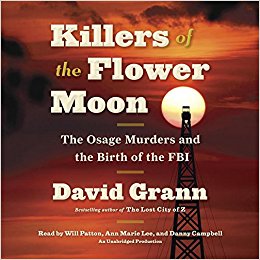
But there were also more local strategies, hatched by greedy operatives and enforced by targeted killings, such as the murders of Osage Indians at the heart of a new book by David Grann, Killers of the Flower Moon.
The Osage Indian nation dated back to well before the formation of the United States, when the Osage roamed through what are now four states (Kansas, Missouri, Arkansas and Oklahoma). After the Louisiana Purchase in 1803 when the new U.S. government “bought” vast tracts of territory west of the Mississippi River from France and after a series of negotiations, the Osage ceded 52 million acres in return for the U.S. government’s protection from other tribes. But the Osage had more to fear from the white men.
In 1870, the Osage were ultimately pushed onto their final destination, the north central portion of Oklahoma, where they lived by subsistence farming and by leasing land to ranchers for grazing. Under the agreement negotiated by Chief James Bigheart, the land was owned by the Osage though administered by the U.S. government. Bigheart also negotiated a deal in which the Osage maintained mineral rights to their land.
That proved important because oil was discovered in Osage County making the tribe relatively wealthy due to a system called headrights. This meant that each tribe member would be allotted royalties from both the sale of the oil leases and also for a percentage of the extracted petroleum. Since some of the bidders on the leases were people like Frank Phillips, George Getty and Frank Sinclair, the auctions on some leases would begin at $500,000 and end at over $1 million. In 1923, in just one day, $14 million in oil leases were sold: over $200 million in today’s dollars.
This wealth helped transform Osage territory; with the main villages — Fairfax, Hominy, and Pawhuska – becoming the equivalent of Western boomtowns. Horses and wagons were replaced by Model T Fords; one-level wooden frame stores gave way to five-story brick office buildings; telegraph offices were replaced by blocks and blocks of telephone poles and wires.
Envious Whites 
By standards of the time, the Osage Indians became rich; some employing servants, living in large homes, even purchasing grand pianos. In other words, the Osage began behaving like rich white Americans, but – because they were Indians – their displays of wealth provoked a backlash in the U.S. press. For instance, in writing about the auctions, a journalist for Harper’s Monthly asked, “Where will it all end? Every time a new well is drilled the Indians are that much richer.  The Osage Indians are becoming so rich that something will have to be done about it.”  (Grann, p. 76)
Osage Indians.
Two things were done. First, the federal government instituted a system of guardianships. This meant that each Osage tribe member could be deemed “incompetent,” and that necessitated a guardian be appointed to the case. As Grann notes, this appointment was nearly always based on the quantity “of Indian blood in the property holder; or what a state supreme court justice referred to as ‘racial weakness.’“ (ibid, p. 78)
Congressmen would study and analyze expenditures made by each individual Osage and criticize the amounts spent on certain items. At times these assessments echoed Rudyard Kipling’s famous dictum about England bearing the white man’s burden for colonized natives, or as Grann quotes a congressman:
“Every white man in Osage County will tell you the Indians are now running wild. The day has come when we must begin our restriction of these moneys or dismiss from our hearts and conscience any hope we have of building the Osage Indian into a true citizen.” (ibid, p. 79)
Therefore, in 1921, not only were the Osage limited by needing approval from their guardians for expenditures, but limits were placed on how much they could annually withdraw from their trust fund. Practical exceptions like having medical bills or wanting to send children to private colleges did not matter. As one can imagine, this guardian system also provided ample opportunities for embezzlement of the Osage “trust” funds.
The second method that the local power structure utilized to control the Osage wealth was exercised through a legal loophole. That loophole specified that the Osage trust funds could be passed on through family inheritance. What this meant was that if an Osage woman married someone outside the tribe, her husband could inherit her wealth.
A Killing Spree 
But there was even a more sinister side to these arrangements. Osage women started disappearing and people who dared investigate started turning up dead.
Archival photo showing a member of the Osage tribe driving an automobile.
In May 1921, Mollie Burkhart began to worry about Anna Brown, her missing sister. Three years earlier, her sister Minnie had died at age 27 after a brief, mysterious illness. And about a week before Anna’s disappearance, a man named Charles Whitehorn, another Osage, had vanished. Whitehorn’s body was soon found at the base of an oil derrick. He had been shot execution-style with two bullets between the eyes. (ibid, p. 14)
A few days before her disappearance, Anna had gone to see a play with Mollie’s husband, Ernest Burkhart, and his brothers Bryan and Horace. Ernest assured Mollie that Anna would show up soon. But Anna never returned alive. Her body was found by a boy out squirrel hunting at the edge of a creek. She had been killed by a .32 caliber bullet to the rear of the skull. (ibid, p. 19)
Because local authorities seemed reluctant to investigate her sister’s murder, Mollie turned to a man named William Hale, who was a pallbearer at Anna’s funeral. Hale had been a prosperous rancher in Osage county for two decades, a reserve deputy sheriff and a political ally of the county prosecutor. Hale once said, “I will always be the Osages true friend.”
The inquest found that Bryan Burkhart was the last known person to have seen Anna alive. He said he brought her back to her home and never saw her again. His brother, Ernest Burkhart, said, “I don’t know of enemies she had or anyone that disliked her.” (ibid, p. 31)
After eliminating local outlaws and her former husband as suspects, the local Justice of the Peace closed the case in July 1921. He concluded that both Anna Brown and Charles Whitehorn had died at “the hands of parties unknown.” (ibid, p. 35)  That same month, Mollie’s mother Lizzie also passed away. Bill Smith, Mollie’s brother-in-law, became convinced Lizzie had been poisoned.
The mysterious deaths didn’t stop there. In February 1922, a 29-year-old Osage named William Stepson died, also believed to have been poisoned. Five months later, Joe Bates, another Osage tribe member in his 30s also died of suspected poisoning. (ibid, pgs. 67-68)
With the death toll climbing, but the public and private inquiries yielding meager results, the Osage turned to Barney McBride, a wealthy white oil man whom they trusted and who was genuinely sympathetic to Indian affairs. He knew several people in Washington who might help.
The night McBride arrived in Washington, he stopped at the Elks Club to play billiards. As he departed, someone wrapped a burlap bag tightly over his head to silence him. The next morning, McBride’s body was found near a culvert in Maryland. He had been stabbed 20 times, his head was bashed in, and, except for his shoes and socks, his body was stripped naked. The authorities suspected McBride had been followed from Oklahoma. The Washington newspapers called McBride’s killing “the most brutal in crime annals in the District.” (ibid, p. 69)
A few weeks later, the dead body of Henry Roan was found in his car. He had been a friend of William Hale, the rancher who had vowed to help solve the murder of Anna Brown. (ibid, pgs. 81-82)
But the killing spree only got worse. A spectacular explosion tore through the house of Mollie Burkhart’s sister and brother-in-law, Rita and Bill Smith, the man who had voiced his certainty that Mollie’s mother Lizzie had been poisoned. Rita Smith and a maid Nettie Berkshire died in the blast and Bill Smith died four days later.
That incident attracted the attention of a former prosecutor, W.W. Vaughn, who learned that a potential witness was in a hospital in Oklahoma City suffering from suspected poisoning, George Burkhart, a nephew of tribal chief James Bigheart. When Vaughn reached the hospital room, he met alone with the ailing man shortly before he died. Vaughn then called the Osage County sheriff and told him he now had all the information he needed and would take the first train to pass on the evidence to the sheriff. The sheriff asked him if he knew who killed Bigheart. Vaughn replied that he knew a lot more than that. (ibid, p. 94)
But Vaughn never arrived in Pawhuska to meet with the sheriff. He was dragged from his Pullman car and his is body was found 36 hours later with his neck broken. Whatever notes he took concerning his interview with Bigheart had disappeared. With Vaughn’s death, the official number of murders in the Osage case rose to 24. The local and state authorities seemed powerless to stop it.  Whoever was running the plot seemed beyond the reach of the law.
Federal Attention
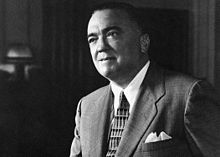
In the summer of 1925, the head of Washington’s Bureau of Investigation decided it was time to intervene in a serious way. One of the functions of the Bureau, which had not yet been named the FBI, was to investigate crimes on Indian reservations. The director was 29-year-old J. Edgar Hoover, who knew his position was tenuous. Hoover decided the only way to prevent more bad publicity was to call in a law enforcement acquaintance from the area and give him the power he needed to crack the case.
FBI Director J. Edgar Hoover
The man Hoover called upon was Tom White, a Texas Ranger for 12 years before joining the Bureau in 1917. Hoover offered White the stewardship of the Oklahoma City office and the freedom to select his own task force. Hoover made a good choice and was wise to give White the independence he needed.
White decided to pursue the conspiracy on two levels. He would stay in Oklahoma City as the public face of the inquiry. From there, he and his chief assistants – most notably John Burger – would review the files that had accumulated from all law enforcement agencies over the last four years. Secretly, White would employ a team of undercover agents who would slowly flow into the Osage area seeking to make friends and to find leads. One of these agents was John Wren, a Ute Indian.
White  was interested in finding out if Bill Smith, the bombing victim, had revealed anything before he died. Through all his suffering and slipping in and out of comas at the hospital, Smith had managed to say that he had only two enemies in the world. They were William Hale, the rancher who had professed his devotion to the Osage people, and his brother-in-law Ernest Burkhart, Mollie’s husband and Hale’s nephew. (ibid, p. 152)
But there was something else White discovered during his inquiry into Smith’s final hours. Before Smith died, David Shoun, a popular doctor in Osage County, got him to sign a document making Shoun’s brother James, who was also a doctor, the administrator of Smith’s dead wife’s estate. (ibid, p. 153)
That document led White to uncover a massive system of graft and embezzlement, involving as much as $8 million stolen from the Osage through the guardian system (or about $112 million in today’s dollars).
In reviewing the evidence, White thought it was odd that Hale was never considered a suspect in the murder of Henry Roan because Hale was the recipient of a $25,000 insurance policy upon Roan’s death. And employees of the insurance company said Hale had approached them to sell Roan the policy. When an agent suggested $10,000 as the sum, Hale upped it to $25,000. Since Hale was not a relative, he had to prove that Roan owed him money in order to collect on the policy of a man who was not yet 30. Hale produced a document that said Roan owed him the precise amount of the policy. White later found that the document had been doctored. (ibid, p. 159)
White also discovered another curious aspect of the Hale/Roan relationship. Hale had unsuccessfully tried to purchase Roan’s mineral headrights. But the attempt led White to another lead. While studying the record of the murders, and the scam that Dr. Shoun had pulled on Smith before his death, White concluded that, with Mollie Burkhart’s relatives dying off one by one, more and more headrights were ending up with Mollie, who was married to Ernest Burkhart, Hale’s nephew.
Was this the objective of the conspirators? White reasoned that if he was right about Hale, it was time to turn to the criminal underworld for more information. In talking to local criminals who specialized in cracking safes, White came across a source who said he knew the man who had created the “box” – the nitroglycerine fuse and package – for the Smith bombing. It turned out that, while in the process of a jewel heist, this man had been killed by a local merchant. But, as White later learned, the robber was killed because Hale had tipped off the merchant. (ibid, p. 176)
Financial Motive
The case was broken when White went back into the files and discovered an informant named Blackie Thompson, who was half Cherokee. He told White that Ernest Burkhart and William Hale had tried to enlist him in the Smith bombing, but he was arrested for theft before the bombing was carried out. White confronted Burkhart with Thompson’s sworn affidavit. When Burkhart still denied it, he had Thompson enter the room to endorse the document. Burkhart then admitted his role, saying that when he expressed reservations about the bombing, Hale said to him, “What do you care. Your wife will get the money.” (ibid, p. 190) Burkhart also revealed the names of the killers who Hale had recruited to murder Henry Roan and Anna Brown.
Hale did everything to escape justice. He attempted to influence the grand jury, he tried to have his case moved out of federal court and into state court. He even hired an assassin to murder a key witness. But White heard about it before it could occur and confronted the accused assassin. Hale and three accomplices were eventually convicted.
In his book about the mystery, author Grann argues that if the victims had been white, Hale would have received the death penalty. But since they were Indians, the conspirators were sentenced to life in prison. Ernest Burkhart and Hale were eventually paroled. Hale later said, “If that damn Ernest had kept his mouth shut, we’d be rich today.” (ibid, p. 248)
Shortly after Hale went to jail, White retired from the Bureau and became a prison warden. Hoover closed the case. But that meant the public never discovered who stabbed Barney McBride in Washington and who threw W. W. Vaughn from that Oklahoma City train.
Grann looked up Vaughn’s surviving descendants and was told that Vaughn’s family was threatened not to pursue the matter any further. (ibid, p. 259) But they did, and information was passed on from one generation to another. Their major suspect was a local banker named H. G. Burt, who tried to embezzle money from Vaughn’s estate and was later sued by his widow.
White had discovered that Burt and Hale were close associates. In fact, White had one informant who labeled Burt a murderer. And Burt had a motive for his involvement in the conspiracy. After George Bigheart died, his valuable headrights were passed on to Bigheart’s daughter whose guardian was Burt. Burt also was on the train with Vaughn when it departed Oklahoma City and he reported Vaughn’s disappearance. And, when Hoover sent Tom White to Oklahoma City to take over the case, Burt moved to Kansas. (ibid, p. 264)
At the end of the book, Grann looked up the records of Indian guardianships that the Bureau of Indian Affairs maintained. Two things struck him as revealing about these records. The first is the recurrence of guardianship rights to powerful people in Osage County like Burt and the owner of the local Trading Company. Some of these local luminaries  had as many as 13 wards. The second curious matter was the number of wards who died mysteriously under guardianship. (ibid, p. 281)
After doing an inquiry into other cases in which the Bureau had information that did not lead to the Hale plot, the author concludes that the official number of Osage dead greatly exceeds the 24 named by the FBI. Grann believes that one of the most common forms of murder was through hypodermic needle overloaded with morphine. Then, cooperative doctors, like the Shoun brothers, would conceal the actual cause of death. (p. 290)
The book leaves the reader with the clear implication that the conspiracy to kill and rob the Osage was much wider than the one that Hale organized. As one authority on the case told Grann, “If Hale had told what he knew, a high percentage of the county’s leading citizens would have been in prison.” (ibid, p. 291)
James DiEugenio is a researcher and writer on the assassination of President John F. Kennedy and other mysteries of that era. His most recent book is Reclaiming Parkland.