Showing posts with label Laotians. Show all posts

2024-04-30

America Must be Stopped and Palestine Must be Free

The current world situation is unquestionably far worse than "normal". While there have always been conflicts, the world has never had a situation where one country repeatedly selects another one anywhere in the world and proceeds to utterly destroy it as the US has done with, to list a few of its victims, Vietnam, Cambodia, Laos, Iraq, Afghanistan, Libya and Syria. We also have the US so desperate to maintain hegemonic control of everything on earth that it is willing to push humanity to the brink of nuclear war over who controls some provinces in Ukraine or a small Chinese Island. The world has not often, if ever, seen a country like the US that murders at will and actively supports and abets a genocide as in Palestine. The world situation is most definitely far worse than "normal" right now. 


On the positive side, though, there are clear signs that the evil American empire is nearing its end. BRICS and dedollarization will neuter the US because its power is based on a house of cards (ie. the petrodollar) that will soon come crashing down once more countries follow the lead of Russia, China and Iran and overcome their dollar dependency. Without the ability to create money out of thin air based on nothing concrete, the US will not be able to bully other countries with illegal sanctions or to start horrendous wars all over the world. Just as people in the West are now seeing through (as the Global Majority has always seen) the lies-based mythology around Zionism and the Zionist regime currently occupying Palestine so are they seeing through the lies of American "exceptionalism" and the "rules-based international order", which has never actually meant anything more than "we [the US] make the rules and you [everyone else] follow the orders". Hypocrisy as an ideology cannot work forever.

The rulers have gone too far once again. In the early 20th century, with labor making gains toward a fairer and more equitable society, the Establishment needed Roosevelt to make minimal concessions in order to avoid a revolution or, worse in the eyes of the greedy rich, socialism. In the late sixties, the protest movement forced the Establishment to end a war they wanted to continue and the draft, too. Now, after 40+ years of destructive neoliberalism and 20+ years of constant war, young Americans, seeing they have no future in such a society and disgusted by what their country is doing to the Palestinians, have finally stood up to say no. I do not know if the current protest movement will last or if it can stop the genocide, but it has already helped to show to the world the utter depravity of the ruling class, the media and the rich. There is no turning back now and that is a very good thing.

Hopefully America and its "Israeli" attack dog will not nuke the world on their way out the door.

2017-10-09

America’s Long History of Warfare and Murder

by Lawrence Davidson
Consortiumnews.com

If you go to the Wikipedia page that gives a timeline of U.S. foreign military operations between 1775 and 2010, you are likely to come away in shock. It seems that ever since the founding of the country, the United States has been at war. It is as if Americans just could not (and still cannot) sit still, but had to (and still have to) force themselves on others through military action.
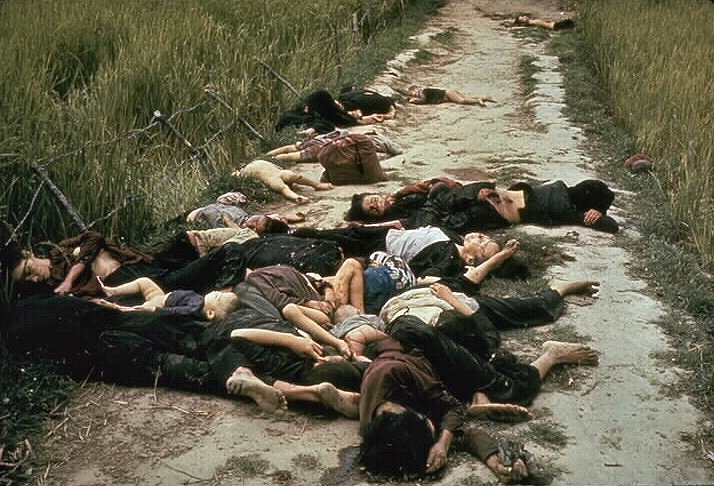
Photos of victims of the My Lai massacre in Vietnam galvanized public awareness about the barbarity of the war. (Photo taken by U. S. Army photographer Ronald L. Haeberle)
Often this is aimed at controlling foreign resources, thus forcing upon others the consequences of their own capitalist avarice. At other times the violence is spurred on by an ideology that confuses U.S. interests with civilization and freedom. Only very rarely is Washington out there on the side of the angels. Regardless, the bottom line seems to be that peace has never been a deeply ingrained cultural value for the citizens of the United States. As pertains to foreign policy, America’s national culture is a war culture.
It is against this historical backdrop that the recent Ken Burns 18-hour-long documentary on the Vietnam War comes off as superficial. There is a subtle suggestion that while those American leaders who initiated and escalated the war were certainly deceptive, murderously stubborn and even self-deluded, they were so in what they considered to be a good cause. They wanted to stop the spread of Communism at a time when the Cold War defined almost all of foreign policy, and if that meant denying the Vietnamese the right of national unification, so be it. The Burns documentary is a visual demonstration of the fact that such a strategy could not work. Nonetheless, American leaders, both civilian and military, could not let go.
What the Burns documentary does not tell us – and it is this that makes the work superficial – is that none of this was new. Almost all preceding American violence abroad had been rationalized by the same or related set of excuses that kept the Vietnam slaughter going: the Revolutionary War was about “liberty,” the genocidal wars against the Native Americans were about spreading “civilization,” the wars against Mexico and Spain were about spreading “freedom,” and once capitalism became officially synonymous with freedom, the dozens of bloody incursions into Central and South America also became about our “right” to carry on “free enterprise.” As time went by, when Washington wasn’t spreading “freedom,” it was defending it. And so it goes, round and round.
A Ghastly Process 
Understanding the history of this ghastly process, one is likely to lose all faith in such rationales. However, it seems obvious that a large number of Americans, including most of their leaders, know very little of the history of American wars (as against knowing a lot of idealized pseudo-history). That is why Ken Burns and his associates can show us the awfulness of the Vietnam War to little avail. The average viewer will have no accurate historical context to understand it, and thus it becomes just an isolated tragedy. While it all might have gone fatally wrong, the American leaders were assumed to be well intentioned.
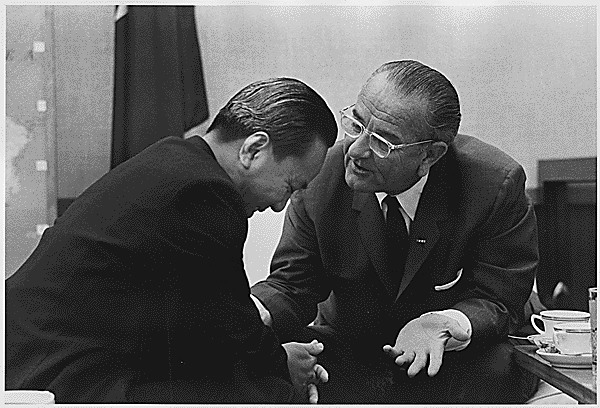
President Lyndon Johnson meeting with South Vietnamese President Nguyen van Thieu on July 19,1968.
Describing the Vietnam War in terms of intentions is simply insufficient. In the case of war the hard-and-fast consequences of one’s actions are more important than one’s intentions. The United States killed roughly 2 million Vietnamese civilians for ideological reasons that its own leaders, and most of its citizens, never questioned.
Most of its citizens, but not all. There was, of course, a widespread and multifaceted anti-war movement. The anti-war protesters were, in truth, the real heroes, the real patriots of the moment. Along with the accumulating body bags, it was the anti-war movement that brought an end to the slaughter. However, once more Burns’s documentary comes off as superficial.
Burns leaves the viewer with the impression that the only truly legitimate anti-war protesters were veterans and those associated with veterans. But those were only a small part of a much larger whole. Yet the millions of other Americans who protested the war are essentially slandered by Burns. The documentary presents them as mostly Communist fellow-travelers. We also see various representatives of that non-veteran part of the movement apologize for their positions. There is the implication that the movement had bad tactics.
Here is an example: one of the points that the Burns documentary makes is how distasteful was the labeling of returning soldiers as “baby killers.” Actually this did not happen very often, but when it did, one might judge the charge as impolitic – but not inaccurate. You can’t kill 2 million civilians without killing a lot of babies. If we understand war in terms of the death of babies, then there might be fewer wars.
U.S. leaders also sent 58,000 of their own citizens to die in Vietnam. Why did these citizens go? After all, this was not like World War II. North Vietnam had not attacked the United States (the Bay of Tonkin incident was misrepresented to Congress). The Vietcong were not Nazis. But you need an accurate take on history to recognize these facts, and that was, as usual, missing. And so, believing their politicians, the generals, and most of their civic leaders, many draftees and volunteers went to die or be maimed under false pretenses.
The inevitable post-war disillusionment was seen by subsequent U.S. leaders as a form of mental illness, and they labeled it “the Vietnam Syndrome.” The “syndrome” was as short-lived as popular memory. In March 2003, President George W. Bush invaded Iraq under false pretenses and U.S. forces proceeded to kill half a million civilians.
In the end, American behavior in Vietnam was not just tragically flawed – it was criminal. But it was also historically consistent – an expression of a long-standing and deep-seated war culture, a culture that still defines the American worldview and has become the very linchpin of its domestic economy. That is why the wars, large and small, never stop.
A Gun Culture, Too
America’s propensity to violence in other lands is but one side of a two-sided coin. Callous disregard for civilian lives abroad is matched by a willful promotion of violence at home. That willful promotion is the product of a right-wing ideological orientation (stemming from a misreading of the Second Amendment to the U.S. Constitution) that demands a nearly open-ended right of all Americans to own an almost unlimited number and types of firearms. The result is gun regulation laws that are embarrassingly ineffective.
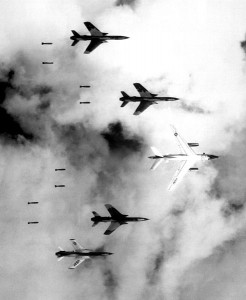
Air Force F-105s bomb a target in the southern panhandle of North Vietnam on June 14, 1966. (Photo credit: U.S. Air Force)”
Again, the consequences of this position are much more profound than any claim that its supporters’ intentions are to defend citizens rights to own guns. Since 1968 about as many Americans have been killed in-country by gun violence (1.53 million) as have died in all of America’s wars put together (1.20 million). The numbers are too close to be dismissed as coincidence. Both reflect a culture of exceptionalism that grants at once the United States government, and its citizens, extensive rights to act in disregard of the safety and security of others.
You would think Americans would recognize an obvious contradiction here. You cannot maintain a safe population and, at the same time, allow citizens the right to own and, largely at their own discretion, use firearms. Nonetheless, some Americans imagine that they have squared this circle by claiming that their guns are for “self-defense” and therefore do make for a safer society.
This is just like the U.S. government’s constant exposition that all its violence is committed in the name of civilization and freedom. In both cases we have a dangerous delusion. Ubiquitous gun ownership makes us unsafe, just as does the endless waging of war.
The inability to see straight is not the sort of failing that can be restricted to one dimension. If you can’t grasp reality due to ideological blinkers or historical ignorance, you are going to end up in trouble both at home and abroad – not just one place, but both.
And, the more weaponized you are, both as a state and as a citizen, the greater the potential for disaster. In the end the United States cannot stop killing civilians abroad unless it finds the wisdom to stop killing its own citizens at home – and vice versa. That is the U.S. conundrum, whether America’s 320 million citizens realize it or not.
Lawrence Davidson is a history professor at West Chester University in Pennsylvania. He is the author of Foreign Policy Inc.: Privatizing America’s National Interest; America’s Palestine: Popular and Official Perceptions from Balfour to Israeli Statehood; and Islamic Fundamentalism. He blogs at www.tothepointanalyses.com.

2016-09-08

America's Murderous Legacy in Laos

The Real News Network

As Barack Obama becomes the first sitting U.S. president to visit Laos, The Real News brings you an interview with Fred Branfman, the man who first exposed America's secret bombing campaign there.


JAISAL NOOR, TRNN: As Barack Obama, the first sitting U.S. president to visit Laos, we replay a report that looks at the legacy of the US bombing in Laos. We bring you an interview with the man that exposed the massive secret US bombing of Laos.

FRED BRANFMAN: From the Deputy Chief of Mission to Laos testifying to the U.S. Senate Foreign Relations Committee--this is an exact quote--when he was asked why they quadrupled the bombing of northern Laos, he said, quote, Well, we had all those planes sitting around and couldn't just let them sit there with nothing to do. unquote.

BARACK OBAMA: For the people of Laos, obviously this war was no secret. Over the course of roughly a decade the United States dropped more bombs on Laos than Germany and Japan during World War II
 
NOOR: President Obama visited the Cope Center that works with victims of explosives left from the Vietnam War era, providing them with prosthetic limbs and takes part in unexploded ordnance clearing efforts.

OBAMA: 270 million cluster bomblets were dropped on this country. For the people of Laos, the war did not end when the bombs stopped falling. 80 million cluster munitions did not explode.

NOOR: Despite Obama's visit the United States remains one of the handful of countries that continue to manufacture and sell cluster bombs, to its allies such as Saudi Arabia which is currently using them in Yemen.

This report is from 2008.

PETER HERBY: A cluster munition is a canister which is fired from an aircraft or an artillery position which contains many small sub munitions, the small munitions, which then explode. And some of these canisters can contain as many as 650 of these small sub munitions.

REKHA VISWANATHAN: Seventy-eight million unexploded cluster bombs are scattered across Laos to this day, active reminders of the Vietnam War. From 1964 to 1973, the US illegally bombed the country as part of a secret war to disrupt Vietcong supply routes into Vietnam.

HERBY: In Laos, they have been everywhere at the time of the war, in the 1960s and '70s, in villages. And the place was basically uninhabitable because of the degree of weapons contamination and, mainly, cluster munition contamination.

VISWANATHAN: The Laos National Unexploded Ordinance Program, or UXO, says Laos has the distinction of being per capita the most heavily bombed nation in the world.

MENG JUNLAMANEE: I went to the paddy field to work. I started ploughing the field, not knowing there was a bomb there. I ploughed the soil, hit the bomb and it exploded. I didn't know there was a bomb underneath.

JA-LOR: I was pulling the weeds in the paddy field. The hoe hit the bomb, and it exploded.

EDWIN FAIGMANE: People know about the dangers about this UXO, about these cluster munitions on the ground. But it's either they leave it on the ground and they will not be able to farm, or they take the risk just to be able to do some farming and plant rice.

HERBY: Our belief is it will be necessary and it's possible to prohibit perhaps more than 95 percent of existing cluster munitions, which means billions of sub munitions that are sitting in stocks around the world.

NOOR: We also interviewed the man that brought the US bombing of Laos to world attention in 1969, Fred Branfman. He passed away in 2014. This is part of our 2013 interview with Fred.

BRANFMAN: When I interviewed over 1,000 refugees from northern Laos who had had their homes and villages destroyed, tens of thousands of people murdered by U.S. bombing, the one thing I couldn't figure out was why the bombing had so increased after November 1968, when the U.S. had halted bombing over North Vietnam. All the peasants were telling me that the bombing had suddenly become four or five times greater. And I knew there was no military reason for it. It was only a few months later that I read--and this is a very important quote from the Deputy Chief of Mission to Laos testifying to the U.S. Senate Foreign Relations Committee--this is an exact quote--when he was asked why they quadrupled the bombing of northern Laos, he said, quote, Well, we had all those planes sitting around and couldn't just let them sit there with nothing to do. unquote.

Now the situation we have today is very similar. The Bush and Obama administrations have created the first US force of American assassins in our history. They've also created automated machines of war called drones. They have to come up with new missions. For example, President Obama stated as recently as last month that the drone strikes are only aimed at people whose names we know who are plotting to kill us back in America and who we can't get any other way.

This is an absolutely falsehood. The evidence is overwhelming that most of the drone strikes in Pakistan, in Yemen, in Somalia, are what they call signature strikes. These are strikes against people whose names they don't know. They have no idea what their names are. They're drone striking them on the basis of there's a crowd of people who they decide might be hiding a militant.

Now you might ask yourself why did they go from striking named people to striking unnamed people. Why did they go? They've only been able to name 77 senior Al-Qaeda leaders and Taliban leaders by name and they've killed 3-5,000 other people. Well the reason is obvious. They're all these drones sitting around out there. They don't know the names of that many Senior Al-Qaeda leaders. They ran out of targets so they then decided to start killing nameless people that both General McChrystal and the former Director of National Intelligence now tell us is infuriating the Muslim world.

NOOR: From Baltimore, this is Jaisal Noor.